
Sometimes health can feel a bit like a thunderclap.
You're living your life as healthy as a horse, then boom, out of nowhere, illness strikes.
Some ills genuinely do strike suddenly. Others, however, may be surreptitiously building for years or even decades before triggering other symptoms – a hidden disease process already underway, if only we knew how to see it.
One such condition is atherosclerosis, the gradual buildup of plaque inside the arteries that is the principal driver of cardiovascular disease. Scientists have long known it can develop silently, years before symptoms emerge.
What hasn't been clear is just how early that hidden process begins – or how common it is at different stages of our lives.
Now, a new study of nearly 17,000 adults in Denmark and Spain, led by cardiologists Henning Bundgaard of Copenhagen University Hospital and Borja Ibáñez of the Spanish National Centre for Cardiovascular Research, has revealed the insidious prevalence of silent atherosclerosis.
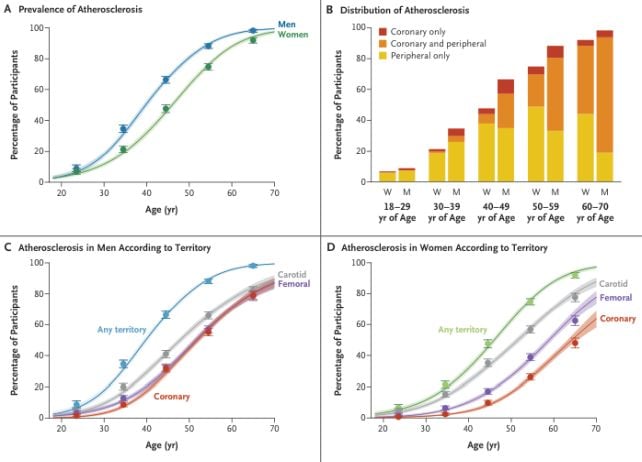
Among participants with complete imaging, more than 57 percent of those aged 18 to 70 had signs of atherosclerosis – but its prevalence varied dramatically according to age and sex.
"Because silent atherosclerosis predicts ischemic events and death independent of traditional risk factors, detection in young adults may identify a population at increased long-term risk at a stage at which the benefit of risk-factor control seems greatest," writes the team in a paper published in the New England Journal of Medicine.
Cardiovascular diseases are the leading cause of death worldwide, and atherosclerosis is the process behind much of that enormous burden.
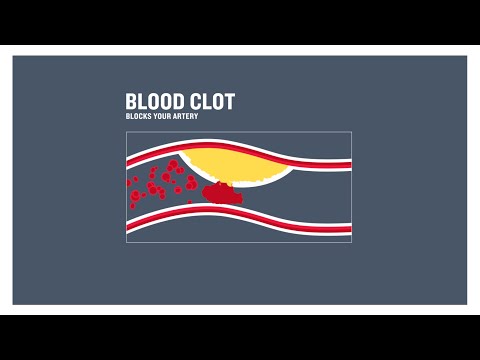
It occurs when fats, cholesterol, and other substances accumulate in artery walls, forming deposits known as plaques. Over time, these plaques can grow, narrowing the space through which blood flows. A plaque that ruptures can also trigger a blood clot – potentially leading to a heart attack or stroke.
Yet this process doesn't begin with the heart attack or stroke. Atherosclerosis can develop for decades without symptoms before causing problems – and some people may never develop symptoms.
Currently, cardiovascular disease prevention largely relies on estimating a person's risk from factors such as age, blood pressure, cholesterol, and smoking.
But those estimates don't necessarily tell us whether atherosclerosis is already there.
Bundgaard, Ibáñez, and their colleagues therefore set out to map the hidden disease itself across adult life.
Their project, called REACT, recruited 16,808 adults aged 18 to 70 in Denmark and Spain, none of whom had been diagnosed with cardiovascular disease.
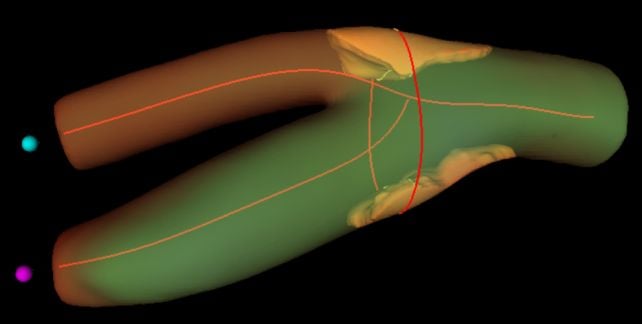
Then, the researchers used ultrasound to search for plaques in the carotid arteries of the neck and femoral arteries of the legs, and CT angiography to examine the coronary arteries supplying the heart.
For the study, the researchers defined silent atherosclerosis as plaque in at least one of those three areas in someone without known cardiovascular disease.
Complete, three-territory imaging was available for 13,186 participants, and from these results, a fascinating picture started to emerge.
Even among the youngest participants, aged 18 to 29, silent atherosclerosis was already present in around 1 in 13 people.
From there, however, its prevalence climbed rapidly. By their 30s, more than a third of men – 34.6 percent – already had detectable plaque, compared with 21.3 percent of women.
Men generally developed this atherosclerotic pattern earlier, with the researchers estimating a head start of around 5 to 10 years. Women showed a later but steeper rise through middle age.
By the ages of 60 to 70, the picture had almost completely reversed from young adulthood: just 1.9 percent of men and 8.1 percent of women had no detectable plaque at all.
But silent atherosclerosis didn't just become more common with age. It became more extensive in the participants' bodies.
Among people in their 30s, plaque in two or three of the examined territories was found in just 6 percent of men and 2.6 percent of women. By 60 to 70, all three territories contained plaque in 56.3 percent of men and 30.7 percent of women.
Nor was the difference simply a matter of how many arteries were affected. The volume of plaque detected also increased dramatically with age, following a pattern consistent with exponential growth.
"Until now, preventive decisions have been based on an estimate of risk, but we did not know whether the disease was already present," Bundgaard says in a statement.
"REACT shows that atherosclerosis can be detected decades before clinical manifestations appear and provides the most comprehensive atlas of the evolution of the disease across adult life."
The findings also exposed a striking disconnect between the disease the researchers could see and the risk predicted by conventional assessments.
When the team compared their imaging results with SCORE2, a standard tool for estimating a patient's 10-year cardiovascular risk, many people with detectable atherosclerosis weren't considered at particularly high risk.
Among participants aged 40 to 69, for whom SCORE2 could be calculated, its high-risk threshold identified just 1.9 percent of those with silent atherosclerosis.
The disconnect between estimated risk and the presence of disease was greatest at younger ages.

That doesn't mean conventional assessments are useless; rather, the researchers say imaging for silent atherosclerosis could potentially complement existing approaches to risk assessment.
The findings don't yet mean that everyone should undergo routine imaging for atherosclerosis. This phase of REACT was designed to map the disease's prevalence, not to test whether screening leads to better health outcomes.
Related: Your Own Mouth Bacteria Could Give You a Heart Attack, New Study Suggests
That's a question the researchers hope to answer next. If funded, the second phase of REACT will include a large randomized clinical trial testing whether imaging-guided prevention can slow or reduce the progression of atherosclerosis more effectively than current practice.
"For decades, we have estimated cardiovascular risk using factors such as age, blood pressure, and cholesterol. This study shows that we can now go one step further and detect the disease directly before it causes a heart attack or stroke," Ibáñez says.
"The future of cardiovascular prevention must be more precise and personalized. If we identify atherosclerosis in its earliest stages, we will be able to intervene sooner, tailor treatment more effectively, and reduce the burden of cardiovascular disease."
The findings have been published in the New England Journal of Medicine.
This article was fact-checked by Michael Irving and edited by Michael Irving. While we pride ourselves on our process, we are only human. If you spot a mistake, please let us know.