
Our pets can now live much longer lives, yet they face an increased risk of cognitive decline similar to human dementia as they grow older.
In canines, the disorder is called cognitive dysfunction syndrome (CDS), and the subtle yet progressive disease can come on very slowly, evading the notice of even the most devoted pet owners.
Similar to people with Alzheimer's disease, the most common form of dementia, dogs with CDS can develop impairments in learning, memory, and executive functions.
Related: Dogs With Dementia Show a Curious Similarity to Humans With Alzheimer's
The neurological signs are "very unspecific", but they may include disorientation, altered social interactions, house-soiling, anxiety, or disturbances in the sleep–wake cycle. A dog might forget where its water bowl is, avoid people or be overly clingy, bark or howl at nothing, and nap less or pace aimlessly at night.
There's even an acronym so owners can remember: DISHA(A), which stands for disorientation in familiar environments, alterations in interactions, sleep–wake cycle alterations, house-soiling, and alterations in activity levels. Sometimes aggression and anxiety are added as extra A's.
The sooner these changes are noticed, the better, because cognitive decline in pets can worsen in a matter of months.
While there is no cure for 'doggy dementia', treatments are being tested that may improve the quality and length of a senior canine's life.
"Unfortunately, when clinical and behavioral signs become so severe, it is too late: severe clinical manifestations are strictly related to severe neurodegeneration, which is a progressive and irreversible condition," researchers wrote in a review on CSD, published earlier this year.
"This kind of situation leads to owners' irritability and frustration, all elements which contribute to aggravate the relationship with their dogs, without considering that all these things also affect the animals' welfare."
Some steps owners could take to protect their dogs may include blocking off dangerous areas of the house, such as stairs, increasing walks to reduce indoor accidents, or introducing medications, such as melatonin.
In the US, the pharmaceutical selegiline is often suggested for dogs diagnosed with age-related cognitive decline, although its effectiveness is uncertain.
Selegiline is the only drug currently approved by the US Food and Drug Administration (FDA) for treatment of CDS. However, in humans, the medication has been ruled an ineffective treatment for dementia.
Given the lack of success with medication, researchers at the University of Adelaide in Australia are investigating whether special training exercises can improve cognition in senior dogs with CCD.
"Some studies suggest up to 60 percent of senior dogs, mostly over the age of 11, are affected by doggy dementia," University of Adelaide veterinarian Tracey Taylor said in 2024.
"Often owners think their dog is just slowing down, but symptoms such as getting lost at home, changing interactions towards other dogs or humans, and vacant staring can all be signs of CCD."
CDS is also known as canine cognitive dysfunction (CCD).
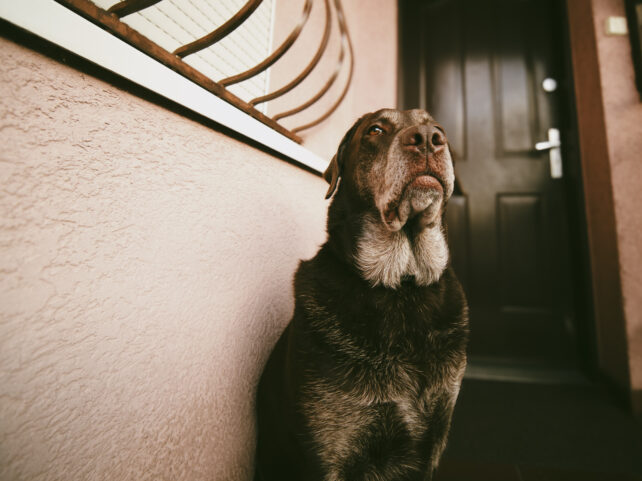
Depending on the region, a dog may be officially diagnosed with CCD if it meets established scales, including the Canine Dementia Scale (CADES), the Canine Cognitive Assessment Scale (CCAS), or the Canine Cognitive Dysfunction Rating Scale (CCDR).
But without a standardized test or a reliable biomarker, researchers are still working out how best to diagnose the disorder.
A recent study of 70 dogs that were seven years or older used the CADES diagnosis, and it found that nearly 66 percent of all dogs exhibited cognitive dysfunction, with 11 percent showing severe dysfunction.
It's unclear if these rates hold for other scales used to assess CCD.
Currently, the only way to make a definitive determination about CCD is to analyze a canine's brain after death.
Interestingly, the brains of dogs that have died with CCD show many of the same markers as human brains impacted by Alzheimer's disease, including protein tangles and a buildup of amyloid plaques.
This makes our canine pets intriguing animal models for what goes on in our own brains.
In a perspective paper published in September 2025, a team of neuroscientists in the US argued that, unlike rodents, dogs are a useful model for dementia because they share the human environment and its associated risk factors.

Some of the researchers are part of the Dog Aging Project at the University of Washington, which seeks to not only increase the lifespan of our pets but also to improve human health.
They write: "The companion dog provides a disease model that contrasts with animal models living in highly regulated, unnatural domains such as laboratories or kennels."
"If CCD can serve as a large animal disease model for AD in humans," the researchers conclude, "the translational power of future [canine] studies could significantly advance human medicine."
Further research on canine dementia benefits both us and our pets.