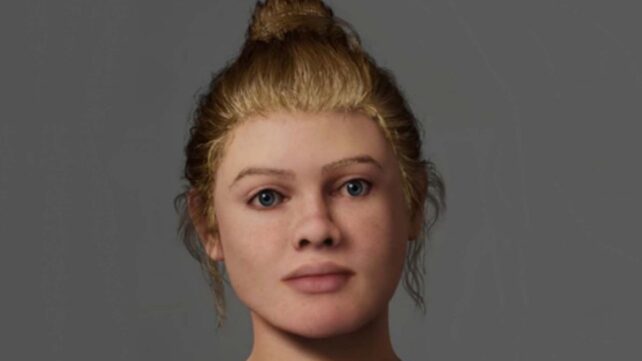
The curious skeleton of a Roman-era individual in Britain, nicknamed the Beachy Head Woman, is not who we thought she was.
It turns out this mysterious woman is not the 'first Black Briton', as some scientists had speculated based on her physical features.
A new analysis of her 2,000-year-old DNA, led by scientists at the Natural History Museum (NHM) in London, suggests she had lighter skin and was actually from Britain.
Related: Face of Overlooked Human Ancestor Could Set Record in Western Europe
"By using state-of-the-art DNA techniques and newly published genomes, we were able to determine the ancestry of the Beachy Head Woman with much greater precision than before," says William Marsh, an archaeogeneticist at NHM.
"We show she carries genetic ancestry that is most similar to other individuals from the local population of Roman-era Britain."
The remains of the Beachy Head Woman have been debated for over a decade.
The skeleton was first found in southeast England sometime in the mid-twentieth century and rediscovered in 2012 – in a box labeled with a tag that gave the remains their name. It read: "Beachy Head (1959)" for the stretch of coastline in East Sussex where the remains are thought to have been found.
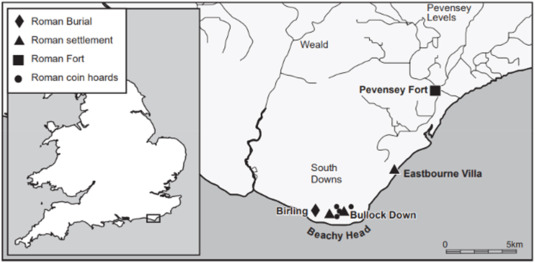
Radiocarbon dating of the skeleton showed the woman died between 129 and 311 cal CE, during the Roman Empire's occupation of what is now Britain. However, the appearance of her skull led some scientists to think her lineage came from afar.
In 2017, a preliminary analysis of her DNA suggested that the Beachy Head Woman was not from Africa, as researchers initially assumed, but from the eastern Mediterranean region.
Now, it seems that, too, may have been wrong.
According to higher-quality DNA extracted from her skeleton, this woman has a "strong genetic affinity to individuals from rural Britain during the Roman occupation and modern-day Britons", Marsh and colleagues write in their published paper.
She holds no signs of recent African ancestry. Based on her genes, she probably had blue eyes, a skin color between pale and dark, and light hair.
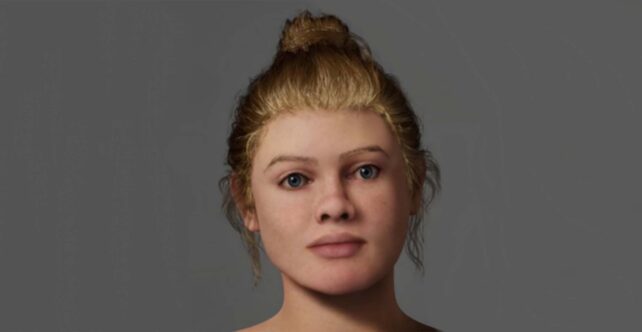
The mystery of the Beachy Head Woman, scientists say, has "sparked important debates about diversity and how we portray individuals from our past."
"The discovery of the 'first black Briton known to us' gained traction across several media outlets, non-fiction books, educational resources, and academic publications," write the research team.
But that was an assumption based on a flawed and unreliable technique.
Traditionally, in anthropology, the physical features of a skull have been used to determine race and ethnicity. But this line of inquiry promotes "outdated notions of the biological reality of race", Marsh and colleagues write, which "overlooks the continuous nature of most human variation".
The case of the Beachy Head Woman illustrates how erroneous assumptions based on appearance alone can be, and why genetics is a much richer and more reliable source of inquiry.

"Our scientific knowledge and understanding is constantly evolving, and as scientists, it's our job to keep pushing for answers," says NHM anthropologist Selina Brace.
"Thanks to the advancement of technology that has occurred in the past decade since Beachy Head Woman first came to light, we are excited to report these new comprehensive data and share more about this individual and her life."
The study was published in the Journal of Archaeological Science.