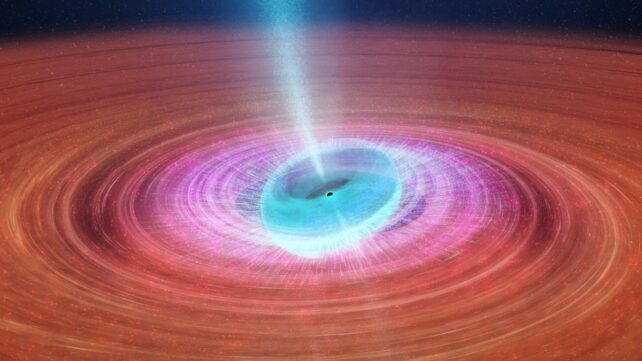
A violent stellar disruption recorded in 2024 has given astronomers their most comprehensive evidence yet of a black hole twisting the very fabric of spacetime around itself.
This effect is known as frame-dragging, or the Lense-Thirring effect, and observing it at the heart of a galaxy named LEDA 145386, around 400 million light-years from Earth, has given astronomers an opportunity to watch general relativity play out in real time.
"This is a real gift for physicists as we confirm predictions made more than a century ago," says astrophysicist Cosimo Inserra of Cardiff University in the UK. "Not only that, but these observations also tell us more about the nature of TDEs – when a star is shredded by the immense gravitational forces exerted by a black hole."
Related: Weird Black Hole Is Shooting Out Wobbly Jets Because It's Dragging Spacetime
Frame-dragging is a prediction of general relativity, and it's easy to picture. Imagine putting a spoon in honey and rotating it. The honey rotates with the spoon, with the effect strongest closest to the spoon, and growing weaker with distance.
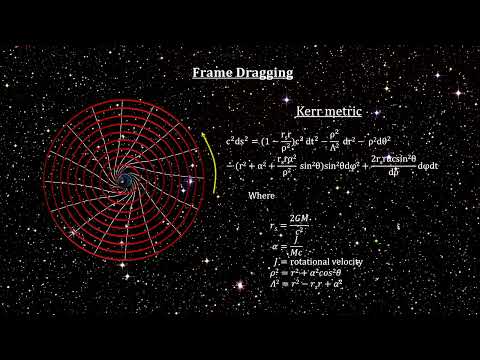
Anything with mass gravitationally warps spacetime. Whenever that mass is rotating, spacetime warps with a respective twist. Multiple observations of frame-dragging have been made before, including its effect on satellites around Earth itself.
Near Earth, however, the effect is subtle. Frame-dragging becomes much more pronounced around objects a few million times more massive than the Sun, like supermassive black holes, making these environments excellent laboratories for studying how the phenomenon works.
Of course, the downside is that supermassive black holes are typically too far away to study their more subtle activities in detail. That means we often have to wait for a cataclysmic event, such as the destruction of a star, to measure any elusive behaviors.
This is the case with the black hole at the heart of LEDA 145386, with a mass of around 5 million times that of the Sun.
In January 2024, the Zwicky Transient Facility recorded the object sharply brightening in a manner scientists determined was consistent with a tidal disruption event – the scream of light emitted as a passing star is torn asunder by the black hole's powerful gravity. Such events are known, but rare and super interesting. So, naturally, astronomers kept watching.
"When a star passes close to the supermassive black hole, the black hole's strong gravity stretches it out and eventually tears it apart, so that material from the star starts falling onto it," explains astronomer Santiago del Palacio of Chalmers University in Sweden.
"Such an event becomes very bright; when a new one was discovered by an optical telescope, it triggered us to start observing the black hole in different wavelengths as quickly as possible."
Over time, a strange pattern emerged. Every 19.6 days, the X-rays emitted by the black hole varied in brightness by more than an order of magnitude. Meanwhile, the radio emission from the object also fluctuated, with a variation of more than four orders of magnitude. Tellingly, these X-ray and radio fluctuations were in sync with each other.
A black hole devouring a star is known as a tidal disruption event, because the star is disrupted by the black hole's tidal forces – its gravitational pull. When this happens, the star doesn't immediately vanish beyond the black hole's event horizon; its dismembered innards spew out and form a disk that orbits the black hole, gradually falling towards its horizon.
Not all the star's material falls. Astronomers think some material is accelerated along the magnetic field lines toward the black hole's poles, where it is launched into space with tremendous force, generating enormous jets of material at speeds close to that of light.
The accretion disk around the black hole emits X-radiation; meanwhile, synchrotron acceleration of the jet produces radio light. Synchronized fluctuations in both suggest the entire structure is wobbling like a spinning top – the effect of frame-dragging.

"Such cross-band, high-amplitude, and quasi-periodic synchronous variability strongly suggests a rigid coupling between the accretion disk and the jet, which precesses like a gyroscope around the black hole's spin axis," says co-first author Yanan Wang of the Chinese Academy of Sciences.
Models of a co-wobbling disk and jet produced similar results, confirming that objects like LEDA 145386's unruly black hole can offer a laboratory not just for studying accretion processes and jet formation, but also for testing general relativity itself.
"By showing that a black hole can drag spacetime and create this frame-dragging effect, we are also beginning to understand the mechanics of the process," Inserra says.
"So, in the same way a charged object creates a magnetic field when it rotates, we're seeing how a massive spinning object – in this case a black hole – generates a gravitomagnetic field that influences the motion of stars and other cosmic objects nearby."
The research has been published in Science Advances.