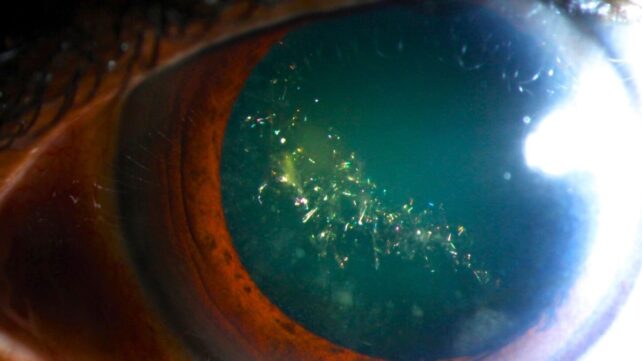
Saint Nicholas is said to have a twinkle in his eye, but there's a real health condition that creates a similar effect in patients: the aptly named 'Christmas tree cataracts'.
Christmas tree cataracts are a rare age-related condition, often taking optometrists by surprise when they encounter the glistening, multicolored crystals suspended in the lens of a patient's eye, lit up by direct focal illumination.
Related: Why Blue Eyes Aren't Really Blue (And What Makes Green So Rare)
One case study describes the dazzling effect these cataracts produce as "a spectacular array of polychromatic needle-shaped crystals… giving the appearance of colored lights decorating the branches as on a Christmas tree".

This 'Christmas tree' sparkle forms when calcium builds up in the lens, speeding up the disintegration of crystallin proteins.
The protein breakdown leads to an excess of cystine, an amino acid that, at high concentrations, crystallizes to form the needle-like shards.
These refract the optometrist's light, producing a variety of colors, including pink, green, blue, red, and gold, depending on the angle of the light source.
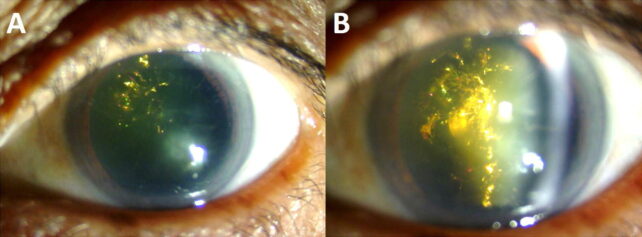

The condition doesn't often impact patients' visual acuity, but it is associated with myotonic dystrophy, a genetic disorder that causes muscular dystrophy.
Some studies have found Christmas tree cataracts in nearly all patients with myotonic dystrophy type 1, which suggests it could be a useful way of spotting the degenerative disease in its early stages.