
A strange chunk of metal that lay hidden in the soil for thousands of years may shed new light on one of the most mysterious cultures in ancient China.
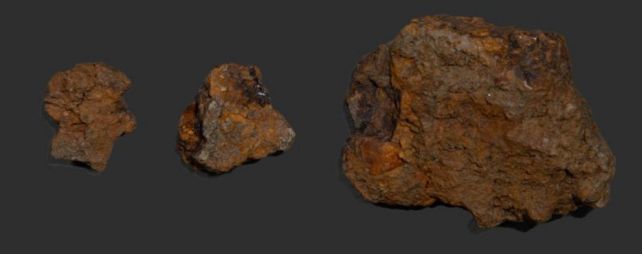
The approximately 3,000-year-old Sanxingdui artifact appears to be an axe-like object made of iron – which likely came to Earth from space in the form of a meteorite.
It's an extraordinary discovery that sheds light both on the Sanxingdui culture and the use of iron for crafting precious objects long before iron smelting became widespread.
"As the earliest Bronze Age meteoritic iron artefact found in Southwest China," writes a team led by archaeologist Haichao Li of Sichuan University in China, "it fills a critical gap in the region's metallurgical records and provides new insights into early iron use both regionally and globally."
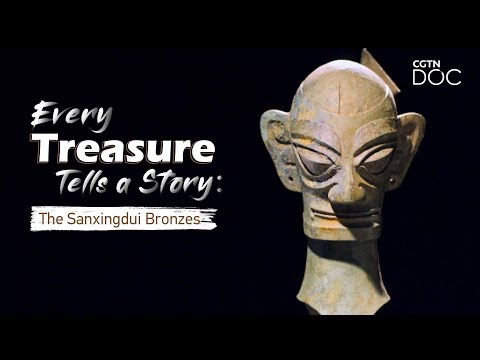
Sanxingdui is a major archaeological site in Southwest China, dating back to 2800 to 600 BCE. It reached its peak during the Shang Dynasty between around 1600 and 1050 BCE, and left in its wake iconic, eerie art and evidence of a strong emphasis on ritual.
One type of deposit made by the Sanxingdui people is what archaeologists refer to as "sacrificial pits" in the ritual precinct of the walled city. These are eight pits from which archaeologists excavated some 17,000 extraordinary ritual objects, including bronze masks, figurines, ivory, and jade tools.
The precise purpose of these pits is unknown, but the presence of ash, charcoal, and evidence of burning on some objects suggests the sites may have been used for ritual offerings.
Whatever their purpose, they have provided an invaluable source of artifacts that help us understand the aesthetic and material principles prized by the people of Sanxingdui.
One sacrificial pit, however, yielded a treasure of a kind unlike anything else in the assemblage.
"Among the many artifacts recovered in Sanxingdui, an unusual iron artifact (K7QW-TIE-1) was unearthed from Pit No. 7," the researchers write.
"This artifact was found vertically embedded at the bottom of the eastern wall's southern section. It is elongated in the form of an axe-like tool or weapon."
The object measures about 20 centimeters (8 inches) in length and 5 to 8 centimeters (2 to 3 inches) in width. It was in poor condition, so the researchers carefully extracted the part of the pit wall in which it was embedded and took the whole block back to the laboratory for testing.
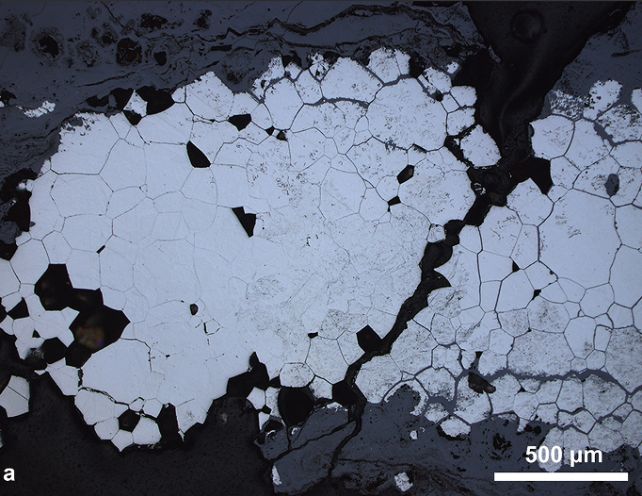
The chronology of the surrounding artifacts dates the object to the Shang Dynasty, before iron smelting spread across China. However, X-ray fluorescence revealed that the object is at least 90 percent iron by weight, with 7.41 percent nickel, and the rest trace elements.
That composition, the researchers say, would have been difficult to achieve with the metal-processing techniques of the Late Shang period,
Bronze was the metal of choice for tools, weapons, and jewellery during the Bronze Age – hence the era's name – which in China began around 2000 BCE. The alloy was durable and easily available, made by smelting copper and mixing it with tin and other metals.

Cast iron smelting only took off in China around 800 BCE, when the technology to smelt iron from its ore became widespread, after people discovered how to reach the very high temperatures required for the process.
So the use of iron is unusual for the Bronze Age – but not without precedent. In other places around the world, including other parts of China, some rare and precious artifacts appear to have been made from iron not dug from beneath our feet, but that fell blazing from the sky.
However, the Sanxingdui find suggests this rare material may have been used differently here. Unlike objects from China's Central Plains, which often combined meteoritic iron with bronze, the Sanxingdui artifact appears to have been made entirely from iron.
Related: Strange Metal From Beyond Our World Spotted in Ancient Treasure Stash
"The presence of meteoritic iron at Sanxingdui further highlights the distinctive metallurgical practice in Southwest China, in contrast to contemporaneous practices in the Central Plains," the researchers write.
Combined with its discovery in a ritual pit, the find raises the intriguing possibility that the meteoritic iron wasn't just a run-of-the-mill material to the Sanxingdui people, but was precious enough to be included in whatever activity involved accumulating treasure in a pit and setting it ablaze.
"The artifact's fragile state poses significant conservation challenges for further cleaning," the researchers write.
"Future work needs to be undertaken focusing on high-resolution characterization to refine the artifact classification and clarify the relevant functional and ritual roles."
The discovery has been published in Archaeological Research in Asia.