
The beautiful moment when an entire group of sperm whales came together to support the birth of a calf has, for the first time, been recorded in unprecedented detail.
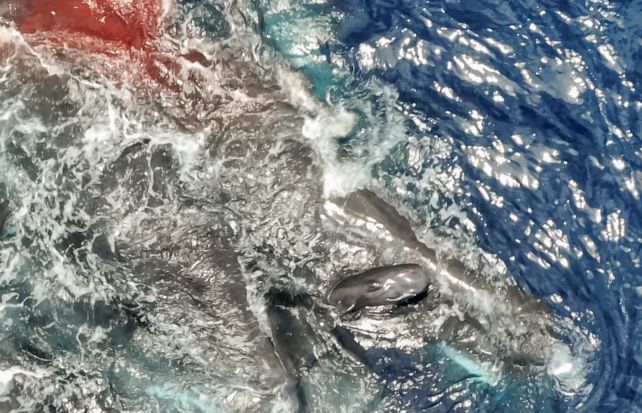
Over several hours on 8 July 2023, scientists recorded two sperm whale (Physeter macrocephalus) family groups coming together in the Caribbean Sea off the coast of Dominica, taking turns to assist with the birth and help the newborn calf stay at the surface to take its first breaths.
"Our results suggest that kin and non-kin engaged in sustained, cooperative postnatal care, taking turns to support the newborn and maintain group cohesion, in contrast to historical kin-segregated foraging patterns," writes a cross-disciplinary team led by computer scientist Alaa Maalouf of MIT's Project CETI.
"These findings provide rare quantitative evidence of direct allocare [caring for non-biologically related offspring] in cetaceans and can lend support to the hypothesis that transient, structured cooperation during birth is a key mechanism sustaining complex sociality in sperm whales."
Sperm whales are among the most social animals on the planet. Like other cetaceans, they live in groups; their survival is based on cooperation and collaboration.
For sperm whales, the smallest units of their huge clans – groups of up to 10 individuals – are matrilineal, led by a mother, and populated with her daughters (adult males typically live separately, only visiting female groups for reproduction).
How that social structure works in a birthing context is not well understood. Prior to this event, just four sperm whale births had been reported in the last 60 years, and all of those were either anecdotal or observed within whaling contexts. Those reports suggested a level of community support during the birth of a new calf, but exactly what that entailed was never documented.
In July 2023, Maalouf and his colleagues were conducting fieldwork off the coast of Dominica. The team of marine and computer scientists was working together as part of Project CETI, an ongoing effort to decipher the language of sperm whales using state-of-the-art recordings and machine learning.

All seemed relatively normal until, at 9:50 am local time, the researchers encountered a group of 11 sperm whales congregating at the surface – a group consisting of two unrelated matrilines that usually forage separately.
The whales' behavior was unusual enough that the scientists stopped and deployed their suite of observational instruments, including hydrophones for audio and drones for overhead video.
What unfolded over the next few hours was nothing short of a wonder.
At precisely 11:12 am, a pregnant whale known as Rounder started delivering her calf, a process that took 34 minutes from beginning to end. Other adult female whales positioned themselves around her in tight, synchronized formation. At 11:46 am, the scientists observed plumes of blood and the newborn whale, marking the moment of birth.
Then a flurry of activity set in. Newborn sperm whales likely can't stay afloat on their own, so the entire extended group took turns keeping the calf at the surface to breathe until it was able to swim on its own. Meanwhile, other cetacean species turned up, seemingly to rubberneck.
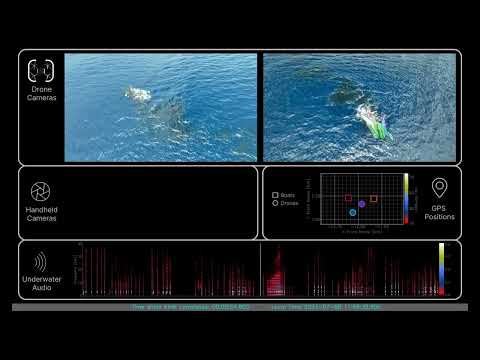
"The group rapidly transitioned to cohesive and highly active behavior; individuals took turns lifting the newborn, physically supporting and pushing it to the surface, consistent with supporting a negatively buoyant neonate. This phase continued for about an hour, during which time the entire unit remained tightly grouped," the researchers write.
"In addition, there were close passes by Fraser's dolphins (Lagenodelphis hosei) and brief interactions with pilot whales (Globicephala macrorhynchus), which encompassed the sperm whale cluster and occasionally dove beneath them."
To make sense of what they had observed, the researchers turned to technology. They used machine learning and computer vision to identify individual whales, track their movements, and study how the group interacted throughout the birth.

This analysis revealed that every single member of the 11-whale group took at least one turn supporting the calf in the hour following the birth, with about 96 percent of that time covered by a core group of four whales: Rounder, the new mother; Aurora, her half-sister; Ariel, a juvenile unrelated to Rounder; and Atwood, an older relative of Rounder.
Meanwhile, the audio recordings show that the soundscape throughout the birth is intense and active. What the whales were saying, however, was not addressed in the current study, which focused on what the whales were doing.
Related: Sperm Whales Have Been Seen Using Their Ultimate Weapon Against Attacking Orcas
Even without an audio analysis, though, the study gives us new insight into the secret lives of these mysterious, but deeply intelligent, animals.
"Our results provide quantitative evidence for the paradigm that calf survival, particularly around births, drives selection for the social bonds underpinning the complex social organization that has evolved in sperm whales," the researchers write.
"These findings place the complexity of sperm whale birth behavior and coordination in comparative context with terrestrial mammals, including primates and humans, raising questions about the cognitive architectures and communication systems that support and mediate these behaviors."
The research has been published in Science Advances.