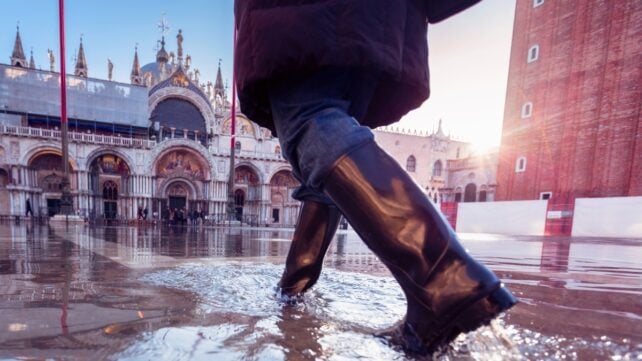
Venice is going under as sea levels rise, with all signs suggesting we could lose this UNESCO World Heritage Site within the next three centuries.
A team of scientists from across Europe and the UK has examined four options for protecting the so-called 'floating city' before it sinks forever beneath the waves. But the best option for the future of Venice might be a hard sell.
Led by oceanographer Piero Lionello from the University of Salento in Italy, the team explored how well these four options – movable barriers, ring dikes, closing the Venetian Lagoon, and relocating the city – would pan out under forecast sea levels, based on different future emissions scenarios.
Sea level rise is the result of a complex interplay between fossil fuel emissions from human activities, which increase the greenhouse gases in our atmosphere that trap solar radiation as heat.
This accumulated heat – best known as global warming – is absorbed by the oceans, land, ice, and the atmosphere.
The combined effect of melted ice and the ocean's thermal expansion, along with increased storm frequency and intensity, means Earth's oceans and seas are, for the most part, inundating areas of land they haven't lapped at for hundreds or even thousands of years.
Though Venice is known affectionately as the floating city, this is a misnomer. For more than 1,600 years, the city has held its head above water atop millions of wood pilings, and it's honestly quite amazing they've even held up this long.
On top of sea level rise from climate change, the land on which Venice rests is sinking.
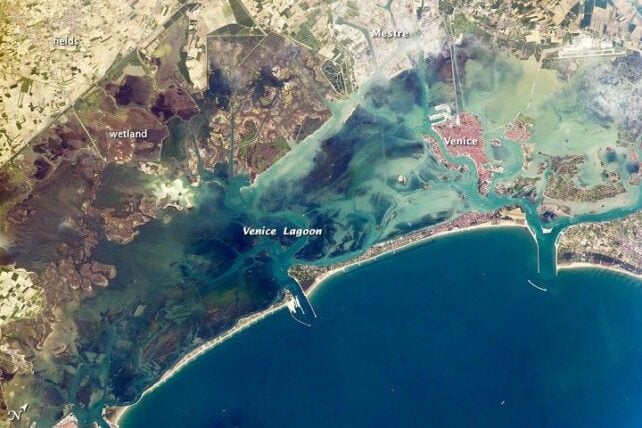
In the past 150 years, the city, its islands, and the lagoon in which they are nestled have faced increasing floods. Of 28 extreme flooding events to hit Venice, where more than 60 percent of the city was flooded, 18 have occurred in the past 23 years.
Their only protection against storm waves from the Adriatic Sea currently is the narrow barrier island that runs along the lagoon's edge, and three movable barriers, introduced in 2022, that can enclose its inlets.
Lionello and team have found it's going to take a lot more than that to protect the canal-riddled city from succumbing to its own watery grave. Basing their estimates on previous engineering projects and predictions of local sea level rise, they've laid out the sinking city's options.
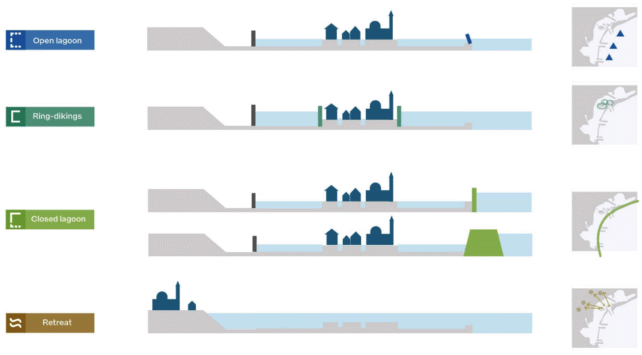
The open lagoon
The first option in their paper – carrying on with this 'open lagoon' strategy – involves closing the lagoon inlets using movable barriers whenever flood risk hits a certain level. The existing infrastructure involved in this approach has so far cost €6 billion (around US$7 billion).
But although this strategy is better than simply doing nothing, modeling based on the IPCC's Sixth Assessment Report suggests even these extra measures become ineffective when sea levels rise by 1.25 meters (4.1 feet) – a benchmark that's likely to be surpassed by 2300, even in low-emissions scenarios.
"As closure frequency increases, the probability of malfunction or delayed operation rises, reducing the level of protection afforded to monuments and the safety of residents," Lionello and colleagues explain in a paper reporting their findings.
In the case of multi-day long closures, this could even require a sewage treatment system and a large-scale pumping system to maintain water quality.
Ring dikes
This option essentially encloses the key features of Venice – the main island and its neighbors – within circular barriers about 3 meters high that would isolate them from the fluctuating lagoon waters outside.
While this could provide adequate protection against sea-level rise of up to 6 meters, the authors note it would have a detrimental effect on the city's connection to the lagoon ecosystems and the overall vibe, which could impact cultural heritage and tourism.
The authors estimate that this option could cost between €0.5 and €4.5 billion.

The closed lagoon
Another option is enclosing the lagoon entirely by raising the level of the barrier island and permanently damming the lagoon inlets, with a height of about 5 meters.
This option comes with several benefits, namely that it could protect the city from sea level rise of up to 10 meters.
While this strategy preserves the city's monuments, housing, and tourism, it sacrifices the natural lagoon ecosystem that historically shaped it.
But it would also mean the end of Venice's life as a functioning port. And it's among the more expensive options: The authors estimate it could cost at least €30 billion.
And there's also the issue of making sure the water doesn't stagnate: A permanent pump system would be essential to prevent things from getting nasty.
The end of the floating city
The last option is retreat: Relocate Venice's residents, its important monuments and buildings, and call it a day on the floating city.
This would be a mammoth undertaking, and a heartbreaking one. And it comes with the steepest price tag: €100 billion, a cost that includes not only the expensive undertaking of monument relocation but also compensation for residents forced to leave their island homes.
This would also mean allowing the lagoon ecosystem to succumb to the deeper, warmer, and saltier waters that sea level rise entails, the effects of which are unknown.
An uncertain future
Weighing up the risks to Venetian heritage, culture, and the lagoon ecosystems against the costs of protecting them is not straightforward, but with these estimates, policymakers and residents have a clearer idea of their options going forward.
Related: Sea Levels Are Higher Than We Thought, And The Implications Are Huge
"Given grossly insufficient international efforts to reduce greenhouse gas emissions and the inertia of sea level rise, it is essential to contemplate radical transformations for the city of Venice and its lagoon," Lionello and team write.
"Under a high-emission scenario and assuming no additional accommodation measures, the present open lagoon strategy is likely to become inadequate before the end of the century."
At this stage, ring dikes or dams seem the best options, but the team warns policymakers and communities should begin planning now: Large-scale engineering projects such as these can take up to 50 years to get underway.
The research was published in Scientific Reports.