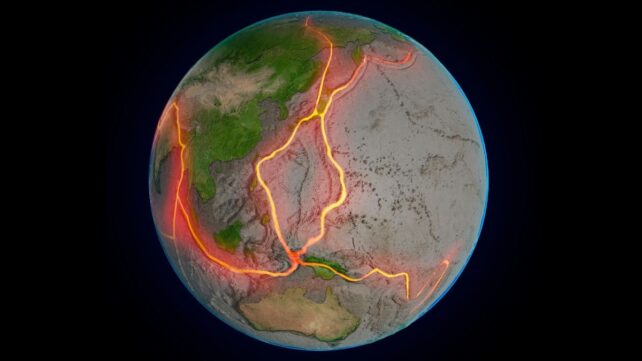
Ever wondered where in the world your backyard was, within the ancient supercontinent of Pangaea? Now, you can find out for yourself.
A team of Earth scientists has just released an update to Paleolatitude.org, a tool that reveals the shifting latitudes of any given location on Earth over 320 million years of continental drift.
This could help put existing geological and paleontological data into a whole new perspective: A fossil left behind can be tracked not only across time, but space, too.
A quarry near Winterswijk in the Netherlands, for instance, contains fossils of plants and animals that lived 245 million years ago.
All evidence points to these lifeforms surviving in a climate more similar to that of the modern Persian Gulf than to that of eastern Europe.
This was not simply because Earth was warmer at the time.
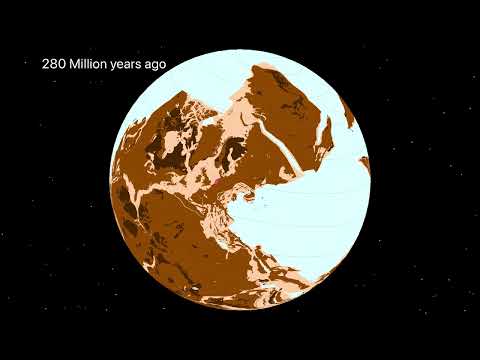
The Utrecht Paleogeography Model – on which the new tool is based – confirmed that 245 million years ago, the Winterswijk fossils were located at a latitude similar to that of modern-day Arabia, as shown in the video below with the Netherlands marked in pink.
This latest installment adds new detail – and more user-friendly features – to the Paleolatitude.org calculator, which was first released about a decade ago.
"With the new model, we have much greater certainty, and our understanding of biodiversity is shifting from one-dimensional – that is, solely over time – to three-dimensional, encompassing space as well," explains co-author Emilia Jarochowska, a paleontologist at Utrecht University.
"This enables us to draw important lessons for the resilience of biodiversity in the present."
The new tool includes a global paleogeographic model spanning 320 million years, including geographic features that are now "thrusted over each other in orogenic (mountain) belts".
It also brings paleomagnetic models up to date with new data, because it's not just the continents that wandered over time: the poles did, too.
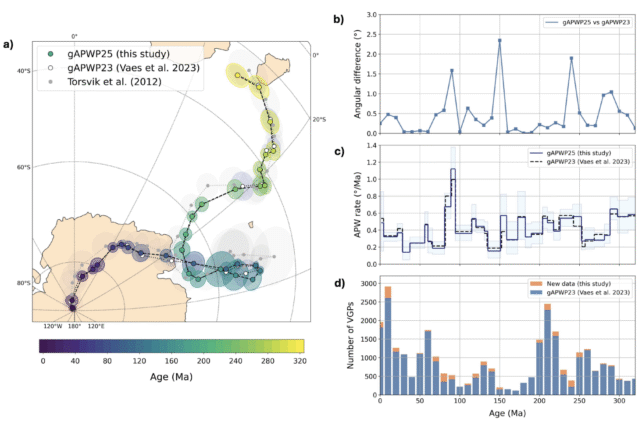
The new web platform allows users to export data and graphs, and even upload their own data for bulk paleolatitude computation (we'll leave that to the scientists).
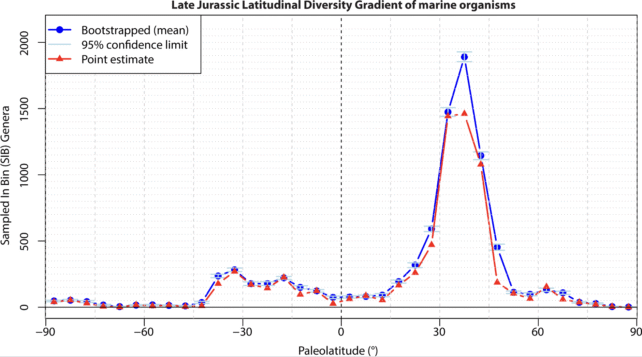
To showcase what the new tool is capable of, the researchers calculated a biodiversity gradient for the late Jurassic based on the historic latitudes of landmasses that have since been reshuffled.

Using a dataset of around 34,000 Upper Jurassic marine fossils, the team was able to wind back the clock on the locations where these fossils were found to the latitude at which they would have been deposited at the time of death.
Not only were the researchers able to map out which latitudes had the highest diversity at the genus level, but they were also able to apply statistical adjustments, including uncertainty and bootstrapping, to the data to give a more scientifically sound result.
"This allows us, for example, to show what happened to global biodiversity during and after mass extinctions in the past, for instance due to the Earth rapidly warming or cooling," says Jarochowska.
"Which latitudes became uninhabitable first, and which became refuges? Which species migrated, which adapted, and which went extinct?"
Related: Africa Is Splitting Apart Faster Than We Thought, Forming a New Ocean
The team plans to extend the model even further into Earth's history, to encompass the Cambrian explosion 550 million years ago.
But for now, you can check out what latitudes your own backyard (or anywhere else you can think of) has traveled through by simply entering the location here, and tracing its journey through the ages.
The research was published in PLOS One.