
In the wild unknown, out beyond the orbit of Neptune, astronomers have found a tiny world that defies our understanding of skies.
This baffling object measures around 500 kilometers (310 miles) across, too small for its weak gravity to retain an atmosphere for long – yet an atmosphere it has. It's thin and tenuous, to be sure, but a world as small as (612533) 2002 XV93 shouldn't have an atmosphere at all.
It may not sound like much, but this relatively minuscule chunk of ice and rock in the cold, dark reaches of the Solar System may change what we know about atmospheric retention.
In the process of studying the icy world, astronomers have showcased cutting-edge techniques for finding faint phenomena, so far away.
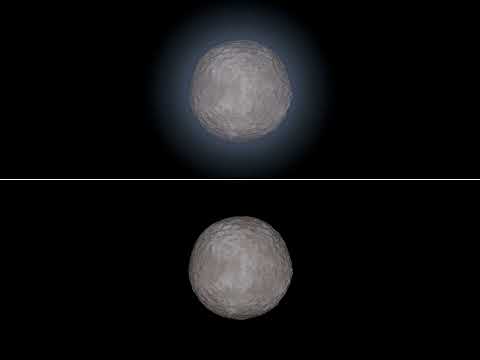
2002 XV93, as it is known for short, is a type of object known as a plutino. It's a small body that shares an orbit similar to Pluto's orbital rhythm, at around 40 times Earth's distance from the Sun, in resonance with Neptune's orbit.
These small icy worlds are thought to represent a fossil record of the early Solar System, recording information about what it was made of and how things moved around in it. The resonance with Neptune, for example, shows that Neptune moved outwards, sweeping things up as it went.
But the space out beyond Neptune – the Kuiper belt – is a strange sort of no-man's-land for astronomy. It's filled with small, icy objects that are extremely difficult to find, let alone study in detail, because they're too far from the Sun to reflect much light we can detect.

Often, scientists need to rely on indirect detection methods. In the case of 2002 XV93, the method of observation relied heavily on chance: In 2024, astronomers led by Ko Arimatsu of the National Astronomical Observatory of Japan were in just the right place to watch it pass in front of a distant star – an event known as a stellar occultation.
The researchers captured the occultation from three different locations in Japan, recording in minute detail as the star's light was temporarily snuffed out by the much closer plutino.
For a bare rock, the way the star's light would change over the course of the occultation is pretty stark and straightforward – suddenly winking out as 2002 XV93 slipped in front of it, and winking back as the occultation concluded.

However, that's not what the astronomers observed. The entire event lasted just 15 to 20 seconds, depending on the viewing location – and for about 1.5 seconds before and after totality, the light curve showed a gradual dimming and brightening, respectively.
This kind of gradual fading can only be explained if the starlight passed through an atmosphere, bending (refracting) as it went.
Based on this dimming and brightening, the researchers built refraction models to understand what kind of atmosphere could have produced the signal. Using Pluto's atmosphere as a basis, they assumed a specific temperature structure and a composition mainly made up of methane, nitrogen, or carbon monoxide.
Then, they simulated how dense that atmosphere would be at different altitudes, and how light would bend as it passed through.

Their closest results suggested an atmosphere of just 100 to 200 nanobars – around 5 to 10 million times thinner than the atmospheric density of Earth at sea level.
This is wild for several reasons. The first is that we now have instruments sensitive enough to detect refraction through a barely-there atmosphere from the far reaches of the Solar System.
The second is that the team's models suggest such an atmosphere would be lost in as little as a few hundred to a thousand years. The most plausible way that it could have an atmosphere now is if that atmosphere is being replenished somehow.
Given that there are many objects in the Kuiper belt, one scenario the researchers propose is that a comet smashed into 2002 XV93, releasing gas that has formed a temporary atmosphere that will soon dissipate.

The other possibility is that, like Pluto, 2002 XV93 has active cryovolcanoes, which release icy sludge and volatiles from within the plutino, replenishing a constantly leaking atmosphere.
Related: A 'Crazy Idea' About Pluto Was Just Confirmed in a Scientific First
Whatever it is, though, the object represents the first atmosphere detected in a small trans-Neptunian object (TNO), other than Pluto. The results suggest that even small bodies can host atmospheres, and, even more excitingly, with a bit of luck, we can detect them even when they are next to nonexistent.
"This discovery suggests that the traditional idea that global dense atmospheres form only around larger planets must be revised," the researchers write in their paper.
"Even a few-hundred-kilometer TNO can host, at least transiently, an atmosphere, challenging standard volatile-retention scenarios. Our findings suggest that a fraction of distant icy minor planets can exhibit atmospheres, potentially sustained by ongoing cryovolcanic activity or produced by a recent impact of a small icy object."
The research has been published in Nature Astronomy.