
We already know that moving your body is important for brain health, but a new study reveals a possible reason why: It could be triggering a kind of hydraulic pump that flushes out fluid in the brain.
By studying mice and conducting simulations, researchers at the Pennsylvania State University (Penn State) have found that movements in the abdominal muscles can ripple all the way up to the brain, potentially cleaning out waste materials that build up during the day.
It's tangible evidence that what goes on in our brains and our bodies isn't so separate after all, and a good reminder to get that body moving, in whatever way works for you, throughout the day.
"Our research explains how just moving around might serve as an important physiological mechanism promoting brain health," says Penn State neuroscientist Patrick Drew.
"In this study, we found that when the abdominal muscles contract, they push blood from the abdomen into the spinal cord, just like in a hydraulic system, applying pressure to the brain and making it move."

Since mice are mammals, their bodies work a little bit like ours, which is why scientists often look to them first when trying to understand human physiology.
It's also possible to do things to mice that would never pass muster for humans – like putting a window in their skulls to observe what's going on in there.
In this study, the researchers peered through such windows into the brains of living mice, using two-photon microscopy to capture high-definition images of what was going on inside.

When the mice walked on treadmills with their heads held in place, the scientists could see their brains shift immediately after the abdominal contraction that comes right before the mouse takes a step.
By applying light pressure to the abdomens of anesthetized mice, the researchers confirmed that this was the source of the brain's shift.
"Importantly, the brain began moving back to its baseline position immediately upon relief of the abdominal pressure," Drew says. "This suggests that abdominal pressure can rapidly and significantly alter the position of the brain within the skull."
Perhaps our brains are getting the same treatment when we step up from a lunge or twist in a yoga pose.
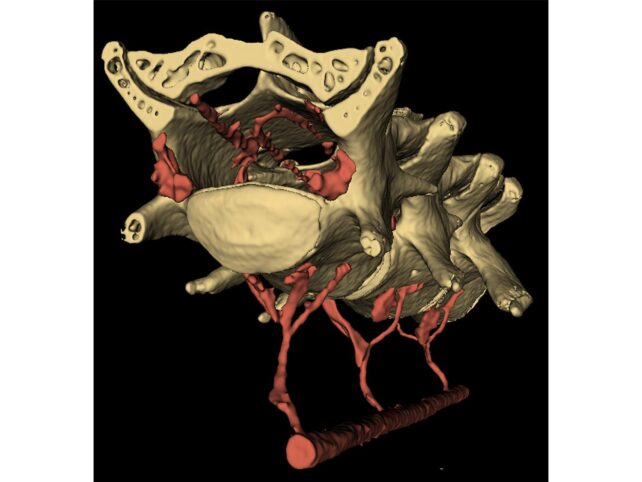
Micro-computed tomography (CT) scans – which use X-rays to help scientists assemble virtual, 3D reconstructions of internal structures – revealed the network of veins that make up this 'pump' between the abdominal cavity, the spinal cord, and the brain.
It's difficult to account for all the complex physics involved as fluid flows in and around the brain's many membranes, so they took a simplified approach when it came to the computer modeling aspect of the study.
"The brain has a structure similar to a sponge, in the sense that you have a soft skeleton and fluid can move through it," explains biomedical engineer Francesco Costanzo, who led the computational modeling for this study.
"Keeping with the idea of the brain as a sponge, we also thought of it as a dirty sponge – how do you clean a dirty sponge? You run it under a tap and squeeze it out," Costanzo says.

Of course, the brain isn't really as simple as a sponge – but it's a starting point for understanding what is arguably one of the most complex organs in the body.
Their simulations revealed that the subtle movements in the brain, triggered by abdominal tensing, would be enough to push cerebrospinal fluid (CSF) through and out of the brain into a layer between the brain and skull known as the subarachnoid space.
Research has shown that CSF flow is important for removing waste products from the brain that can otherwise contribute to neurodegeneration.
Interestingly, in sleep, CSF flows in the opposite direction: It soaks into the brain from the subarachnoid space. Until now, it's been unclear why CSF flow varies so drastically between sleep and waking; this research offers one possible explanation.
Related: A Sleep Disorder Affecting Nearly 1 Billion People Is Still Overlooked
"This kind of motion is so small. It's what's generated when you walk or just contract your abdominal muscles, which you do when you engage in any physical behavior. It could make such a difference for your brain health," says Drew.
These findings were reported in Nature Neuroscience.