When it comes to modeling near-future climate change, scientists have taken their absolute worst-case greenhouse gas emissions scenario off the table, deciding it is "implausible".
You might've come across this worst-case scenario in the projections scientists make about our planet, from extreme weather events and sea-level rise, to ocean health and species extinction.
When they do these modeling studies, scientists usually present possible results for a range of scenarios based on the different ways humans might manage greenhouse gas emissions.
Not all of those scenarios are equally likely, but they give us an idea of what we could be in for, and a basis for making decisions (and policies) about the energy sources and other technologies we use.
So, how can scientists rule out the worst-case climate scenario? And what do all these scenarios really mean?
In 2011, a team of scientists led by climatologist Detlef van Vuuren proposed a system to help the climate modeling community explore how the climate might change from the present to the year 2100.
They called these scenarios the "representative concentration pathways" or RCPs for short.
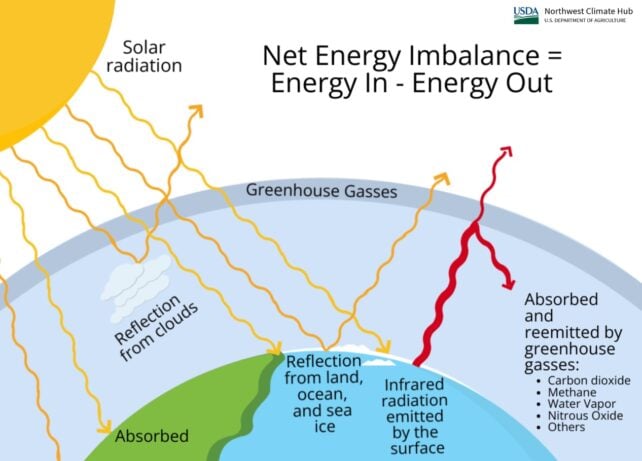
When greenhouse gases are added to our atmosphere – through the extraction or burning of fossil fuels, or from ecosystems in distress – they build up to form an insulating layer that traps heat within.
This contributes to radiative forcing: a measure of the extra heat, in watts, trapped per square meter within the confines of Earth's atmosphere.
Each RCP is based on a certain amount of radiative forcing accumulated in the atmosphere by the end of this century.
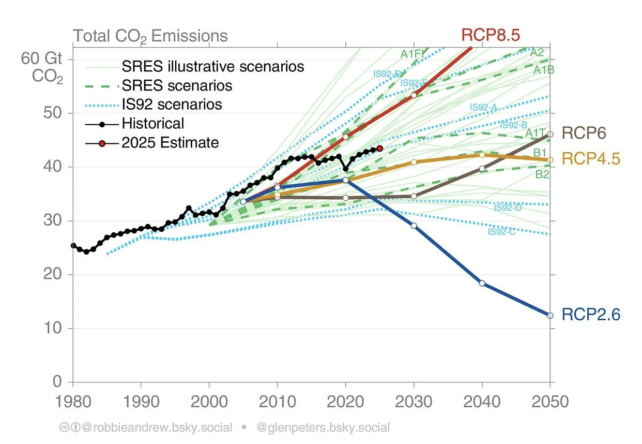
When scientists first developed the RCPs, they proposed four levels of radiative forcing we might reach by 2100: 2.6 watts per square meter, 4.5, 6, and 8.5.
Scientists have used these pathways to simulate what conditions we might face this century, based on how we manage our greenhouse gas emissions.
For instance, under RCP 8.5, climate scientists projected that the global mean temperature could rise by as much as 4.8 °C from pre-industrial levels by 2100.
In 2021, the United Nations Intergovernmental Panel on Climate Change (IPCC) incorporated RCPs into a set of Shared Socioeconomic Pathways (SSPs), bringing socio-economic development into the picture to make the models more realistic.
This brings us to SSP5-8.5: A scenario in which global development is achieved through the exploitation of fossil fuels, resulting in very high levels of greenhouse gas emissions that raise radiative forcing to 8.5 watts per square meter by 2100.
Now, 15 years since the RCPs were first laid out, van Vuuren and a swathe of other climate scientists from around the world have published a paper stating that the scenario with the highest level of radiative forcing, SSP5-8.5 (and the original RCP 8.5), is "implausible."
Climatologist Andrew King, from the University of Melbourne in Australia, is one of the scientists who contributed to that paper.
He says there's a very good reason the RCP 8.5 scenarios have been retired – and it's not because scientists were 'wrong' about climate change.
"The removal of this high-emissions scenario isn't, as Trump and other climate skeptics have claimed, a sign of failed modeling, or that climate change was a hoax," King writes in an article for The Conversation.
"Although often slow and incomplete, our efforts to tackle climate change have made a tangible difference. We have averted the worst climate future once thought possible."
This means RCP 8.5 will not be included in the upcoming IPCC 7th Assessment Report.
To some experts, it's not all that surprising that RCP 8.5 has been ruled out.

Even when it was first developed, "RCP 8.5 was chosen to represent the high end of the baseline scenario range available to the researchers at the time – around the 90th percentile," write climate journalist Zeke Hausfather and climate scientists Glen Peters and Piers Forster in a blog post.
"It was never a likely outcome even in a world that did not address climate change; rather it was always intended to represent a worst-case scenario that pushed fossil fuel expansion to the max."
The retirement of RCP 8.5 and SSP5-8.5 shows how far we've come in reducing our emissions with renewable energy technologies such as solar, wind, electric vehicles and batteries.
But this doesn't mean we're off the hook when it comes to the greenhouse gas emissions that are amplifying global climate change – not by a long shot.
Now, according to the new paper from King and his colleagues, the high end of the emission range includes two hypothetical futures in which the world "does very little to combat climate change" throughout this century and beyond, or doesn't take action until the second half of the century.
Those scenarios still involve a dangerous and possibly catastrophic level of warming, up to 3.5 °C above pre-industrial levels by the century's end, but they entail "substantially slowing current observed trends towards rapid expansion of renewable energy".
Related: 80% of Earth's Rivers Are Quickly Losing Oxygen, Study Reveals
"Rapid declines in clean energy costs have bent the curve of future emissions downward, with new scenarios designed to reflect current policies notably lower than most baseline scenarios in the literature," Hausfather, Peters, and Forster explain.
"The 21st century is now unlikely to see a continued expansion of fossil fuel use globally, with current policy scenarios reflecting relatively flat global emissions going forward."
'Business as usual' may have shifted. But the need for climate action, it seems, is no less urgent.
The research was published in Geoscientific Model Development.