
A new study may have revealed a crucial cog in the biological machinery that spins the wheel of aging.
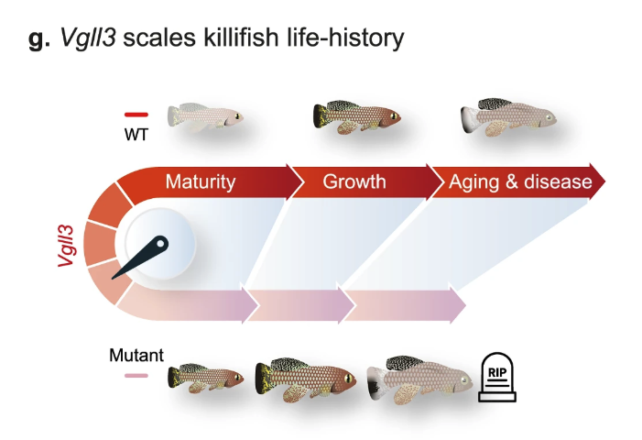
It's a gene that appears to dictate how fast African turquoise killifish (Nothobranchius furzeri) grow and how quickly they reach reproductive age.
However, there is a major downside: Changes to the gene, known as vestigial-like 3 (or vgll3), can also lead to a higher risk of cancer in these fish as they age and shorten their lifespan.
This is rare experimental evidence of a genetic trade-off that researchers had been searching for, specifically in vertebrates, animals with a backbone like us.
Led by scientists at the Hebrew University of Jerusalem, the research team wanted to interrogate the idea of antagonistic pleiotropy, the concept of genes that boost early growth but cause harm later on.
It's a theory that's growing in popularity, but until now, tangible proof for it in the form of specific genes has been hard to come by.
The experimental evidence we have here supports the idea that certain genes dictate a 'live fast, die young' approach. It also helps explain why genes that limit lifespan are retained through evolution.
"We have effectively caught evolution in the act of making a trade-off," says geneticist Itamar Harel, from the Hebrew University of Jerusalem.
"For years, we've asked why our bodies can't just maintain themselves indefinitely.
"This gene gives us a direct answer: nature doesn't prioritize longevity, it prioritizes continuity. We are built to sprint, not to marathon."
The researchers wanted to take a closer look at vgll3 because natural variations in the gene have previously been linked to puberty timing in humans and reproductive age in salmon. It's also known for its role in cell growth.
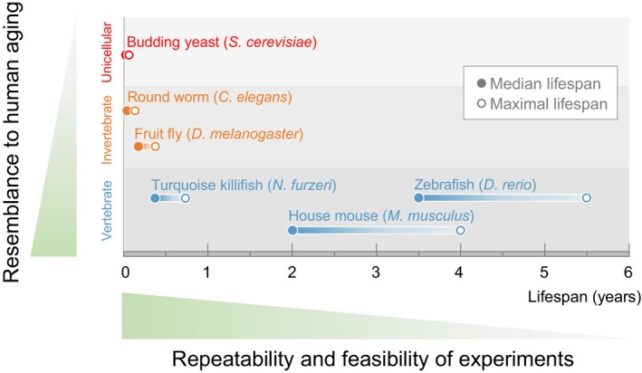
As killifish live such short lives – just a few months – they're perfect for aging and longevity studies.
The researchers used CRISPR gene editing to modify the vgll3 gene in the killifish, mucking up the proteins it produces.
These modified fish showed increased rates of cell division: They grew faster and reached sexual maturity earlier.
Near the end of their lives, these fish also developed more age-related tumors, including cancers resembling melanoma in humans.
So it seems that in its default state, vgll3 acts as a sort of safety brake. Release it, and aging accelerates.
In addition to dialing up cell division, the researchers also found that variations in the vgll3 gene influenced the activity of stem cells and DNA repair, which is essential for a long and healthy life.
"These findings are consistent with a trade-off," the researchers write, "between early-life benefits, such as accelerated growth and reproductive maturity, and the heightened risk of late-life disease and mortality, warranting further investigation in wild populations."
Humans also have the vgll3 gene, but more research is needed to determine whether it functions in the same way.
If it does, then we might be looking at a dial we can possibly turn, to one day develop cancer treatments and ensure better health in old age – but that's still a long way off.
There has been plenty of prior research into this particular gene, linking it and the protein it makes to cancer, but it's a complicated picture.
Past studies have associated vgll3 with both promoting and suppressing tumor growth, so there's a lot more we need to understand about its role in aging and disease.
For now, the case for antagonistic pleiotropy – and for the existence of single genes that affect growth – just got a lot stronger.
"What's fascinating – and slightly terrifying – is that the cancer we see in these fish isn't a random accident," says Harel.

"It's the direct shadow of their youthful vitality. The same machinery that drives a cell to build a young body is hijacking the system to build a tumor in the old one."
Harel and his colleagues say their next steps with killifish are to see whether it is possible to separate the effects of vgll3 in early years from its harmful consequences later in life.
Related: One Sign of Aging Could Be a Powerful Predictor of Death if You Don't Act
"If we can understand this mechanism," Harel adds, "we might finally learn how to decouple healthy growth from the disease of aging."
The research has been published in Nature Communications.