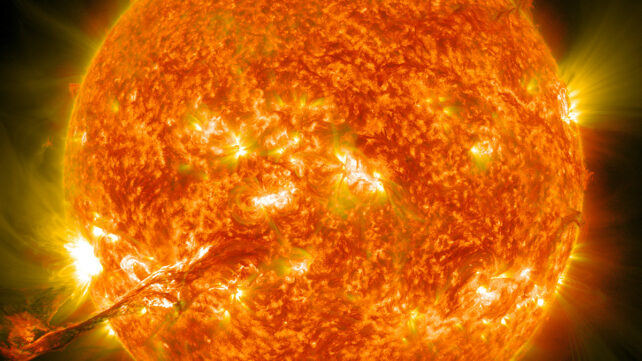
The curious case of the solar system's missing silver has had scientists scratching their heads for years.
Why do ancient meteorite fragments contain much more silver than the Sun, if they were formed at the same time, some 4.6 billion years ago?
If they formed at the same time, from the same swirling mass of dust and gas, they should have similar ingredients. Now a study published in Astronomy & Astrophysics from a team of international researchers may have the answer…
There's a lot more silver in the Sun than we previously thought.
We're only talking a small amount overall, as 98.5 percent of the Sun's mass is made up of hydrogen and helium. However, according to the new calculations, there's 55 percent more silver in our star than past studies had concluded.
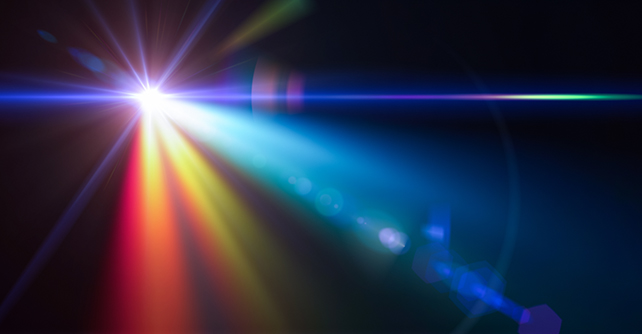
The big shift in estimates comes from a much-improved model for interpreting light emitted by the Sun.
As this light passes through atoms in the outer solar atmosphere, we can tell what that atmosphere is made of by the way the light gets absorbed, leaving dark features at specific wavelengths, known as spectral lines. Each element leaves its own pattern.
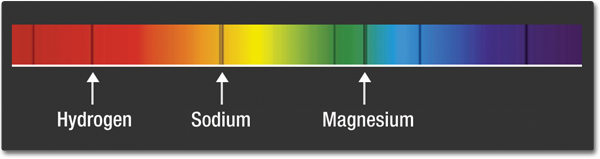
With the help of a supercomputer, this study applies a significantly more detailed, 3D model of the Sun and its light output to reinterpret how silver atoms might behave and might interact with solar rays.
"With our new model, we were able to interpret the spectral lines used to determine the solar silver abundance more accurately," says astrophysicist Sema Caliskan, from Uppsala University in Sweden.

That 55 percent bump brings the amount of silver in the Sun almost fully into line with meteorites of the same age (which, unlike the Sun, we can actually sample due to their regular arrivals on Earth).
The findings aren't just about reconciling a solar system math error. Knowing how much silver is in the Sun helps trace the chemical evolution of the Milky Way, and how long other stars may have been around.
Due to the way silver can be forged as part of a star's death, it also gives us something of a window back to the earliest days of the cosmos, and how celestial bodies have evolved.

"The new knowledge about the Sun's composition is important for the understanding of other stars, planets and cosmic material, because the Sun is one of astronomy's key reference points," says Caliskan,
The new model still has uncertainties. The researchers tested how sensitive their result was to different inputs and found the calculations were most affected by data on how silver interacts with hydrogen.
Future observations and data gathering should help to tighten up the model further, the researchers say.
"We assessed modeling uncertainties via targeted sensitivity tests, finding the results to be most sensitive to the hydrogen-collision data," writes the team in their published paper.
For example, the SUNRISE UV Spectropolarimeter and Imager (or SUSI for short) has collected detailed data on the light streaming to Earth from the Sun, which could be used to further calibrate their model.
Now that they've figured out just how much silver the Sun has, the researchers aim to apply their improved model to other stars. With future studies, using silver as the forensic clue, we should be able to learn more about the Milky Way and how it expanded.
And, as always, new data can be used to verify existing data – giving astronomers a more reliable and robust picture of the Solar System and beyond.
Related: The Longest Journey Sunlight Ever Takes Happens Before It Leaves The Sun
"By studying the light of stars of different types and ages, we hope to understand where silver is formed in the Universe, and how it has been distributed throughout the Milky Way over time," says Caliskan.
The research has been published in Astronomy & Astrophysics.
This article was fact-checked by Rachel Garner and edited by Rebecca Dyer. While we pride ourselves on our process, we are only human. If you spot a mistake, please let us know.