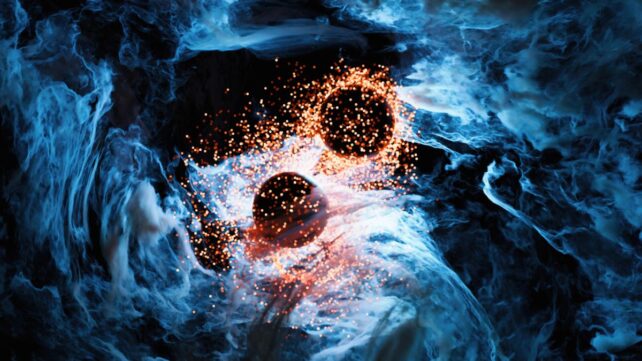
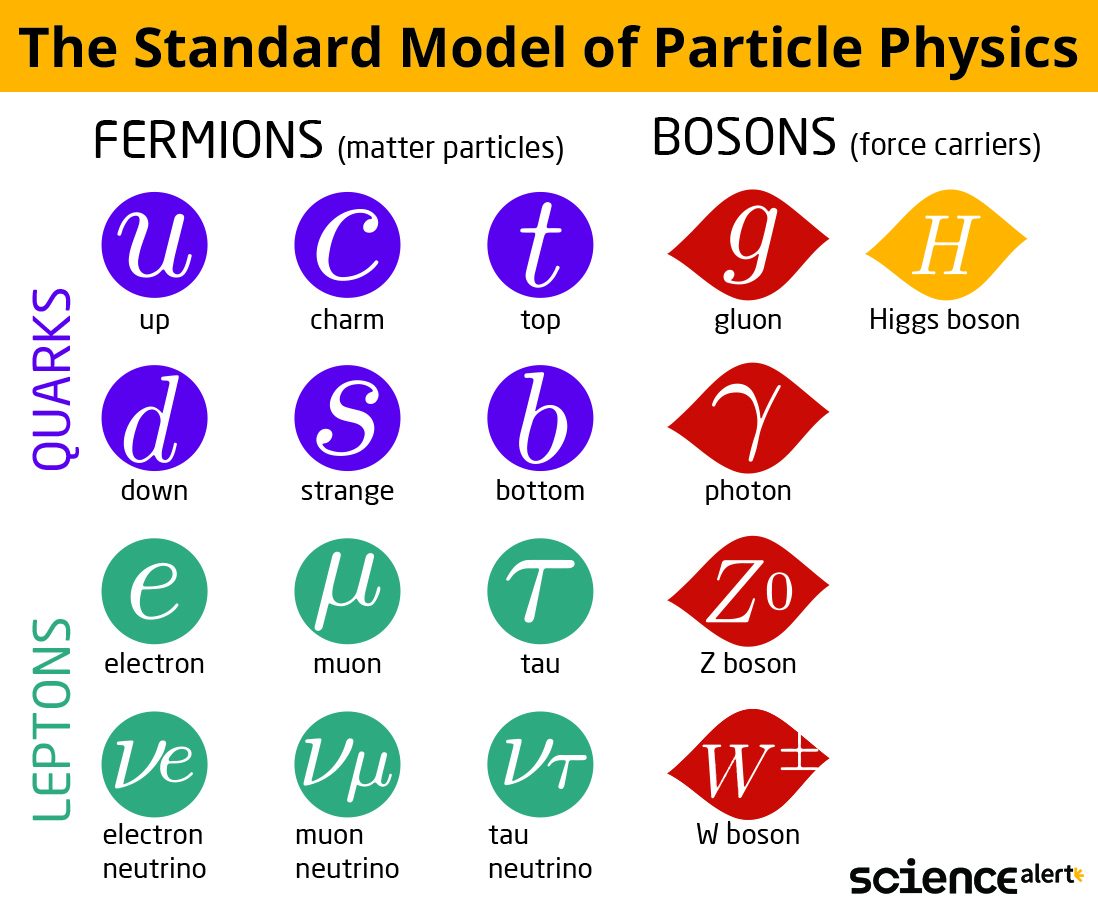
An important part of the Standard Model of particle physics, quantum chromodynamics describes the strong interaction of quarks and gluons to create the ordinary matter we see, touch, and taste.
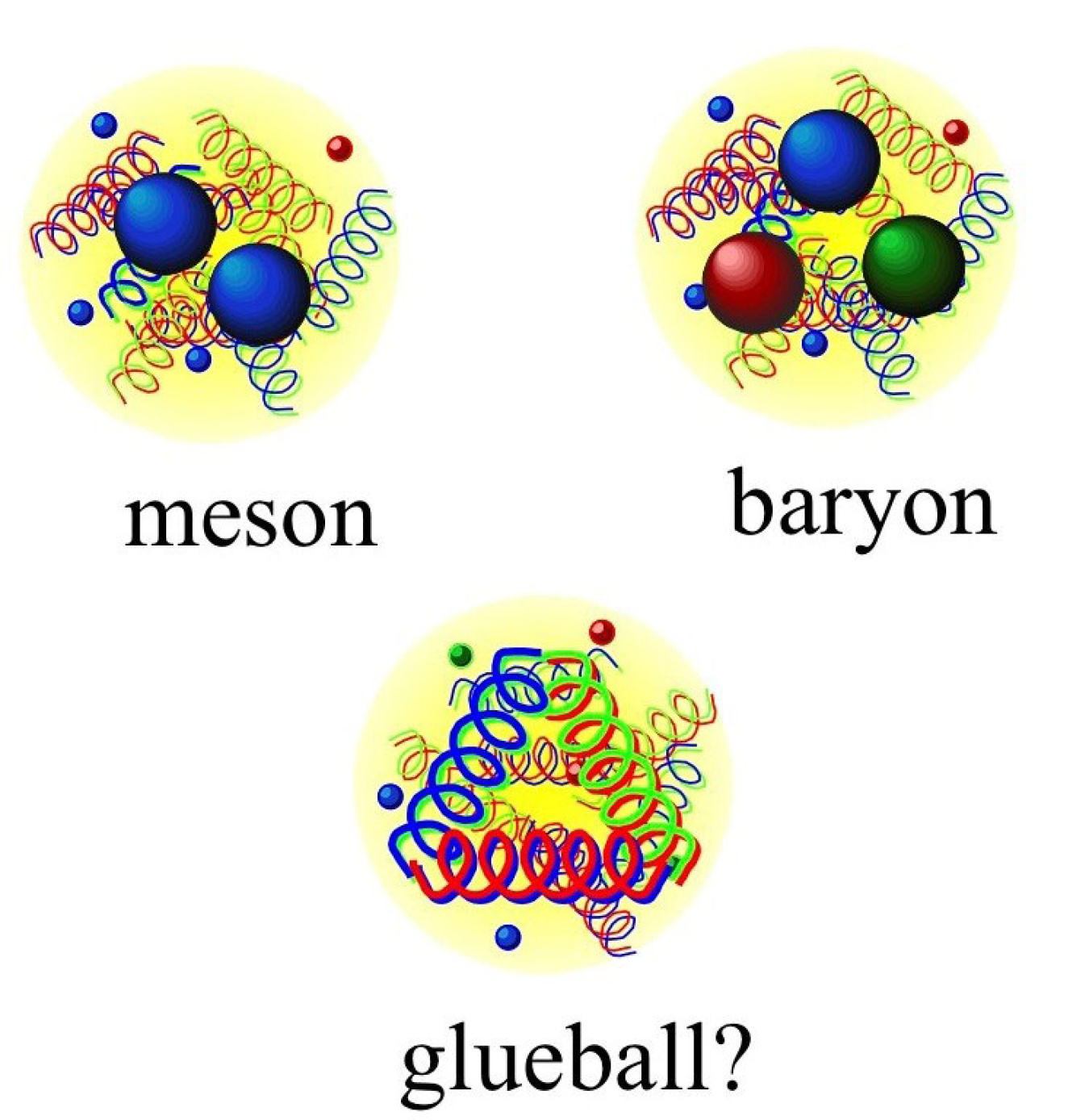
Quarks are fundamental subatomic particles that combine in trios to make up familiar baryons such as protons and neutrons, and gluons are the quantum 'Gorilla Glue' that binds their quark structure together.
For nearly 50 years, physicists have hunted for "glueballs", exotic particles predicted by this theory of the strong interaction.
Now, a collaboration working at a collider in Beijing says it has the clearest evidence yet that a known particle called X(2370) is dominated by one of these elusive states.
"The glueball is an important prediction of quantum chromodynamics, the theory that describes the strong interaction, and is also the only type of particle in nature composed entirely of force mediators," the international team of researchers behind the discovery explains in a statement.
Physicists sifted through the wreckage of high-energy particle collisions to find strong evidence of this glueball, made predominantly of gluons – massless force carriers of the strong interaction between quarks.
The same underlying physics also gives rise to the residual strong force that binds protons and neutrons into an atomic nucleus, much as photons carry the electromagnetic force.
The new evidence for this exotic, unstable glueball's ephemeral existence comes from a recent preprint on arXiv, presented at the International Conference on High Energy Physics in Brazil.
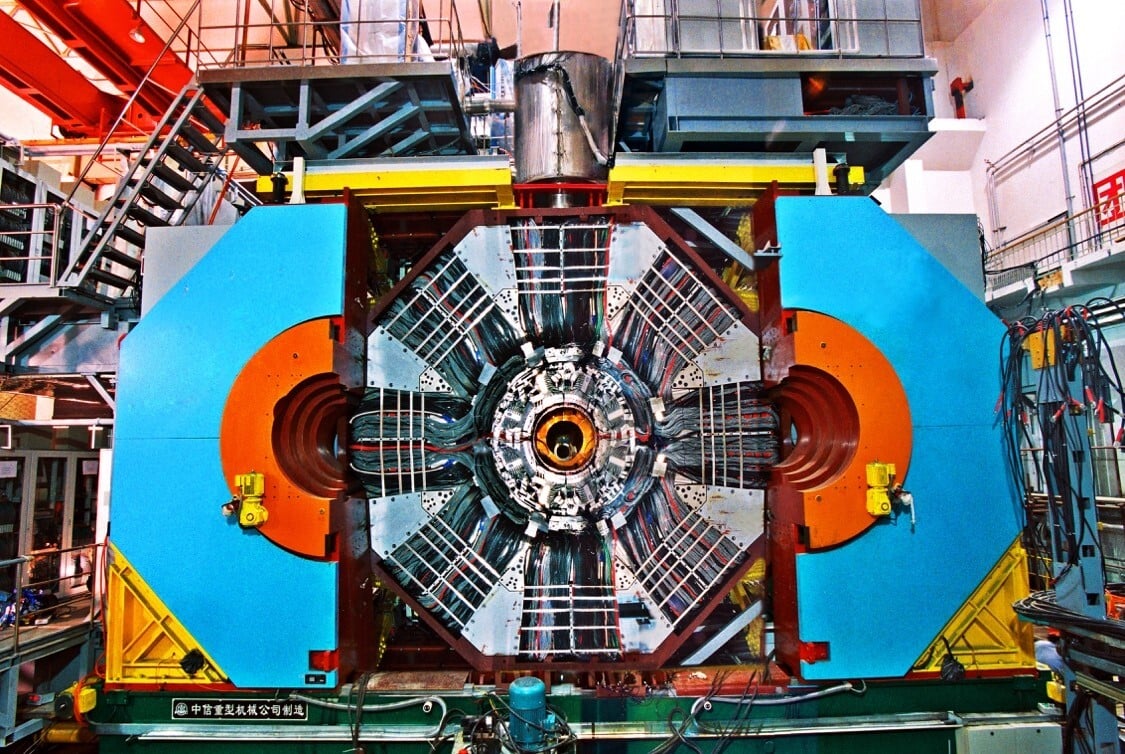
The team's analysis suggests that a glueball is the "dominant constituent" of X(2370), a particle discovered in 2011 by the Beijing Spectrometer III (BES III) Collaboration at the Institute of High Energy Physics (IHEP) in Beijing.
This collaboration uses the Beijing Electron Positron Collider II (BEPCII), a particle accelerator and collider that smashes electrons into their antimatter counterparts, called positrons, to probe perplexing particle physics.
The resultant glueball is an "unprecedented form of matter," says Jin Shan, a particle physicist at Nanjing University and one of the research team's leaders.
"It not only enables the theory describing strong interactions to pass its most rigorous test, but also vastly expands the boundaries of our understanding of the physical world," he told Fan Chen at South China Morning Post.
When particles crash together at nearly the speed of light, the succeeding explosion of subatomic confetti yields a veritable Baskin-Robbins lineup of short-lived products.
One of these is the J/ψ (J/psi) meson, a subatomic particle that pops out of high-energy collisions and decays almost immediately.
These decays "provide one of the best avenues to search for glueballs, and searching for glueballs has been one of the collider's primary physics goals for decades," the researchers say.

Previously, in a study published in the journal Physical Review Letters in 2024, the researchers analyzed 10 billion meson decay events.
They measured the X(2370) particle's mass and spin parity – a property that dictates its interactions and almost-instantaneous decay – for the first time, finding complete agreement between their experimental values and predictions.
Now, they've identified its additional decay modes and determined its flavor-singlet nature, "the most important characteristic of a glueball."
In simplified terms, this means it shows no preference for the six types, or flavors, of quarks – picture a sommelier failing to distinguish the specific fruit profile of tutti frutti ice cream, for an even more colloquial context.
More experiments are needed to further confirm and constrain the prototypes of the highly esoteric glueball; in other words, more particle smashing.
For now, the researchers have essentially ruled out any other alternative explanations, based on how their measurements of X(2370) compare to theoretical predictions.
Still, this finding elucidates the nature of a particle that's wholly alien to our everyday sensibilities and observations of the macro-world.
It also highlights advances in technology and analytical techniques that have recently revealed another decades-in-the-making physics mystery.
Related: After 50 Years, Physicists Find Strong Evidence For What Really Holds Matter Together
So, who knows what wildness will emerge as humanity ramps up the collisional capabilities of next-gen particle smashers.
The authors describe their work as the clearest experimental result to emerge from nearly 50 years of glueball searches, supporting the long-standing theoretical prediction that gluons can bind together into a new form of matter.
This research is available as a preprint on arXiv.
This article was fact-checked by Clare Watson and edited by Rebecca Dyer. While we pride ourselves on our process, we are only human. If you spot a mistake, please let us know.