Somewhere in the world, surely, a Monkey's Paw is cackling maniacally to itself.
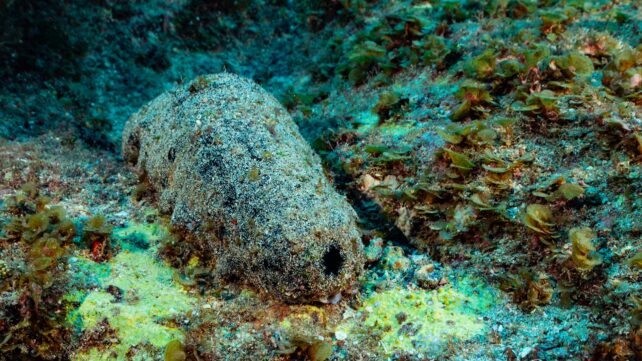
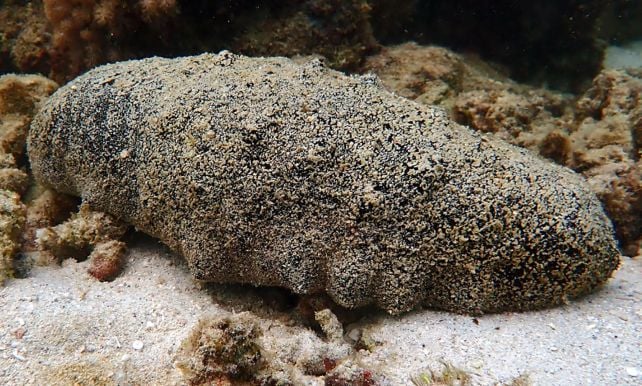
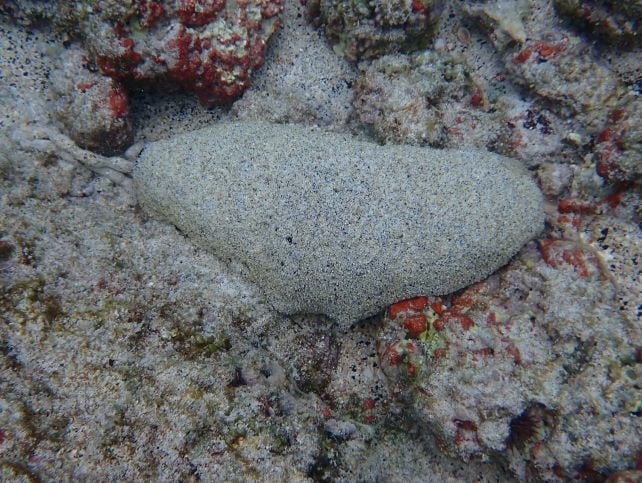
Scattered across the Pacific and Indian Oceans, a humble sea cucumber named Holothuria (Microthele) whitmaei makes its home.
This unassuming animal somewhat resembles poop, has been saddled with the lamentable common name "black teatfish", and is highly prized as a delicacy in some cultures – even though it has been listed as endangered for more than a decade.
And yet, a new study has found, H. whitmaei may live for more than 120 years.
In a genetic study spanning more than two decades, a team led by biologist Sven Uthicke of the Australian Institute of Marine Science has discovered that this species barely grows at all – and can live for an astonishingly long time.
"Although individuals of some sea urchin species can live to over 100 years, deriving at a similar conclusion for the black teatfish was surprising," they write in a paper published in iScience.
"This species is the first sea cucumber species known to surpass a longevity of a century."
The story begins in 2000, when Uthicke and his colleagues were trying to solve a particularly pernicious problem.
H. whitmaei is prized as a delicacy known as bêche-de-mer, and in 1999, declining numbers of the sea cucumber around Australia's Great Barrier Reef prompted H. whitmaei fisheries to close, while Uthicke and his colleague John Benzie attempted to conduct a census – but they ran into a snag when they tried to track the population over time.
Scientists can learn a lot about an animal's lifespan by tagging individuals and returning later to see which ones are still alive, and how they have changed. But sea cucumbers are basically impossible to tag in this way – physical markers tend to fall off within weeks or months.
So the researchers came up with a different way to identify individuals – their DNA. They collected black teatfish from several sites on Australia's Great Barrier Reef, took small tissue samples, and used their DNA as a unique identifier – a tag that was not going to just fall off into the sea.
It worked.
The researchers returned to the reef six months later, and then again after a year. Their results allowed them to identify individuals they had spotted before – and confirm that the population was not bouncing back from overfishing.
The results also suggested the animals might live for several decades – but the short study period made it impossible to say with much confidence. So the samples they had collected were popped into cold storage, and the researchers moved on to other projects for a spell.
Flash forward 24 years after the initial genetic sampling, to September 2024. The researchers were ready to pick up where they'd left off.
Uthicke and his colleagues returned to one of the original sampling sites, at Bird Islet on the Great Barrier Reef's Lizard Island, and went looking for black teatfish.
They found 53. The researchers weighed and measured each animal, took a small tissue sample, and carefully returned it to the seafloor. Then they pulled those decades-old DNA samples out of storage to see whether any of the animals matched.
A staggering number did.
Thirty-one of the 52 animals successfully analyzed were identical genetic matches to samples collected in 2000. That means that at least 60 percent of the animals the researchers examined were at least 24 years old in 2024.
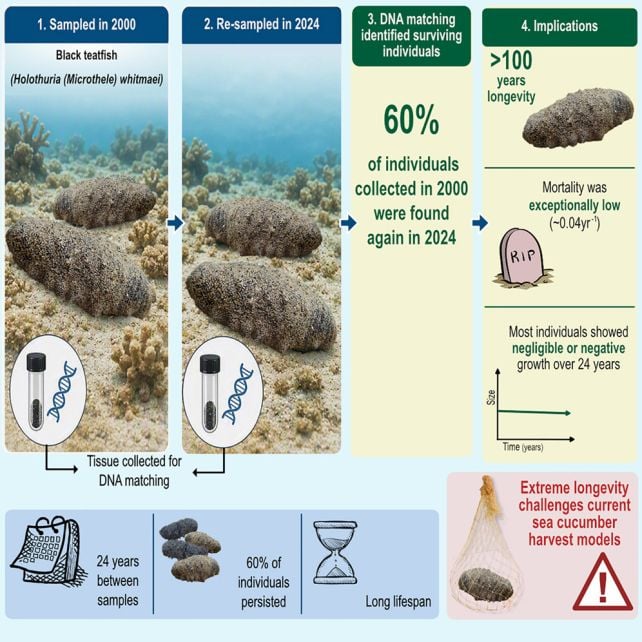
Back in 2000, these individuals were already large, fully grown sea cucumbers, measuring between 26 and 42 centimeters (10 and 17 inches) – near the maximum size for their species.
And this is where it got really strange.
They hadn't grown. In fact, most of the 31 animals had shrunk.
On average, the sea cucumbers were 21 percent lighter and 14 percent shorter than they had been 24 years earlier. Exactly why isn't clear. Sea cucumbers can lose and regain body mass over time, and the researchers suggest that changing environmental conditions may have played a role.
But the researchers were less interested in how much the animals had grown than in how many of them had survived.
In 2000, the team successfully obtained genetic profiles from 76 individual black teatfish. Twenty-four years later, 31 of those individuals turned up again – that's a survival rate of at least 41 percent.
From that survival rate, the researchers could estimate how quickly adult black teatfish disappear from the population over time.
Assuming the mortality rate remains roughly constant throughout adulthood, they calculated an annual mortality rate of just 0.037 – extraordinarily low for a sea cucumber.
They then used that mortality rate to extrapolate how long a cohort could persist. By the time the animals reached 123.3 years old, the model suggests, around 1 percent could still be alive.
And even that could be an underestimate. It's possible – even likely – that the researchers did not locate every surviving animal from 2000; some may have moved away from the sampling area, while others could simply have been missed.
Both would make dead and merely absent sea cucumbers indistinguishable, artificially increasing the apparent mortality rate.
Then there was another problem.
The researchers couldn't find any juveniles – not in 2024, and not in 2000.
Every individual sampled in both surveys was a large adult. The scarcity of juveniles has also been observed in other populations of this species and its close relatives, suggesting that new generations may be entering these populations only slowly.
This could indicate that H. whitmaei lives slowly and replenishes its populations slowly – far too slowly to maintain populations ravaged by the voracious demand of delicacy-hunters.
And H. whitmaei may not be the only sea cucumber we've badly underestimated.
Other holothuroid species share some of the traits that make black teatfish so vulnerable to overfishing, yet basic information about their lifespans, mortality, and recruitment remains surprisingly scarce.
"Our findings provide grounds for reassessment of conservation and management of many holothuroid species, which is especially urgent for the three teatfish species," the researchers write.
That reassessment could have consequences beyond the survival of the sea cucumbers themselves. These strange, sediment-sifting animals perform important work on coral reefs, recycling nutrients and helping maintain the health of the ecosystems they inhabit.
And those ecosystems are already under mounting pressure from a warming world.
"Coral reefs suffer increasingly from climate change-related pressures and individual stressors act cumulatively," the researchers write.
"Adding stress to the system by removing ecologically important species and the ecosystem services provided, such as by sea cucumbers, is incompatible with sustainable management of coral reefs."
The research has been published in iScience.
This article was fact-checked by Rachel Garner and edited by Rebecca Dyer. While we pride ourselves on our process, we are only human. If you spot a mistake, please let us know.