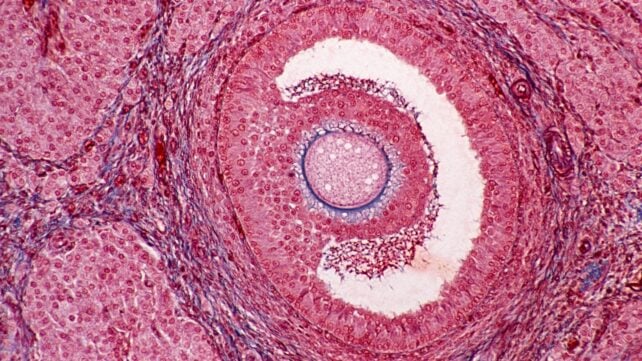
The ovaries are among the first organs to show signs of aging, and yet we still don't really know why or how to slow down the inevitable.
No currently approved therapies can slow ovarian aging.
But new research among humans and mice has now identified a treatment that possibly could – one that's accessible to the vast majority of us.
In experiments among female mice, those that regularly exercised on a treadmill for one month, as opposed to those that didn't, had more follicles in their ovaries.
They also showed a lower loss of primordial follicles, which are dormant eggs that cannot be replaced. They represent the ovary's reserve of immature oocytes.
What's even more exciting, however, is that there's a drug that can replicate these reproductive benefits, even without exercise.
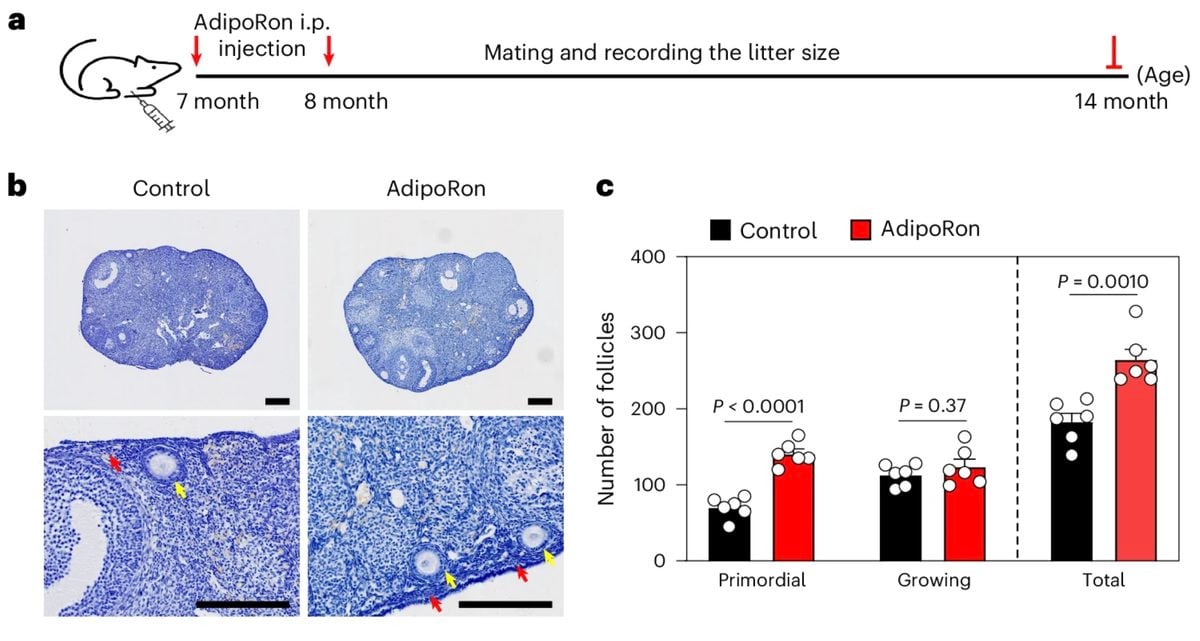
When mice were injected with an experimental drug called AdipoRon, it extended their reproductive lifespan, and they went on to have offspring later in life than untreated mice.
With these injections, the number of total ovarian follicles and the protein levels of anti-Müllerian hormone (AMH) were significantly higher.
Most untreated mice stopped reproducing around 12 months of age.
But mice treated with AdipoRon continued producing offspring until they were up to 15 months of age.
The research, led by scientists at Guangzhou Medical University in China, was published in Nature Aging.
"By confirming the protective effects of physical activity on ovarian aging, this study contributes to the broader understanding that physical activity can delay the aging process in multiple organs," the authors write in their paper, led by biomedical researchers Biao Li, Nana Zheng, and Tong Luo.
According to biochemist Philipp Scherer, who was not involved in the study, this research "is a well-performed, very exciting addition to the field."
Today, there are lots of studies out there that suggest physical activity can prolong a person's lifespan and delay aging in various organs, such as the brain or the heart.
But the health effects of exercise on the ovary are not nearly as well studied.
These new experiments among mice suggest that physical activity really can be a way to slow ovarian aging, and knowing more about the details has revealed a possible new drug target.
"Although our animal experiments support causality, they might not fully recapitulate human ovarian aging," some of the team warn in a research briefing.
"We cannot definitively claim that physical activity prevents menopause…"
But what was found during these experiments is worth investigating further.
Especially since the study authors also found similar evidence in humans.
In two large population studies, one from the UK and one from the US, premenopausal women reported higher physical activity levels than postmenopausal women.
And in the UK study, higher physical activity levels were associated with a later age of menopause among postmenopausal individuals.
There was also another factor uniting the human evidence and the mouse evidence.
Mice that were physically active on a treadmill showed increased levels of a protein hormone called adiponectin in their ovaries.
This peptide is closely linked to the development of ovarian follicles and ovarian reserve.
When female mice were given AdipoRon, a drug that stimulates adiponectin receptors, it extended their reproductive lifespan.
But when researchers reduced adiponectin production in the ovaries of mice, exercise's protective effect against primordial follicle loss fell by 76 percent.
When researchers turned to humans, they found a similar mechanistic link.
Among nearly 147,000 participants in the UK Biobank, those carrying either of two genetic variants linked to adiponectin tended to experience menopause about a month later compared to the rest of the cohort.
"In this study, we provided substantial evidence that adiponectin functions as a primary, albeit not exclusive, mediator of the beneficial effects of physical activity," the team concludes.
"Both physical activity and adiponectin may serve as promising targets for delaying ovarian aging, with substantial implications for both reproductive health and longevity."
But first we need longer-term studies and randomized trials to put exercise interventions and AdipoRon to the test.
AdipoRon is still in the preclinical phase, and more findings are needed before it can advance to human clinical trials.
Still, given that adiponectin is not just present in the ovaries, there's reason to suspect that this drug may have broader longevity applications.
"The mechanisms that regulate ovarian aging and female infertility are not well understood," says Scherer in a research briefing for Nature Aging.
"This is particularly relevant today as more women delay childbirth into their late 30s, making interventions that preserve ovarian function increasingly important."
The research has been published in Nature Aging.
This article was fact-checked by Rebecca Dyer and edited by Rebecca Dyer. While we pride ourselves on our process, we are only human. If you spot a mistake, please let us know.