
The qubits at the center of quantum computing systems are the equivalent of the binary bits that classical computing processors use – but while classical bits can only be 1 or 0, qubits can be 1, 0, or a blend of both (superposition), a flexibility that promises to transform the power of our computers.
There's one nagging problem with superposition, which is that as soon as a qubit is accessed and measured, its value then gets fixed to 1 or 0. The instant it's checked up on, the most useful characteristic of the qubit disappears.
Now researchers from China and Brazil, publishing their work in Physical Review B, think they have a solution to the problem. Essentially, it involves reading the electrical current produced by a qubit, rather than the qubit itself.
In theory – and this is a theoretical study, with no actual experiments involved – that would mean being able to read a qubit without reading it, like glancing at something in your peripheral vision.
Modeling by the researchers suggests the technique might retrieve qubit data with an accuracy of up to 99.85 percent.
"If a qubit has been prepared in a certain superposition of 0 and 1, its direct measurement tends to destroy that superposition and, consequently, the information it contained," says physicist Jose Carlos Egues, from the University of São Paulo in Brazil.
"Our strategy is different. Instead of transferring the information to an auxiliary qubit, we seek to obtain it from a signal produced by the qubit under study itself."
That "auxiliary qubit" option is one of the methods current quantum computers use: Known as ancillas, they take on the qubit's information so it can be read without interfering with the original.
It works, but it adds time and complexity.
Here, the researchers have proposed that qubits known as Andreev qubits could help. Based on Andreev states that separate superconducting materials, they can encode 0s, 1s, and superpositions.
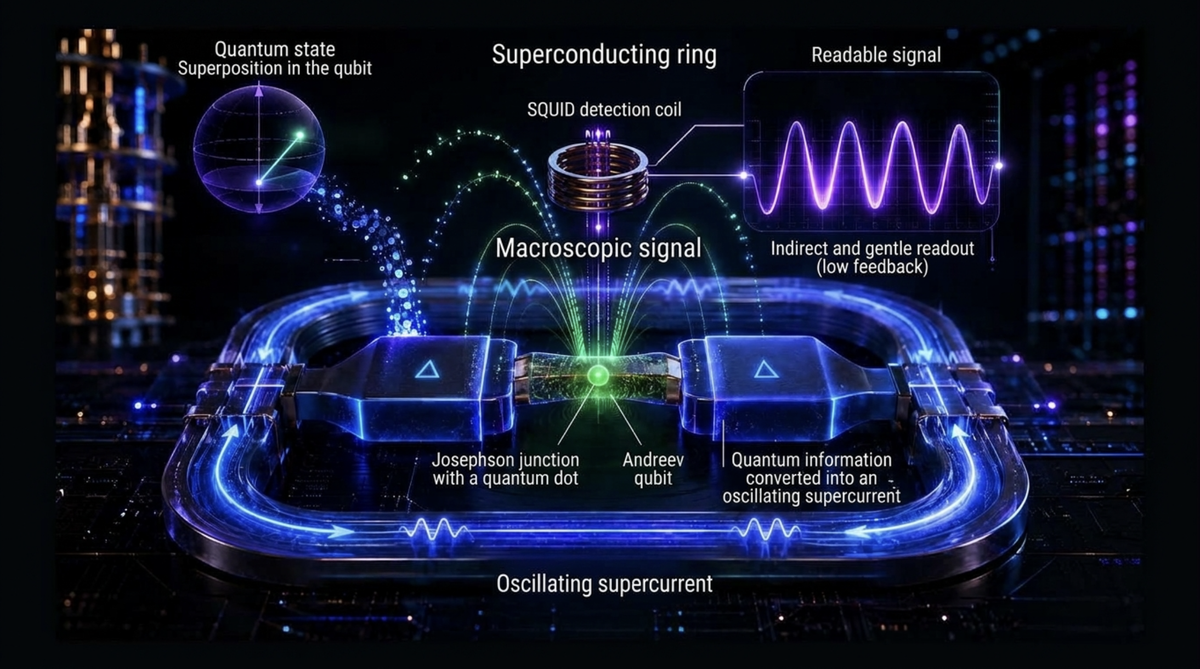
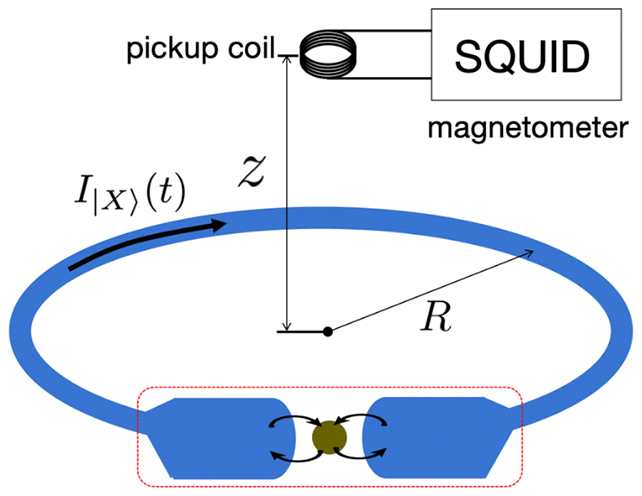
Based on the researchers' calculations, Andreev qubits in superposition produce oscillating electrical currents without any external voltage needed – powered by the quantum behavior itself.
That could then reveal the quantum state of the qubit, via the magnetic field produced by the oscillations.
"In the system under consideration, this region is a quantum dot – that is, a nanoscale structure in which electrons are spatially confined – formed in an indium arsenide [InAs] nanowire connected to superconducting materials on both sides," says Egues.
"It's in this environment that the states characterizing the Andreev qubit are formed."
Andreev qubits have been extensively investigated before, but the idea of their electrical behavior producing a signal that can be read is new. It's the first time this kind of oscillating electrical signature has been suggested as a way to decode the qubits.
Essentially, the Andreev qubit produces a 'supercurrent', the researchers determined. As the qubit moves between states, its electrical current shifts, which can be measured in terms of the properties of the resulting oscillation.
A separate device tasked with detecting the variations is deployed to make the system work, to create a setup where one 'compass' points the way and the other 'compass' interprets those directions.
"Thus, by measuring how the current varies over time, it's possible to reconstruct the initial state of the qubit," says Egues.
After each measurement is carried out, the researchers suggest, there's no need to initiate the reset the qubit typically requires.
The obvious next step is to attempt to build the device the researchers have theorized about here, and put it to the test. Eventually, the process of reading qubits could be simpler and more reliable, unlocking the full potential of quantum computing.
"Our method doesn't eliminate the fundamental problem of quantum measurement," says Egues.
"But it can approach the limit of a non-destructive readout and, at the same time, avoid the use of auxiliary qubits – the ancillas – employed in other non-destructive quantum measurement protocols."
The research has been published in Physical Review B.
This article was fact-checked by Rebecca Dyer and edited by Rebecca Dyer. While we pride ourselves on our process, we are only human. If you spot a mistake, please let us know.