
The Heisenberg uncertainty principle, introduced by German physicist Werner Heisenberg in 1927, puts forward the concept of a certain fuzziness in physics. It says that if one characteristic of a quantum particle can be predicted with precision, a paired characteristic becomes less certain.
Position and momentum are the most often-mentioned of these pairs, known as non-commuting variables. Being able to ascertain where a quantum particle is makes it harder to judge its movement, and vice versa.
That fuzziness makes it more difficult to take accurate measurements of weaker signals in physics – in everything from the LIGO gravitational wave detector to the atomic clocks that underpin systems like GPS.
Now researchers led by a team from Shanxi University in China think they've found a fundamental workaround, and it involves looking backward into the past, as well as ahead into the future.
"We experimentally demonstrate simultaneous estimation of non-commuting variables beyond the Heisenberg uncertainty bound and verify the results using weak measurement," write the researchers in a preprint version of their paper, which has yet to be peer-reviewed.
Rather than making a prediction of the future to take a measurement, the researchers wanted to test an alternative approach: taking a measurement using data from both before and after the point to be measured.
The hypothesis was that the two-way perspective should remove some of the fuzziness in observations. It was put to the test using 52 billion rubidium atoms collected in a small glass chamber, with a laser used to line up their spins (magnetic properties).
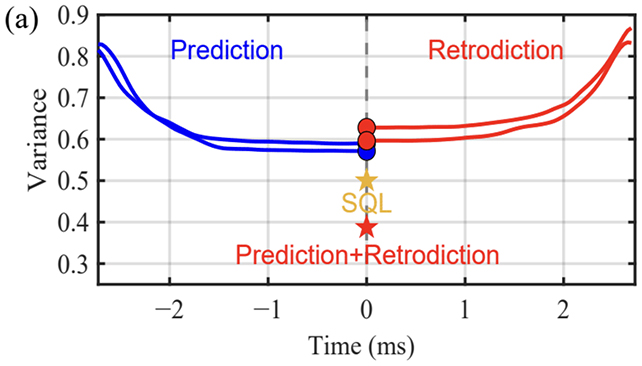
As the spin alignment caused the atoms to behave as one quantum system, the momentum and position of which could then be measured by a second laser.
Using readings from both before and after improved the accuracy of the system's predictions, by a modest amount – they were around 20 percent more precise than the Heisenberg uncertainty limit allows.
"The central ingredient of this approach is the consistent incorporation of both past and future measurement information to refine the inference of the system state at a given time," write the researchers.
Measurements were taken continuously for 84 minutes, and the setup enabled the researchers to measure both position and momentum simultaneously. The usual trade-off between the two was eased.
Of course, waiting until after something has happened to measure it means you're limited in terms of real-time monitoring, but the strengths of the new technique and the greater accuracy may outweigh whatever disadvantages there are.

"This brings interesting prospects for further research on quantum measurements, and for quantum-enhanced sensing that combines trajectory and entanglement strategies," write the researchers.
In a lot of quantum systems – including the atomic clocks mentioned earlier – retrospective readings are the norm anyway, so scientists wouldn't necessarily slow down the analysis using the new approach.
It means we could be looking at more accurate quantum sensors coming online in the future, and may be getting greater insight into future quantum research findings, now that we know how the before-and-after status of a system can work in tandem.
The researchers are still keen to improve the experimental setup further, with more precise instrumentation and more accurate readings. Adding in the concept of quantum entanglement could be one way forward.
Importantly, Heisenberg's limit on the uncertainty of a quantum system still applies (which is good news – it underpins a lot of fundamental physics theory). What this study shows is that the principle can be circumvented to some extent, by working out probabilities in a different way.
"Over the past century, this seminal theoretical framework has not only served as a critical component in the interpretation of quantum mechanics but has also revolutionized our conceptual understanding of measurement limitations at the quantum scale," write the researchers.
The research is not yet peer-reviewed, but a preprint is available online at arXiv.
This article was fact-checked by Rebecca Dyer and edited by Rebecca Dyer. While we pride ourselves on our process, we are only human. If you spot a mistake, please let us know.