Even though Mars is millions of kilometers across the Solar System, scientists have a pretty good handle on its geology.
We know, broadly, what types of minerals can be found there, and the geological processes that shape it.
But then sometimes all we have to do is scratch the surface, and a whole new mystery comes tumbling out, glinting dully under the Martian Sun.
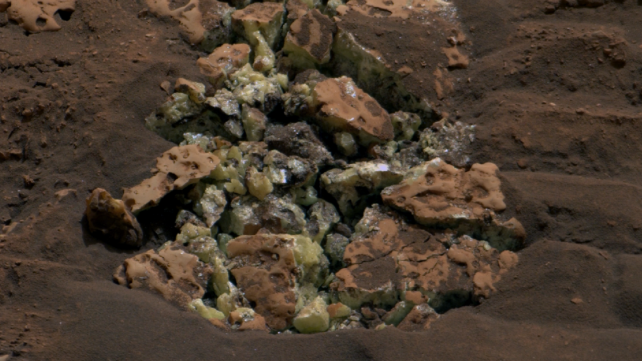
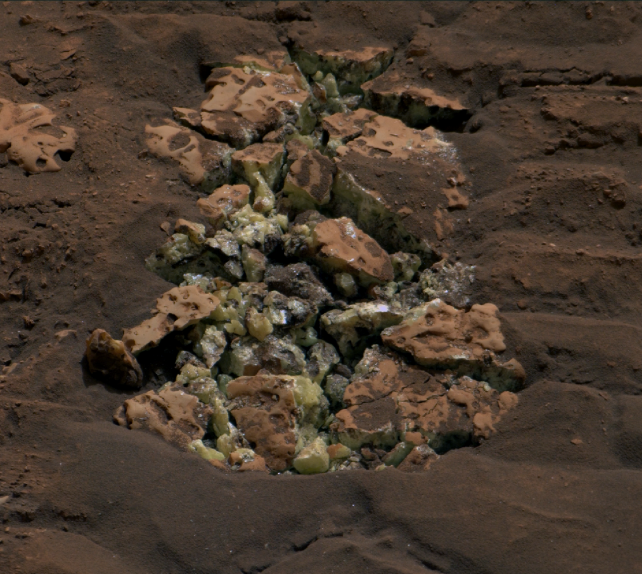
Like the time in 2024 when NASA's Curiosity rover rolled its 899-kilogram (1,982-pound) body over a completely unremarkable rock in the Gale Crater's Gediz Vallis Channel.
When the rock burst open under the strain, the pale yellow shine of its contents stumped NASA scientists – it appeared to be crystals of startlingly pure elemental sulfur – brimstone.
Although sulfates are fairly common on Mars, this marked the first time sulfur had been found on the red planet in its pure elemental form – and the surrounding ground was littered with more of the same kind of rock.
"Finding a field of stones made of pure sulfur is like finding an oasis in the desert," Curiosity project scientist Ashwin Vasavada of NASA's Jet Propulsion Laboratory said at the time.

Sulfates are salts containing sulfur and oxygen, often dissolved in water alongside other minerals. When the water evaporates, sulfate minerals can crystallize out, leaving deposits behind.
These sulfate minerals can tell us a lot about Mars, such as its water history and how it has weathered over time.
Pure sulfur is a different matter altogether. On Earth, large deposits are often associated with volcanic or hydrothermal activity, but there was no evidence of the high-temperature conditions that could have produced such a deposit directly in Gediz Vallis.
There are, to be fair, a lot of things we don't know about the geological history of Mars. But finding scads of pure sulfur just hanging about on the Martian surface suggested that something important was missing from our understanding.
Now, two new studies have begun to piece together how this strange deposit might have formed – and what it could tell us about the ancient Martian environment.
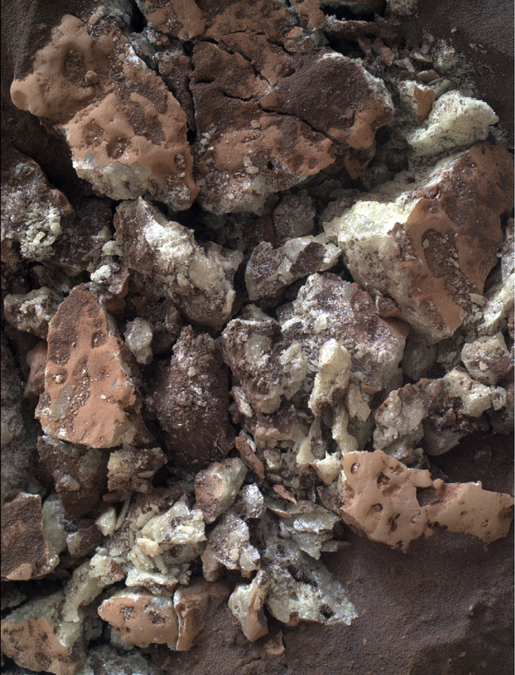
In a paper published in Science in June 2026, a team led by planetary scientist Scott VanBommel of Washington University in St. Louis took a closer look at Curiosity's observations of the sulfur-rich rocks, revealing that the discovery was even more unusual than it first appeared.
He and his colleagues studied the images the rover had taken of the region, along with its chemical analyses of the sulfur it unmarsed.
The results confirmed that the initial impression of the amount of sulfur was correct. It lay scattered across an area measuring some 2,100 square meters. One pure sulfur rock was weird enough, but this was positively preposterous.
And it was remarkably pure – a stark contrast to the sulfate minerals usually found on Mars.
There was one more key piece of information. Curiosity weighs much less on Mars, thanks to the red planet's lower gravity – about as much as a 341-kilogram object weighs on Earth. The way the rock popped open when Curiosity bore down with just some of this weight suggests that it was relatively fragile.
VanBommel and his colleagues believe that the most plausible way so many fragile rocks could come to be scattered intact in Gediz Vallis is if they formed there.
One possibility, the researchers suggest, is that the sulfur originated in gases released by ancient volcanic activity. As those gases cooled, they became trapped beneath the Martian surface, possibly within cage-like structures of ice called clathrates.
Over time, erosion carved out Gediz Vallis, releasing pressure on the buried gases and allowing them to escape. Chemical reactions between the sulfur-bearing gases could then have produced deposits of pure sulfur, without the need for high temperatures at the site.
Based on the geological context, the researchers estimate that the sulfur deposit formed between 3.1 and 2.8 billion years ago.
"It's hard to wrap your head around how long those rocks had been sitting there with little to no chemical alteration happening to them," geochemist Jeff Berger of NASA's Johnson Space Center, who co-led the study, said.
But this is not the only way elemental sulfur could have formed on Mars.
In a separate study published in Geophysical Research Letters in July 2026, atmospheric scientist Jiawei Wang of Cornell University led a team that investigated whether a chemical reaction in water could produce pure sulfur without high temperatures or the involvement of living organisms.
The researchers mixed dissolved sulfide with chlorate, a compound containing chlorine and oxygen that may have been present on ancient Mars, in acidic water at room temperature.
And sure enough, the reaction produced tiny yellow crystals of elemental sulfur.
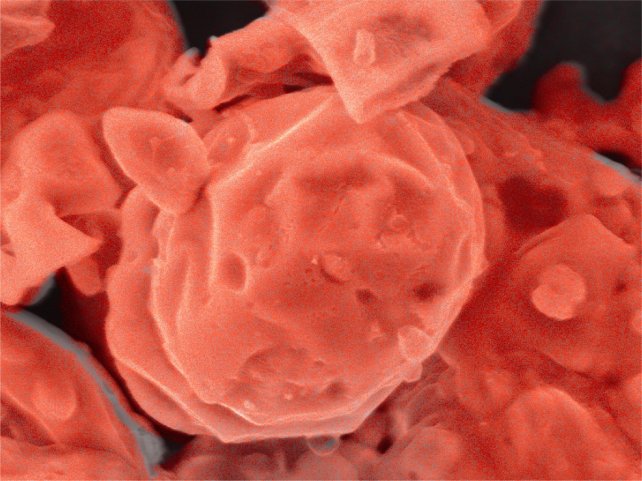
Crucially, the amount of chlorate made a significant difference – lower concentrations favored the formation of pure sulfur, while higher concentrations produced more sulfate.
The crystals were microscopic, rather than the chunks Curiosity encountered, but the researchers suggest that similar reactions occurring over much longer periods could produce larger deposits.
And Wang's team noted that the hydrogen sulfide needed for the reaction could have come from the same underground gas reservoirs proposed by VanBommel's team.
But why so much fuss about yellow rocks on a red world?
Sulfur, it's important to understand, is an essential element for all life. Many organisms take it up in the form of sulfates, using it to make two of the amino acids essential for building proteins.
Since we've known about sulfates on Mars for some time, the discovery doesn't tell us anything new in that area. And although microbes can produce elemental sulfur here on Earth, Wang's experiments show that living organisms aren't necessary to explain how it might have formed on Mars.
We're yet to find any conclusive signs of life on Mars, anyway. But we do keep stumbling across bits and pieces that living organisms would find useful, including chemistry, water, and past habitable conditions.
It's interesting that the stuff life needs keeps turning up on a planet that – so far at least – seems utterly devoid of it.
Because once upon a time, Earth, too, was devoid of life. The two planets have taken different paths, but what we find on Mars could contain tantalizing clues to how our own world evolved, long, long ago.
"Mars provides us with a frozen snapshot from billions of years ago," Berger said. "We can go back and look at deep time in a way that we can't do on Earth."
The two papers were published in Science and Geophysical Research Letters.
This article was fact-checked by Rebecca Dyer and edited by Rebecca Dyer. While we pride ourselves on our process, we are only human. If you spot a mistake, please let us know.