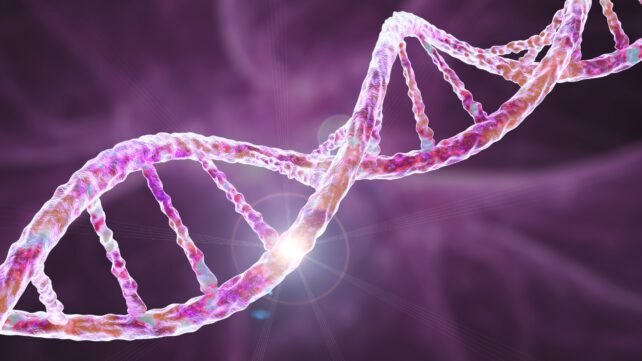
It's one of the most basic premises in the evolutionary theory of natural selection: Gene sequences within DNA sometimes spontaneously – and randomly – mutate.
In theory, the odds of this occurring shouldn't depend on how important a section of the DNA helix is to the organism.
Occasionally, scientists have put forward an alternative: that more 'important' genes might be somehow protected from the chaotic forces of mutation.
But University of Bath biologists Laurence Hurst and Sofia Radrizzani have just published evidence in PLOS Biology that suggests there's no need to rewrite our understanding of evolution just yet.
"The claim that mutation is slower for important genes is a triumph of hype over substance," says Radrizzani.
"It's a really old suggestion and is reinvented in various forms routinely."

In 1972, biologist Edward Cox proposed that some gene sequences are more protected from the chaotic forces of mutation depending on how essential they are to the organism.
"By assuming that spontaneous mutation rates vary sequence by sequence, one can arrive at a plausible organizing principle for the structure of higher chromosomes," he wrote.
Cox's theory is by no means mainstream, but it has resurfaced a few times since.
Five decades later, in 2022, a team led by J. Grey Monroe of the Max Planck Institute for Biology Tübingen in Germany published evidence that mutations were less frequent in 'important' parts of the genetic code of the thale cress, Arabidopsis thaliana.
But in 2023, another team of scientists, from Nanjing University in China and the University of Bath in the UK, tore their methods to shreds. One of those scientists was Hurst.
Re-analyzing the data, Hurst and his colleagues were unable to produce the same results, citing errors in the way Monroe's team had sequenced the DNA.
Some of their points even led Monroe et al. to correct one part of their paper – but they didn't budge on their core findings.
"Although we overlooked some sources of errors, these are insufficient to invalidate our conclusions," Monroe and team wrote in a reply.
Now, Hurst and his colleague Radrizzani have done their own experiments, using a large collection of existing spontaneous mutation data from the E. coli bacterium (Escherichia coli) and the baker's yeast fungus, Saccharomyces cerevisiae.
Both microbes were bred for many generations while being exposed to as few pressures as possible, allowing mutations to accumulate.
Altogether, they mapped the genome location of about 3,600 mutations in E. coli and 4,600 in yeast, and ranked how essential the genes were to the microbe's survival (e.g., how much the microbe uses the gene, and whether it can survive without it).
They claim it is the "largest and cleanest" sample of mutations so far.
"Analyze the data any which way and we found nothing. In neither species did these key genes have a lower mutation rate," Hurst says.
There was no difference in the mutation rate for genes that produce abundant proteins, or ones that have been challenged by natural selection over evolutionary time, or ones that are essential to cell survival.
The only factors that seemed to increase a gene's chance of mutation were structural. For instance, when a cell replicates its DNA, it copies some genes later than others. In yeast, genes copied later in the process, it turns out, do tend to mutate more frequently.
"While we see known causes of variation in mutation rates, we found no evidence for the effects that have been proposed as a challenge to the conventional model," Hurst says.
"There are certainly no grounds for a shift in paradigm."
He thinks the confusion may come down to a sampling bias: Organisms with mutations in their important genes may not live to tell the tale.
"We'd expect natural selection to rapidly remove mutations when they occur in more important genes, because these mutations are more likely to be harmful to the organism," says Hurst.
"This can create the illusion that important genes have fewer mutations when, in reality, some mutations have simply disappeared before we have a chance to analyze them – what you can think of as 'ghost mutations'."
The research has been published in PLOS Biology.
This article was fact-checked by Rebecca Dyer and edited by Rebecca Dyer. While we pride ourselves on our process, we are only human. If you spot a mistake, please let us know.