
It's hard to imagine a system of physics simpler than a billiard table.
Send a ball across the table, and its path follows a simple rule: It travels in a straight line until it hits a wall, then bounces away at the same angle it came in.
Yet even a system this simple can, at least in theory, reproduce any computation that can be performed by a much more sophisticated computer.
According to mathematicians Eva Miranda of the Polytechnic University of Catalonia in Spain and Isaac Ramos of ETH Zürich in Switzerland, a single ball bouncing around a specially shaped two-dimensional billiard can simulate a universal Turing machine – one capable of simulating any other Turing machine.
For Miranda, it's the culmination of years of work to distill a mechanical system down to the minimum number of parts it needs to function as a computer.
"What is the minimal geometric mechanism that allows a physical system to do universal computation, and how can we detect it?" she says.
"The billiard is the most demanding test of that process of simplification. A single particle. The whole program is inscribed in the geometry of the boundary."
A Turing machine isn't really a machine in the conventional sense. It's a mathematical model of computation devised by British mathematician Alan Turing in 1936.
In its simplest form, it consists of an imaginary strip of tape divided into cells, a head that can read and write symbols on that tape, and a set of instructions telling it what to do next.
Each individual operation is extremely simple: read a symbol, write a symbol, move along the tape, repeat.
A universal Turing machine takes this a step further: It can simulate any other Turing machine, meaning it can, in principle, perform any computation that can be expressed as an algorithm.
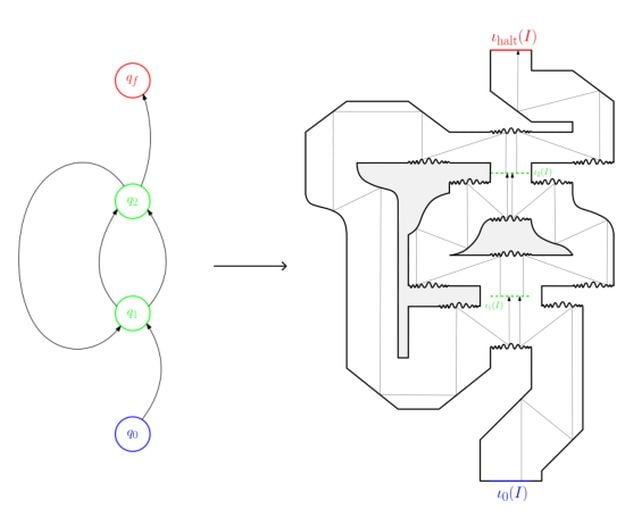
Miranda and Ramos found a way to reproduce the function of the Turing machine using nothing more than geometry and a bouncing ball.
In their mathematical 'billiard' – the word they use to describe their system – the ball's position can encode information, while the carefully designed shape of the walls determines what happens to that information next.
As the ball travels from one part of the billiard to another, its trajectory advances the computation, just as a Turing machine works through its instructions one step at a time.
Billiards have been linked to computation before, but previous models needed additional complexity, such as multiple interacting balls, three-dimensional structures, or moving walls.
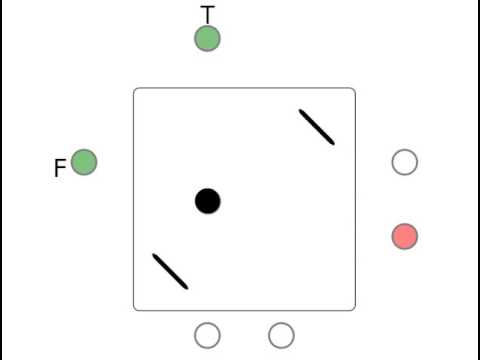
Miranda and Ramos stripped all of that away. Their system needs just one particle moving in two dimensions between fixed walls.
"A billiard table that computes doesn't look like a computer. It looks like a badly drawn labyrinth, full of corners and arcs that seem like whims," Miranda says.
"The program is the shape of the walls. The algorithm is, literally, the trajectory."
But while it's possible to turn a billiard table into a universal computer, it's not just the useful bits that get transferred across. The billiard also inherits the limitations.
One of those is a conundrum known as the halting problem.
Imagine a computer is asked to determine whether a program will eventually finish running, or simply run forever. On a case-by-case basis, this is absolutely achievable – like your operating system updates installing, or a file conversion finishing.
But Turing proved that no single algorithm can reliably answer that question for every possible program and input. Previous work showed that this fundamental limit could be reproduced in physical systems involving multiple balls.
Miranda and Ramos's billiard shows that it can be reproduced in the motion of a single ball.
To demonstrate this, the researchers designed their billiard so that a computation reaching its halting state corresponds to the ball hitting a wall at a 90-degree angle, sending it back along the path it came.

If the computation never halts, the ball's trajectory never repeats. But if an algorithm could determine whether it would eventually repeat, it would be capable of solving the halting problem – which, as Turing demonstrated, is impossible.
"Chaos imposes a barrier of precision; undecidability imposes a logical barrier," Miranda says.
"Even if we know the equations and the initial data exactly, there may be no algorithm that decides whether a trajectory will ever enter a given region.
"That doesn't mean every individual trajectory is mysterious. In many concrete cases we'll get an answer. What's impossible is a universal method that settles every case."
There are good reasons nobody will be replacing silicon with billiard balls. The construction is an idealized mathematical one, relying on information encoded at increasingly fine scales that couldn't be reproduced with unlimited precision in a physical table.
But billiards of this kind are not just mathematical curiosities.
These theoretical structures are useful to physicists because the simple motion of a particle bouncing between boundaries can stand in for more complicated physical systems, from colliding particles in a gas to systems governed by steep confining forces.
"We could say they're a kind of skeleton of classical mechanics," Miranda says.
Related: We Just Got 12,000 New Solutions to The Infamous Three-Body Problem
That skeleton can even emerge in celestial mechanics, particularly in mathematical descriptions of close encounters between gravitational bodies, including variants of the notoriously difficult three-body problem.
That doesn't mean Miranda and Ramos have shown that the three-body problem itself is undecidable.
Rather, their work raises the question of whether the same computational limits could emerge in more realistic gravitational systems – adding undecidability to chaos as another fundamental barrier to prediction.
"How many planets does it take for gravity to compute?" Miranda says. "How many does it take for undecidability to appear? Maybe three, maybe five, maybe many more. It's a completely open question."
The work has been published in the Proceedings of the National Academy of Sciences.
This article was fact-checked by Rebecca Dyer and edited by Rebecca Dyer. While we pride ourselves on our process, we are only human. If you spot a mistake, please let us know.