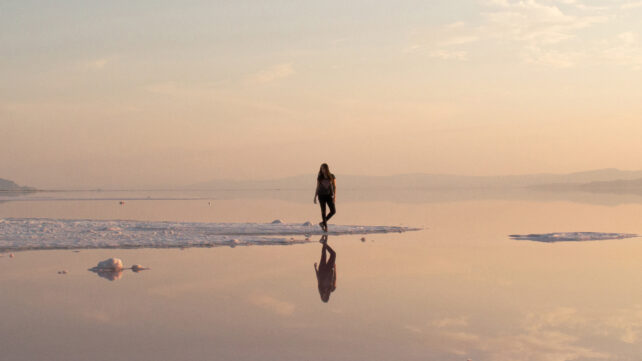
We can often understand more about the future by looking into the past – and in the case of a new study published in Paleoceanography and Paleoclimatology, almost 240,000 years into the history of the Great Salt Lake in Utah.
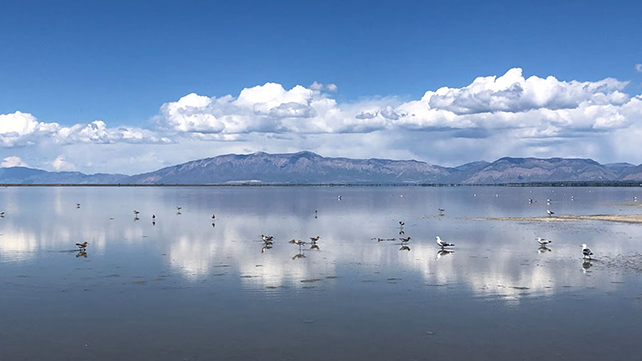
In some areas, the lake is up to 10 times saltier than seawater (it has been called 'America's Dead Sea') and it's the largest saltwater lake in the Western Hemisphere.
The Great Salt Lake currently covers an area of around 4,144 square kilometers (1,600 square miles), but as the new study shows, it has been much larger – and much less salty – in the past.
Researchers from the US analyzed a 120-meter (394-foot) sediment core taken from the lake bed, dating its layers by the radioactive decay of the minerals it carried.
They also measured tiny chemical signals left by microbes to estimate salinity: as the concentration of salt in the water changes, so do the abundance and type of organisms living in it.
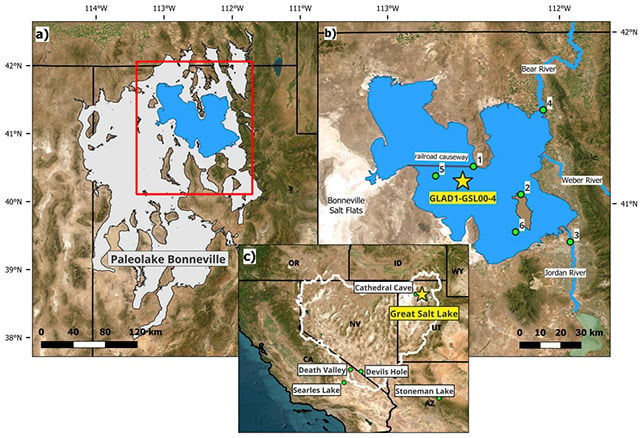
Two periods were identified when the water was much fresher, matching times when it covered a much wider area. Past research has identified these bigger bodies of water as Lake Bonneville (from about 30,000 to 16,000 years ago) and Little Valley (from about 140,000 to 135,000 years ago).
The researchers say the size difference as the lake swelled and shrank is comparable to the difference between a puddle and a pond.
"If you scaled this up to the size of the present Great Salt Lake, that's probably what it looked like," says Earth scientist Rachel So, from the University of Southern California (USC).
"For most of the past 240,000 years, the lake stayed about the same size but briefly grew 10 times larger on two separate occasions."
Flat, step-like ledges cut into the mountains around the Great Salt Lake show where Lake Bonneville and Little Valley used to be, and suggest they were both around 300 meters deep.

This study adds a corresponding measure of saltiness. It seems the earlier Little Valley may have stayed somewhat brackish (still slightly salty), according to the sediment record, while Lake Bonneville was a genuine freshwater lake.
The researchers also call attention to the speed at which salinity rose again as the lake shrank. We're still talking about thousands of years, but it's abrupt in geological terms.
"The fact that the core spans two and a half glacial cycles allows us to see two fresh-to-salty transitions," says Earth scientist Sarah Feakins, from USC.
"It allows us to compare the two fresh lake events for their duration and freshness, to see how fragile and fleeting these moments are."
The researchers suggest extra incoming river water may help explain why Lake Bonneville lasted longer and stayed fresher than Little Valley.
They also draw parallels between the warming conditions that shrank these lakes at the end of different ice ages, and the climate change we're currently experiencing.
"Today we're warming the climate at an unprecedented rate," says Feakins. "That warming makes the atmosphere thirstier, increasing the rate of evaporative drying from the soil and lakes across the region."
Historical lake records across Nevada, California, and Arizona follow a similar wet-to-dry pattern, evidence that the changing conditions of the time were affecting a wide region – and further verifying the Great Salt Lake findings.
Water leaves this huge lake mainly through evaporation, making it particularly vulnerable to changes in temperature and precipitation. We also know that the last 240,000 years have seen another significant shift that needs to be considered: the demands that humankind is putting on the planet.
"People shouldn't use the defense that 'climate change happened naturally in the past and so the lake shrank' to justify shrinking lakes today as normal or a natural phenomenon," says So.
The research has been published in Paleoceanography and Paleoclimatology.
This article was fact-checked by Rebecca Dyer and edited by Rebecca Dyer. While we pride ourselves on our process, we are only human. If you spot a mistake, please let us know.