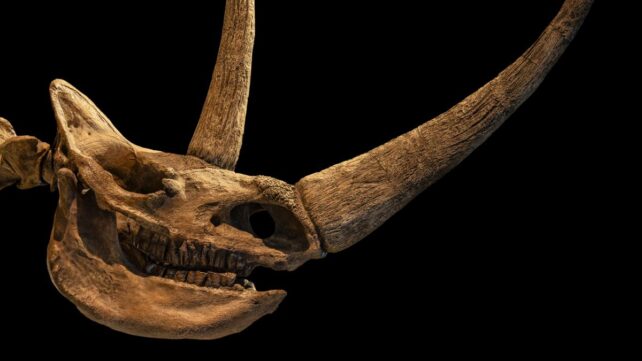
The last meal eaten by a wolf cub before its demise, some 14,400 years ago, has yielded new insight into how the woolly rhinoceros disappeared from this world.
A previous analysis of the stomach contents of a cub found in the Siberian permafrost in 2011 revealed a belly full of woolly rhino (Coelodonta antiquitatis) meat close to the time of the rhino's extinction. Now, geneticists have sequenced the rhino's genome – and found no evidence of long-term population decline or inbreeding.
The results suggest that the extinction of the woolly rhino was abrupt and rapid, rather than the slow descent of a crumbling population already weakened at the genetic level.
Related: Something Weird Happened to Men 7,000 Years Ago, And We Finally Know Why
"Recovering genomes from individuals that lived right before extinction is challenging, but it can provide important clues on what caused the species to disappear, which may also be relevant for the conservation of endangered species today," says evolutionary biologist Camilo Chacón-Duque, formerly of the Centre for Palaeogenetics in Sweden, now at Uppsala University.
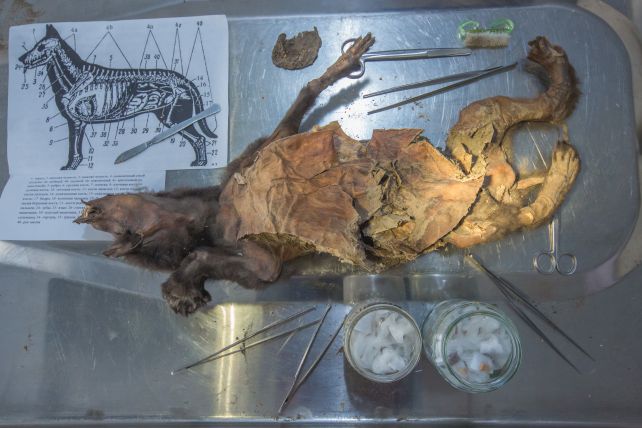
This is the first time scientists have sequenced the entire genome of an Ice Age animal found in the stomach of another animal.
DNA from ancient animal remains is often far too degraded to be useful for sequencing. However, remains from permafrost can sometimes avoid the worst of this decay. And thanks to advanced extraction and sequencing technologies, enough DNA can nowadays be recovered for sequencing and analysis, even with some damage.
Recently, scientists have even demonstrated that predators' meals can be a surprisingly rich source of genetic material, with woolly rhino DNA recovered from fossilized hyena poop more than 30,000 years old.
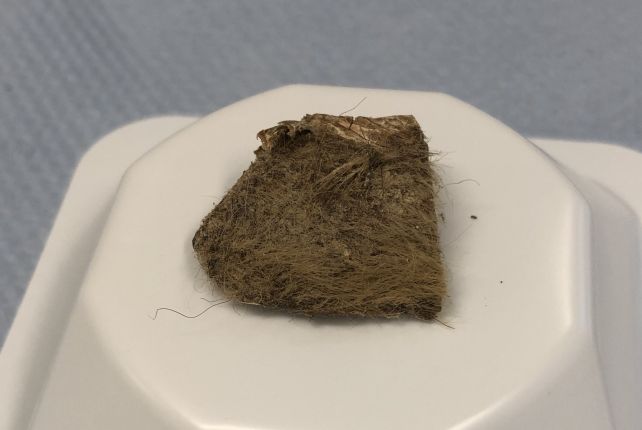
The wolf cub at the center of this study was found near Tumat, Siberia. It died soon enough after its last meal that the rhino flesh wasn't fully digested, and the DNA in those morsels remained relatively intact.
Crucially, the cub also lived around the time the woolly rhino went extinct, giving researchers a rare genetic snapshot from the species' final centuries. If there was a genetic component contributing to the rhino's demise, this particular specimen was likely to contain evidence of it.
If a species declines over a long period of time, the number of available mates also drops, leading to reduced genetic diversity. This shows up in the genes of offspring born from repeated and increased inbreeding – a clear signature of a slow genetic collapse before extinction.
So, the team, led by Sólveig M. Guðjónsdóttir and Edana Lord of the Centre for Palaeogenetics, undertook the painstaking work of reconstructing the genome of the woolly rhino from tissue preserved in the belly of the Tumat wolf cub.
"It was really exciting, but also very challenging, to extract a complete genome from such an unusual sample," Guðjónsdóttir says.
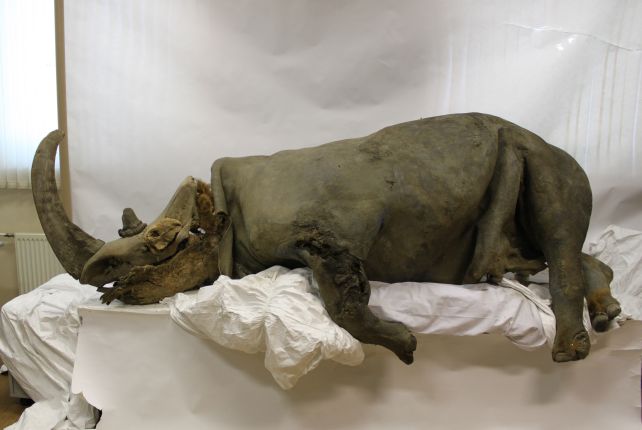
Then, the researchers compared the genome to two other woolly rhino genomes – one from around 18,500 years ago and the other from around 48,500 years ago. If there were any genetic degradation consistent with a species decline or an increase in harmful genetic mutations, the temporal spacing of these samples would have shown it.
The researchers found no indications that the woolly rhino population was destabilizing prior to extinction.
"Our analyses showed a surprisingly stable genetic pattern with no change in inbreeding levels through tens of thousands of years prior to the extinction of woolly rhinos," Lord says.
Prior work on the 18,500-year-old woolly rhino genome also found no signs of the degradation indicative of population decline. That was solid evidence from a single individual, but the DNA from the Tumat cub thousands of years later is a strong confirmation.

Together, the results show that the woolly rhino remained genetically healthy until near its extinction, ruling out a long, drawn-out population collapse.
That suggests that the woolly rhino was suddenly wiped out by something else. Given that the animal had lived alongside humans for thousands of years prior to extinction, and that the world was undergoing some dramatic climate upheavals 14,000 years ago, the likely cause of their demise was an inability to adapt to changing conditions, the researchers say.
"Our results show that the woolly rhinos had a viable population for 15,000 years after the first humans arrived in northeastern Siberia," says geneticist Love Dalén of the Centre for Palaeogenetics, "which suggests that climate warming rather than human hunting caused the extinction."
The research has been published in Genome Biology and Evolution.