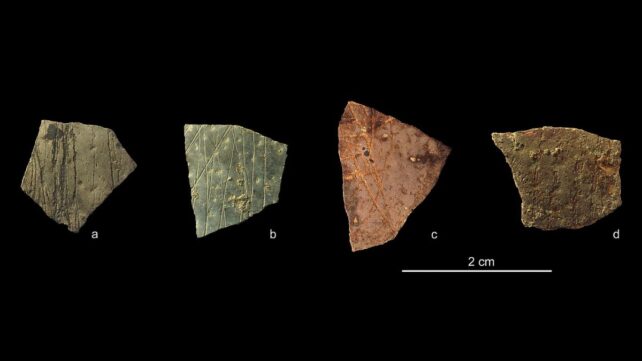
Ancient humans were surprisingly creative, structured, and geometrical in their thinking some 60,000 years ago, according to some intricately engraved ostrich eggshells found across southern Africa.
The surviving fragments from these decorated shells, first described in 2010, are not randomly scribbled, like the edges of a daydreamer's notebook, but etched with mindfully geometric features, such as grids and diamonds.
These designs, analyzed in a new study from researchers in Italy, provide a bridge between eons and a glimpse into the minds of our predecessors.
"These signs reveal a surprisingly structured, geometric way of thinking," says Silvia Ferrara, an archaeologist at the University of Bologna and senior author of the study.
"We are talking about people who did not simply draw lines, but organised them according to recurring principles – parallelisms, grids, rotations and systematic repetitions: a visual grammar in embryo."
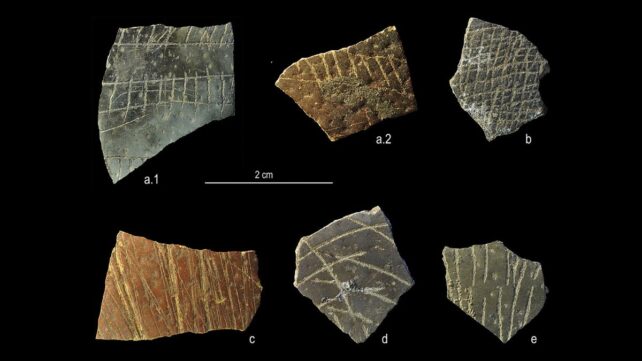
To decipher the 'geometric grammar' used by the shells' decorators, the researchers analyzed the spatial arrangement of marki(TExier et al. ngs on 112 engraved ostrich eggshell fragments. Discovered at two shelter sites in South Africa and a cave site in southern Namibia, these intact shells may have been used in their heyday as water containers, as they still are by some foragers in the region.
But were their designs intentionally complex? The researchers examined nearly 1,300 lines etched on the shell fragments and concluded that their makers demonstrated a striking level of cognitive organization.
More than 80 percent of the etchings display coherent spatial regularities, with designs rich in parallelism, right angles, and the repetition of lines and patterns. The more complex creations feature hatched bands, grids, and diamond motifs.

These designs provide evidence that early humans had not only a steady hand but also a creative mind capable of cognitive operations such as rotation, translation, and embedding, which transform simple lines into diverse creations and hierarchical designs.
What's more, this is tangible evidence of the cognitive foundation necessary for the emergence of abstract thought. The ability to conceptualize things outside of one's personal experience, including things that can't be seen or may not even exist, is a defining human trait and the source of all our good (and bad) fiction.
The study builds on previous findings suggesting that humans possess an intuitive sense of geometric features, such as line, point, parallelism, and right angles, and that these 'geometric intuitions' are part of humanity's core knowledge.
"These engravings are organised and consistent, and show mastery of geometric relationships," says Ferrara.
"There is not only a process of repeating signs: there is real visuo-spatial planning, as if the authors already had an overall image of the figure in mind before engraving it."
Related: 10,000-Year-Old Symbols And Art Found in Egyptian Rock Formation
Of course, it's unclear if these designs hold some deeper esoteric meaning – and that's beyond the scope of the work. But they highlight a crucial progression in the evolution of human thinking, one that laid the foundation for a future full of art and invention.
"Our analysis shows that Homo sapiens 60,000 years ago already possessed a remarkable ability to organise visual space according to abstract principles," says Valentina Decembrini, a PhD student at the University of Bologna and the study's first author.
"Transforming simple forms into complex systems by following defined rules is a deeply human trait that has characterised our history over millennia, from the creation of decorations to the development of symbolic systems and, ultimately, writing."
This research was published in PLOS One.