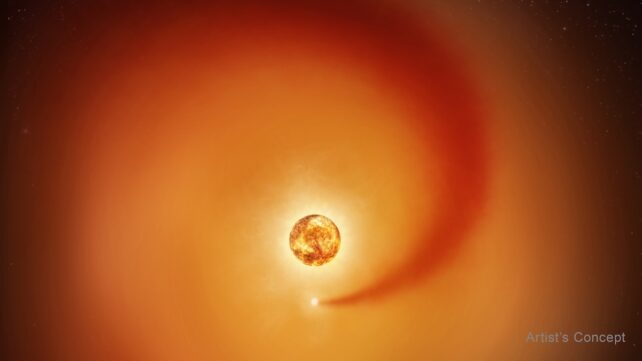
Betelgeuse is one of the weirdest stars in the sky, but astronomers can now explain one of its most enduring mysteries. A small companion star has been confirmed, revealed by the wake it leaves as it plows through the red giant's atmosphere.
Ignoring interference from the occasional dusty sneeze, Betelgeuse's light seems to vary according to two distinct cycles. One lasts about 400 days and has been linked to internal pulsations. The second, however, lasts around 2,100 days, and has been much harder to account for.
The leading hypothesis suggests a small, dim companion star on a tight orbit around the red giant, with observations culminating in a likely detection last July. Now, Betelgeuse's buddy has finally been confirmed, several months after its proposed name, Siwarha, was accepted.
Related: Betelgeuse's Mysterious Dimming May Have a Simple Explanation
Almost eight years of observations using the Hubble Space Telescope, the Fred Lawrence Whipple Observatory in Arizona, and Roque de Los Muchachos Observatory in the Canary Islands, Spain, provided sufficient evidence of a second star's 'wake' in the guise of a high-density trail of gas in Betelgeuse's bloated atmosphere.
"It's a bit like a boat moving through water. The companion star creates a ripple effect in Betelgeuse's atmosphere that we can actually see in the data," says Andrea Dupree, an astronomer at the Harvard & Smithsonian Center for Astrophysics (CfA).
"For the first time, we're seeing direct signs of this wake, or trail of gas, confirming that Betelgeuse really does have a hidden companion shaping its appearance and behavior."
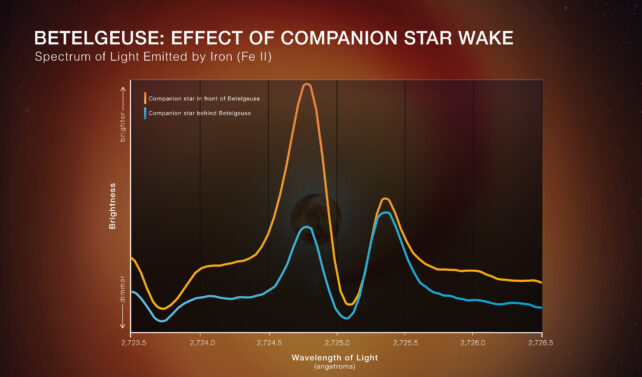
Siwarha isn't dimming Betelgeuse's light – instead, it's altering the red supergiant's spectrum, specifically UV wavelengths emitted by ionized iron. When the companion is in front of Betelgeuse, there's a strong peak in the light emitted by iron.
But after Siwarha 'eclipses' the star, its trailing tail of gas starts to absorb those wavelengths, leading to a shorter peak. The effect slowly fades until Siwarha makes another lap – some 2,109 days, or about 5.77 years, later.

"With this new direct evidence, Betelgeuse gives us a front-row seat to watch how a giant star changes over time," says Dupree.
"Finding the wake from its companion means we can now understand how stars like this evolve, shed material, and eventually explode as supernovae."
Siwarha has now ducked back behind Betelgeuse and won't show its face again until August 2027.
The study has been accepted for publication in The Astrophysical Journal, and is currently available on the preprint server arXiv.