
Prototype quantum computers already exist, but if we're to truly realize their full potential, they need to be significantly scaled up and stabilized – and a team of researchers from IBM just announced an important step toward this goal.
The upgrade concerns the long-distance couplers (L-couplers) that connect qubits together. Qubits sit at the heart of quantum computers, and unlike the conventional bits that underpin classical computing, they're not restricted to a binary state of 1 or 0.
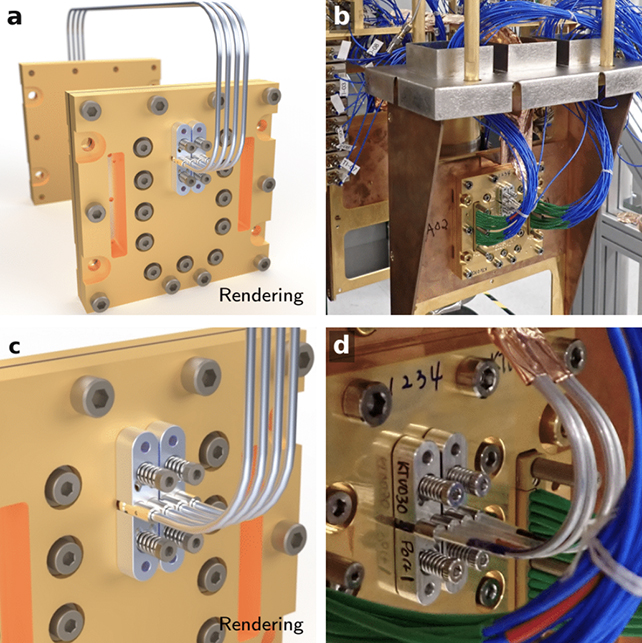
Scaling up quantum computers by linking multiple chips with L-couplers makes more practical sense than trying to pack ever more qubits together on the same microchip.
But the connectors need to be capable of carrying fragile quantum information over very long distances in quantum terms – 80 centimeters (31.5 inches) long in this case.
Here, the researchers linked two 120-qubit chips together with four L-couplers made of superconducting aluminum, achieving an average transfer accuracy of 99 percent, and peaking at 99.29 percent.
It's an important test for this kind of multi-channel setup, with large quantum chips currently able to transfer data through several routes.
"In the coming years quantum computers will scale up markedly in both processor complexity and module count," write the researchers in their paper.
"Such machines will need many nominally identical connections between modules. We demonstrate a practical route to realizing multiple L-couplers between large-qubit processors after the modules are mounted in a cryostat."
If classical bits can be like the heads or tails of a coin (1 or 0), then qubits can be heads, tails, or still spinning between the two until they're measured, which brings an exponential increase in computing power.
What the L-couplers are transmitting here are the quantum states of the qubits, or their spinning properties.
The team also observed that their cables lost very little energy in use, stayed operational through three cycles of warming up and cooling down, and could also transmit entanglement between the two chips.
"To our knowledge this is the first demonstration of a multi-channel quantum interconnect between large-qubit superconducting processors, and it establishes the combined L-coupler technology presented here as a viable building block for scaling modular systems," write the researchers.
IBM is going all in on the modular approach to quantum computing. The qubits and L-couplers demonstrated here are intended to be installed inside fridge-like cryogenic systems that the company unveiled back in August.
These units can keep qubits at the ultra-cold temperatures needed for quantum computing, and now we have a much better idea of how their internal electronic plumbing will work in practice.

The ultimate aim is to link hundreds of quantum chips together in these cryogenic units – cooled down to temperatures 180 times colder than deep space – and from there to deliver the world's first fault-tolerant quantum computer by 2029.
"The successful connection and operation of these cryogenic modules signals a leap forward in that direction and will accelerate our progress alongside continued innovation in quantum hardware, software, and algorithms," says Jay Gambetta, director of IBM Research, who wasn't directly involved in the study.
It's a step in the right direction for these quantum computing systems, though there's still lots of work to do. The researchers noticed magnetic interference that affected signal quality; for example, and further efficiency improvements will be required before these L-couplers are actually ready to be used.
There are a dizzying number of factors to consider when it comes to developing quantum computing, from information transfer and error correction, to calculation speed and hardware practicalities, but every step like this one moves us closer to next-generation computing performance.
"These four high-fidelity L-couplers establish a practical path to scalable quantum interconnects for modular quantum computing," write the researchers.
The research has yet to be peer-reviewed, but a preprint is available on arXiv.
This article was fact-checked by Rebecca Dyer and edited by Rebecca Dyer. While we pride ourselves on our process, we are only human. If you spot a mistake, please let us know.