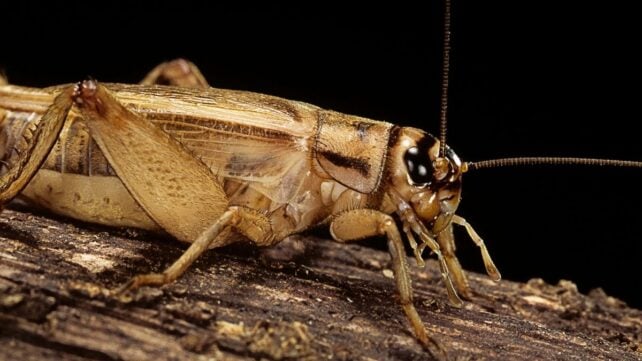
Evidence is mounting that insects may indeed feel pain, and a new study has just added to the pile.
A team from the University of Sydney in Australia has recorded proof that the seemingly simple house cricket – an insect we already know has the equipment necessary to feel pain – protects and grooms its antennae after being poked with a hot probe.
It's really difficult to assess pain experience: Even in humans, pain is so subjective that the most direct measure is asking the person to rate it, usually on a scale from 0 to 10.
And yet, the subjective experience of pain is an important part of what it takes for an animal (or entity) to be considered sentient; that is, being capable of having feelings and emotions, as opposed to just physiological reactions.
Of course, you can't just ask a cricket, "Does it hurt"? You have to find some way of interpreting the cricket's responses to potentially painful stimuli.
This is exactly what a team of animal behavior and cognition experts did back in 2022, by establishing a set of eight criteria for assessing whether an animal can be considered sentient, based on their subjective experience of pain.
They were applying it to crabs, lobsters, and other decapod crustaceans, but it's become a benchmark that can be used for many other animals, too.
If an animal meets any of these criteria, it counts as a mark towards them potentially experiencing pain beyond a simple withdrawal response, and therefore also potentially being considered sentient.
It even led the UK government to include decapod crustaceans (including crabs, lobsters, and prawns) and cephalopods (including octopuses and squid) in the Animal Welfare (Sentience) Act 2022.
The criteria are as follows:
- Nociception (the animal has the nerve receptors necessary for detecting harmful stimuli)
- Sensory integration (the animal's brain regions are capable of synthesizing information from different sources)
- Integrated nociception (the animal has neural pathways connecting harm receptors to the integrative brain regions)
- Analgesia (substances known to work as painkillers in humans change an animal's response to harmful stimuli)
- Motivational trade-offs (the animal shows sufficient signs of weighing up potential harm against potential reward, i.e., flexible decision-making)
- Flexible self-protection (following a harmful stimulus, the animal shows behaviors like wound-tending, guarding, grooming, or rubbing)
- Associative learning (signs of associating harmful stimuli with, e.g., neutral stimuli, or perhaps learning ways of avoiding harmful stimuli through reinforcement)
- Analgesia preference (for instance, an animal learns to self-administer painkilling compounds, or even prioritizes them over other needs, like food, when injured).
Other insects have already ticked some of these boxes: flies and cockroaches have met six of the criteria; bees, wasps, and ants have qualified for four.
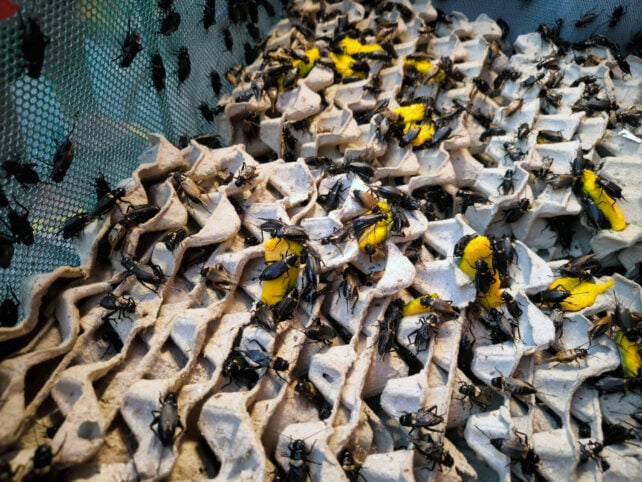
But insects in the order Orthoptera, which includes crickets, have not been sufficiently tested – especially given that the house cricket, Acheta domesticus, is one of the most widely farmed insects in the world, eaten by humans, pets, and research animals alike.
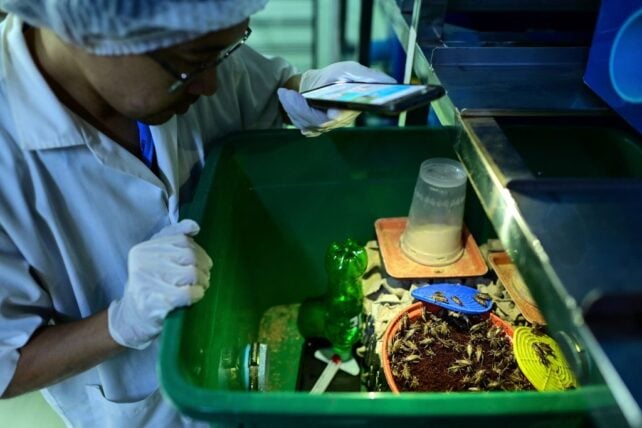
A team from the University of Sydney in Australia conducted an experiment to probe whether house crickets tend to an injury caused by applying some heat to their antennae.
"We found that crickets didn't just reflexively flinch and recover," entomologist Thomas White and philosopher-biologist Kate Lynch explain in an article for The Conversation.
"They nursed the harm, returning again and again to groom the affected site, much as we rub a burned hand."
Both male and female crickets exhibited this behavior, and they were twice as likely to do it when the probe used to prod the crickets' antennae was heated to 65 °C (149 °F), compared to when it was unheated or didn't touch the cricket at all.
This temperature is enough to activate the cricket's 'harm' receptors, but not enough to do long-term damage.

After each prod, the scientists watched the crickets for ten minutes.
"Grooming was directed specifically at the heated side, not spread evenly across both antennae as it was after gentle touch or no contact," White and Lynch explain.
"And the behavior wasn't a brief, reflexive reaction. It was elevated from the outset and tapered gradually over minutes, much like rubbing a burned hand as the felt sting slowly fades."
The new study shows this pet shop staple does indeed meet the criteria for flexible self-protection: a discovery which could have ethical implications for how these insects are treated when they are farmed, handled, and experimented upon.
Related: Disturbing Experiment Bolsters The Case Lobsters Feel Pain After All
"Crickets have already been shown to possess nociceptors, centralized sensory integration, have the capacity to learn from aversive events, and moderate their responses to noxious stimuli following analgesia," White, Lynch, and team write.
Now, they add flexible self-protection to the list, meaning crickets now meet five of the eight criteria.
"Together, these lines of evidence suggest that orthopterans exhibit the same conjunction of features – nociception, integrative processing, learning, and targeted self-protection – that are taken to warrant serious consideration of sentience," the team concludes.
The research was published in Proceedings of the Royal Society B.