
If you're sick of your dead-straight hair or untameable curls, the blame doesn't start with your wash and dry routine, or even the temperature or humidity of your surroundings.
It begins below the skin's surface with hundreds of thousands of tiny follicles littering your scalp.
In 2005, scientists dissected human scalp follicles and found that in people with curly hair, those locks are already forming even before they leave the skull and tumble out over the head.
Their conclusion was that whether hair is curly or straight is programmed within the follicle bulb itself.
In the years since, studies of hair follicles have added more nuance to the science of curly hair.
Here's how it is thought to work, based on what we know so far.
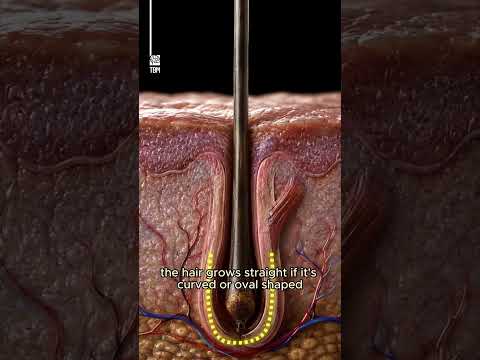
Each hair on your scalp forms within a follicle underneath the skin and then gradually emerges from a pore.
If this follicle is vertical, then the hair that protrudes will also be straight.
But if this follicle is bent like a golf club, the strand of the newly formed hair section is curved as it forms. It's sort of like a mold but a bit more complex.
Recent evidence suggests that cells on one side of the 'mold' divide and mature in different ways from the opposite side.
This means that the composition of keratin and other materials isn't the same all the way around the hair strand.
That creates an asymmetrical strand that is more likely to kink and curl in one direction.
In contrast, the follicles of straight hair have more symmetrical structures.
There are all still many mysteries to the science of curly hair, but a review of the literature in 2019 found that while the makeup of a single hair can play a role in its ultimate coarseness and texture, it's actually the shape of the hair follicle that determines whether it comes out coiled, kinked, or straight.
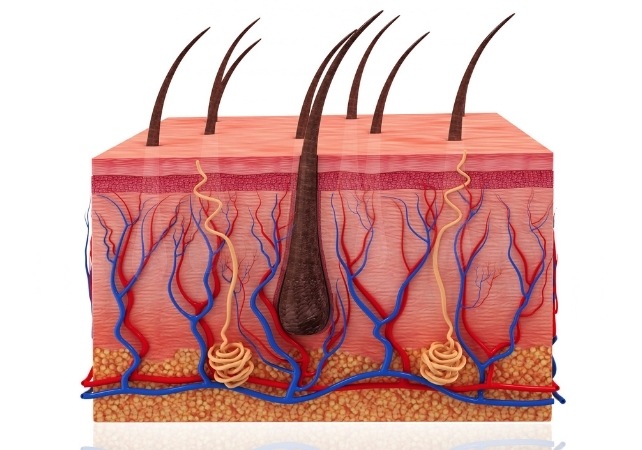
Once the hair leaves the scalp and cascades away from the head, it maintains the shape of its birthplace.
The structure of hair follicles is genetic, which is why a person often shares the same hair type as their family members.
Hair follicles are incredibly complex structures, housing stem cells, blood vessels, and glands, which all work to string together the fibrous strands of our hair.
Once those hairs leave our skin, they are like biological ropes. The cells are no longer dividing and maturing. Pretty much all that is left is a dead keratin fiber. Its life in the follicle, however, forever shapes its future.
While hair types are often categorized by race, the science doesn't support that classification.
Instead, the 2019 review suggests that every population, regardless of ancestry, shows a spectrum of hair shapes, though some curl patterns are more common in some genetic lineages than others.
So why did we evolve different hair follicles in the first place? Scientists still don't really understand why that is, but new evidence supports the theory that our scalp hair evolved to help us stay cool.

In experiments published in 2023, when a thermal manikin was given a wig of human hair to wear in a climate-controlled chamber, researchers found the manikin did not absorb as much heat as when it was bald.
Several different types of wigs were tried on the manikin, including straight hair, loose curls, and tight curls.
Related: Evolution Favored Genes Linked to Red Hair – And Vitamin D May Be Why
All the wigs cooled the head, but curled hair was the best at keeping the manikin cool from the 'solar' radiation above.
It's an interesting idea, but the evolutionary advantages of certain features like hair can be incredibly difficult to parse.
Untangling their roots and combing through the data are challenges scientists are still tackling.
This article was fact-checked by Michael Irving and edited by Rebecca Dyer. While we pride ourselves on our process, we are only human. If you spot a mistake, please let us know.