Scientists have found that a little-known bacterial antibiotic is capable of disarming fungi responsible for life-threatening infections.
It's a welcome discovery in a world where drug-resistant fungi are becoming an increasingly serious global health concern.
"Fungal infections kill an estimated two million people worldwide each year, yet treatment options remain limited," explains molecular biologist Ana Traven of Monash University in Australia, who led the research published in Current Biology.
"Modern medicine, from surgery and cancer treatment to organ transplantation and intensive care, depends on our ability to prevent and treat these life-threatening infections."
Traven and her colleagues have found an existing but little-known antibiotic that might be able to help.
"There are no vaccines for fungal infections, and some of the antifungal medicines we do have can be highly toxic, highlighting the urgent need for new ways to prevent and treat these diseases," Traven says.

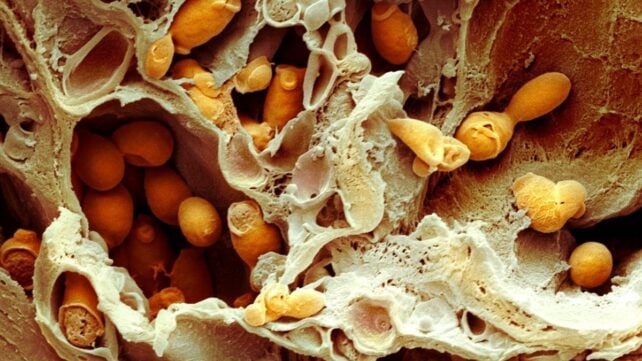
Candida albicans is a typically benign yeast that lives on and inside our bodies, mostly unnoticed – until, on very rare occasions, it can become pathogenic.
Infection usually only happens in people who are already really sick or immunocompromised, or who have risk factors such as major surgery or invasive medical devices.
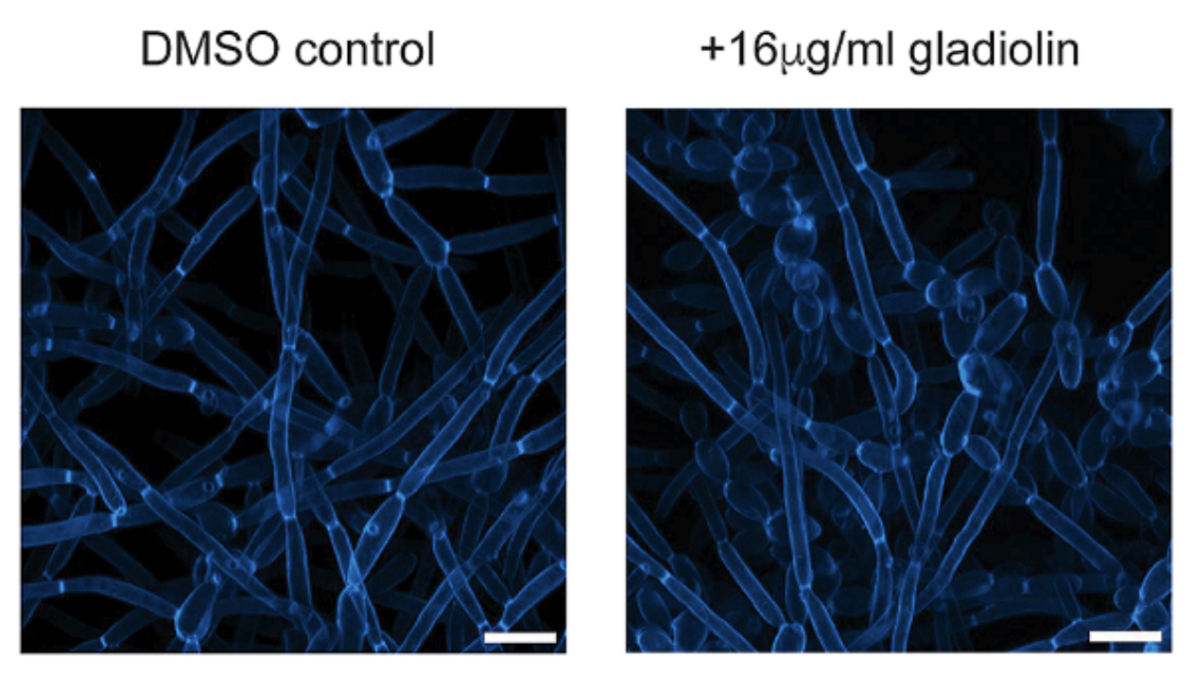
C. albicans can switch between its rounded yeast form, which can help it spread, and a thread-like hyphal form, which can help it invade tissues, oozing a toxin called candidalysin that damages our cells.
If C. albicans reaches the bloodstream – a condition called candidemia – the infection can be life-threatening.
And, increasingly, the antifungal medications we once used to treat it just aren't working like they used to.
A recently discovered antibiotic, gladiolin, switches the fungi from invasive hyphae back to yeast cells – at least, it did in experiments conducted in petri dishes in a lab.
Many of the best antibiotics in our arsenal are 'borrowed' from nature.
Gladiolin is no exception.
First discovered in 2017, gladiolin is produced by the bacteria Burkholderia gladioli, which, like Candida, can also cause complications for people in hospital settings, though it's much rarer.
Bacteria and fungi do not always lead a peaceful coexistence: often, they are competing for the same resources.
The best chemical weapons against one microbe can often be found in the genes of its rival.
Because B. gladioli can be dangerous to humans, especially in the kinds of contexts where C. albicans is also a problem, doctors wouldn't want to just thrust the bacteria in there and see who wins the fight.
Instead, scientists have carefully harvested the gladiolin from lab-grown bacteria, which were originally sourced from the lung of a patient with cystic fibrosis.
Gladiolin has previously shown promising activity against the bacteria that cause tuberculosis, and the new findings add to 2024 research showing that gladiolin can enhance the activity of a powerful antifungal medicine called amphotericin B.

The new research unpacks exactly how this bacterial byproduct affects C. albicans by ramping up two key proteins – Tye7 and Gal4 – and sending the fungus's glucose metabolism into overdrive.
Once C. albicans burns through its glucose, it reverts to its less invasive yeasty form – all thanks to gladiolin.
When the researchers added amphotericin B, the pair had a synergistic effect, suppressing C. albicans biofilms more strongly than either treatment alone.
"Our findings suggest that gladiolin could help existing drugs kill dangerous fungal pathogens, including drug-resistant biofilms that can form on medical devices, while potentially allowing lower, less toxic doses of antifungal drugs to be used," says molecular biologist Greg Challis, also of Monash.
We won't know whether this treatment will work in similar ways in the human body without a series of preclinical trials first, before the drug can be given to humans in clinical trials to test if it's safe and effective.
Related: Deadly Fungal Infections Causing a 'Silent Pandemic', Scientists Warn
"Fungal infections are often overlooked because they are not as common as bacterial infections," says pathologist Nathan Wiederhold, of UT Health San Antonio, who was not involved in the gladiolin research.
"But they can be much more difficult to diagnose and treat, and we're seeing increasing spread and resistance."
We're going to need all the help we can get, and gladiolin could be part of that.
The research was published in Current Biology.
This article was fact-checked by Rebecca Dyer and edited by Rebecca Dyer. While we pride ourselves on our process, we are only human. If you spot a mistake, please let us know.