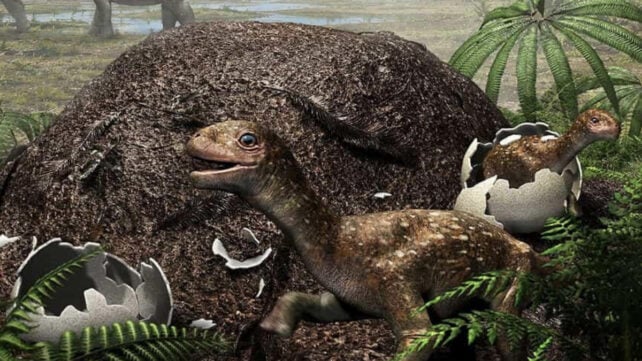
Dinosaurs are not known to have a taste for cold climates.
And yet, somehow, more than 250 fragments of massive dinosaur eggshells have been discovered in the Upper Cretaceous (Maastrichtian) Chorrillo Formation, at Patagonia's southernmost reaches.
A team led by paleontologist Kohei Tanaka of the University of Tsukuba in Japan, who analyzed the eggshells in a paper published in the Royal Society Open Science, says this is the farthest south dinosaur eggs have ever been found.
At the time the dinosaurs laid these eggs, their nest would've been about 55 to 60 degrees south of the equator, in a climate equivalent to modern-day New York.
The researchers believe the soccer ball-sized eggs, Fusioolithus, were laid by titanosaurs, which were the last group of giant long-necked sauropods to walk the Earth.
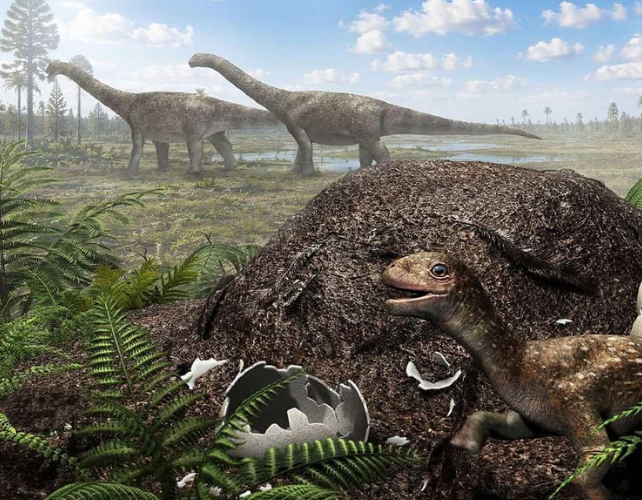
It's rare to find fossil evidence of non-avian dinosaurs nesting so close to the South Pole.
And so far, fragments of Fusioolithus eggshells had only been found in places we know had warmer climates.
Dinosaur eggs required a certain amount of heat to keep their precious contents growing.
But the further south you get, the lower temperatures tend to dip, especially when sunlight hours are so brief in winter.
And yet, the giant titanosaurs couldn't exactly sit on their eggs to keep them warm.
"The nest would be one big omelette," paleontologist Darla Zelenitsky, also on the research team, told CBC.
The eggshells were extremely porous, which, according to Tanaka's previous research, correlates well with dinosaur nests that are entirely covered, with the eggs fully buried.
Covering eggs helps lock their heat inside the mound – sea turtles use this trick – but it wouldn't inherently keep the eggs warm enough.
These nests would've needed an extra heat source.

Heat is essential to fuel all the chemical reactions needed to grow a dino baby across the many months it takes to reach hatching.
Closer to the equator, these nests might've been easily warmed up by sunlight alone.
Still, Tanaka and team don't think there would've been enough heat for this to work in Patagonia - and there's no evidence that geothermal activity could've helped power these dinosaur incubators.
But some of the dinosaurs' living relatives have found their way to a solution: could it be the same trick used by the titanosaurs all those years ago?

Saltwater crocodiles and brushturkeys are known to heap up large mounds of decaying plant matter around and over their eggs to form steamy compost heaps that generate impressively high temperatures as their contents ferment.
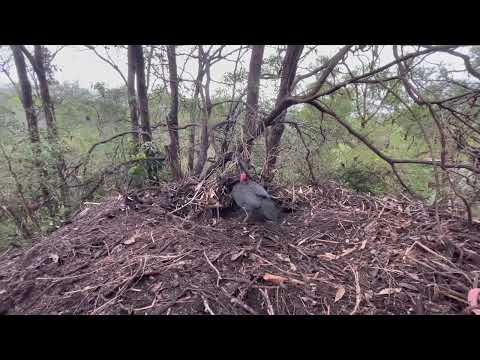
The massive pores in the fossil eggshells add weight to this theory: if eggs are buried, they need larger pores to get more oxygen, while exposed eggs need smaller pores to stop the egg from losing too much moisture.
Related: Scientists Find First Adult T. Rex Trackway – And The Footprints Are Human-Sized
"The high latitude of the area in the Maastrichtian suggests the eggs were buried in a mound-style nest where microbial decay, rather than solar radiation, was the primary source of incubation heat," Tanaka and team report.
"The Chorrillo Formation represents, to our knowledge, the highest paleolatitude area to produce definitive dinosaur egg remains from the Southern Hemisphere, and reveals that titanosaurs were nesting at higher latitudes than previously known."
The research was published in Royal Society Open Science.