
If you're trying to listen carefully to something, it might be better to keep your eyes open.
This surprising finding goes against instinct and conventional wisdom, which suggests closing your eyes shuts out distractions and 'sharpens' your other senses.
A new study from researchers at Shanghai Jiao Tong University in China put the idea to the test. In experiments, participants were tasked with picking a target sound out of background noise, with their eyes either open or closed.
Not only did participants perform better at the task with their eyes open, but what they were looking at made a difference, too.
"We found that, contrary to popular belief, closing one's eyes actually impairs the ability to detect these sounds," says Yu Huang, mechanical engineer at Shanghai Jiao Tong University.
"Conversely, seeing a dynamic video corresponding to the sound significantly improves hearing sensitivity."
The logic behind the assumption that closing your eyes helps with hearing is sound (excuse the pun): The brain can only process so much information at once, so removing all visual distractions should, in theory, free up some resources to focus on an auditory task.
To find out if that holds true, the researchers on the study sat 25 volunteers down and had them try to pick out one of five target sounds – the splash of a canoe paddling, a drum beat, a lark chirping, the rumble of a train, and the clack of a keyboard – amid background noise at a volume of 70 decibels.
They did this under four different visual conditions: their eyes were either closed, or open and looking at a blank screen, a still image, or a video. The latter two were visuals related to the sound they were trying to hear.
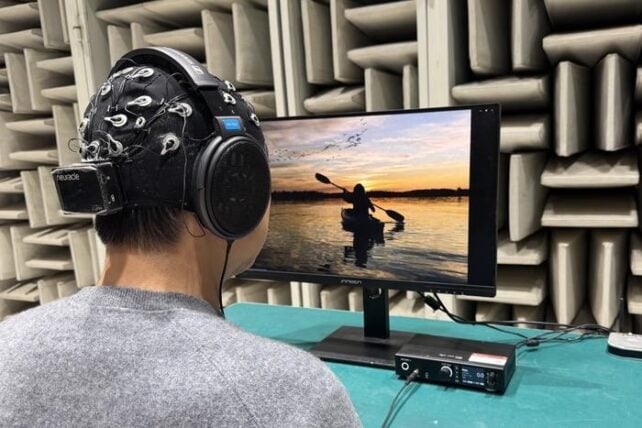
Participants could turn the volume of the target sound up or down, and had to report at which point they could just barely hear the sound over the drone of the background noise. The volume at which they could hear it while viewing a blank screen became the baseline for comparison.
When participants closed their eyes, the sound needed to be 1.32 decibels louder on average before they could detect it, compared to the baseline. In contrast, while looking at a still image related to the sound, people could hear it when it was 1.6 decibels quieter than the baseline.
Watching a video related to the sound made people even more sensitive to it, allowing them to hear it at a volume 2.98 decibels lower than when under baseline conditions.
So why would having your eyes open help you hear something?
To find out, the researchers ran the tests while participants were wearing electroencephalography (EEG) helmets to monitor their brain activity.
Intriguingly, they found that closing your eyes triggers the brain to filter sounds more aggressively, meaning you hear less of general noise and target sounds alike.
"In a noisy soundscape, the brain needs to actively separate the signal from the background," says Huang.
"We found that the internal focus promoted by eye closure actually works against you in this context, leading to overfiltering, whereas visual engagement helps anchor the auditory system to the external world."

That does raise an interesting question: If you're looking at an image or a video of someone paddling a canoe, is your brain just filling in the gaps and believing it can hear the sound of splashing before it actually can? The researchers plan to investigate this in future work.
"Specifically, we want to test incongruent pairings – for example, what happens if you hear a drum but see a bird?" says Huang.
"Does the visual boost come from simply having the eyes open and processing more visual information, or does the brain require the visual and audio information to match perfectly?
"Understanding this distinction will help us separate the general effects of attention from the specific benefits of multisensory integration."
Related: Human Echolocators Can 'See' With Sound, And Brain Scans Reveal How
The study doesn't negate prior findings that suggest closing your eyes can help pick out sounds in quiet environments. But, as the team says, our noisy modern world means you'll probably rarely find yourself in this situation anymore.
There's also still plenty of evidence that long-term blind people can make up the shortfall by making their other senses more sensitive.
But sadly, it sounds like most of us can't just hack ourselves into a Daredevil-like state of heightened awareness.
The research was published in The Journal of the Acoustical Society of America.