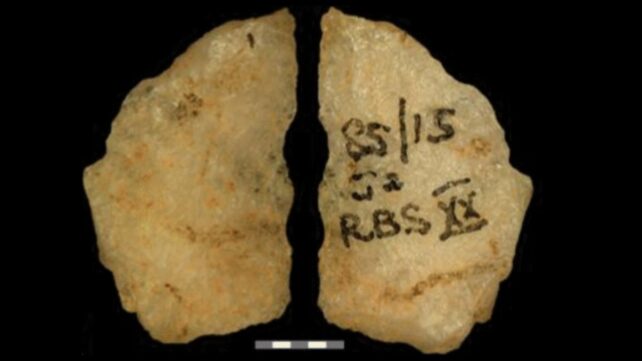
A pile of ancient arrowheads from southern Africa still holds traces of toxic plant residue, even after some 60,000 years.
The discovery pushes back the earliest direct evidence of poisoned arrow use by tens of thousands of years.
While not immediately fatal, researchers say that the poison preserved on the arrows could kill a rodent in about half an hour. It was probably used to slow down hunted animals so humans could track them more efficiently.
Before now, the earliest poisoned arrows from Africa dated to the mid-Holocene, roughly 7,000 years ago.
Related: Neanderthals May Have Been The First To Carefully Concoct This Substance
"Poisoned weapons are a hallmark of advanced hunter-gatherer technology," write an international team of researchers, from universities in Sweden and South Africa.
"Apart from providing the first evidence of hunting with poisoned arrows during the late-Pleistocene in southern Africa," they add, "our findings contribute to the understanding of human adaptation and technobehavioral complexity during a phase of rapid, cumulative innovation in the region."

The ancient arrow tips were first uncovered in 1985 at South Africa's Umhlatuzana Rock Shelter in KwaZulu-Natal province, and yet for decades, they sat in a museum, untouched.
Now, researchers at Stockholm University, Linnaeus University, and the University of Johannesburg have tested 10 arrowheads from the bunch that show visible residue.
Using a technique called gas chromatography–mass spectrometry, the international team identified plant-derived toxic compounds on some of the arrowheads – the first direct evidence of poisonous plant matter on hunting weapons from the Pleistocene.
The most likely source is an abundant plant species in southern Africa called Boophone disticha, which has historically been documented as an arrow poison used by locals to hunt animals such as springbok (Antidorcas marsupialis).
Some scientists have hypothesized that bowhunting in southern Africa during the Late Pleistocene was likely accompanied by poison. But evidence to date is largely based on mechanical signs and hints of possible plant residue that remain ambiguous.
Archaeologist Sven Isaksson from Stockholm University in Sweden led the recent study to test this hypothesis.
For years, he and his colleagues have been working hard to extract clear evidence of plant poison from arrowheads hundreds of years old. Now, they are using those same techniques to sample artifacts thousands of years older than that.
Ultimately, five of the 60,000-year-old arrowheads were found to contain traces of buphandrine – a toxic plant alkaloid that has also been found in poisoned arrow tips from 250 years ago.
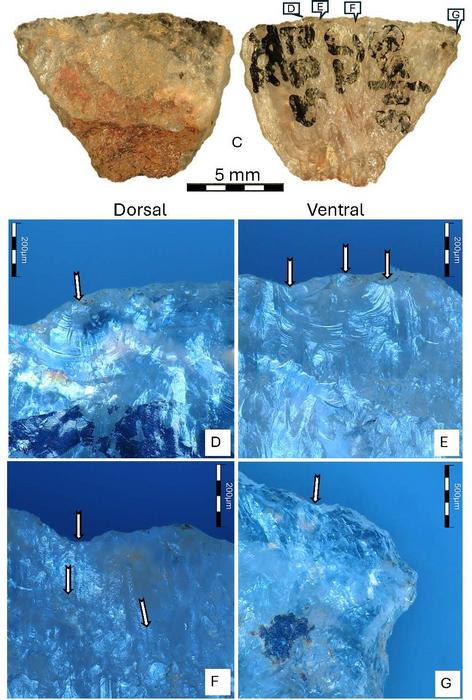
Another toxic alkaloid, called epibuphanisine, was also identified on one of the ancient arrowheads. In their published paper, Isaksson and colleagues write this "cannot be coincidental."
Buphandrine and epibuphanisine are both found in the leaves of B. disticha. Of all 269 historically known bowhunting groups in southern Africa, 168 are known to use poisoned arrows.
To find remnants of these toxins on arrowheads roughly 60,000 years old suggests that this clever subsistence strategy goes way, way back.
"Because poison is not a physical force, but functions chemically, the hunters must also have relied on advanced planning, abstraction, and causal reasoning," the study authors speculate.
Even before this discovery, one of the authors, Marlize Lombard from the University of Johannesburg, argued that it was reasonable to assume hunter-gatherers in southern Africa were using poisoned arrow tips around 60,000 years ago, or even earlier.
By this time, she wrote in a 2025 research article, people in this region already knew of and used edible, medicinal, and insect-repellent plants. Why couldn't they know of and use toxic ones as well?

Recently, scientists discovered evidence of Neanderthals making complex glues out of plant matter around 200,000 years ago.
The cleverness of ancient hominins continues to surprise us.
The study was published in Science Advances.