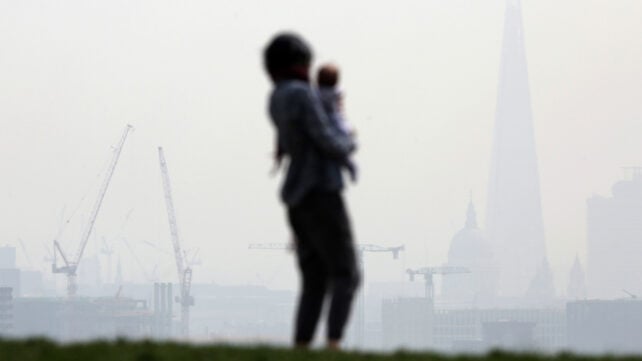
In April 2019, London took drastic action against traffic emissions in a bid to reduce the toxic air pollution that choked up the city's center.
It's called the Ultra Low Emission Zone (ULEZ).
Now, five years' worth of data from this 'natural experiment' has provided scientists with strong evidence that central London's ULEZ (and the Toxicity Charge that preceded it) made a big difference to young residents' lung health.
It's a promising sign for similar clean air efforts around the world.
"To our knowledge, we provide the first evidence that air quality improvements following [the] introduction of a clean air zone are associated with improved lung growth trajectories in children," the study's authors write in their new paper, published in The Lancet Public Health.
"Decision-makers globally should consider accelerating the introduction of clean air zones to improve children's lung health."
It makes sense, in theory, that this kind of policy would help inner-city residents breathe easier.
We know that exposure to traffic-related air pollution increases people's risk for lung disease, including cancer, and early death.
For children and adolescents, exposure is also strongly linked to impaired lung development, which, for the rest of their lives, translates to a higher risk of asthma, chronic obstructive pulmonary disease, cardiometabolic disease, and earlier death.
Official estimates suggest that since introducing the ULEZ, roadside nitrogen dioxide levels (a key gas of concern when it comes to the pollution emitted by heavy traffic) have fallen by 54 percent in central London and by 27 percent city-wide.
But until now, there's been limited evidence of what difference a policy like central London's ULEZ actually makes to residents' health – leaving it open to criticism from those concerned about the costs imposed on drivers.
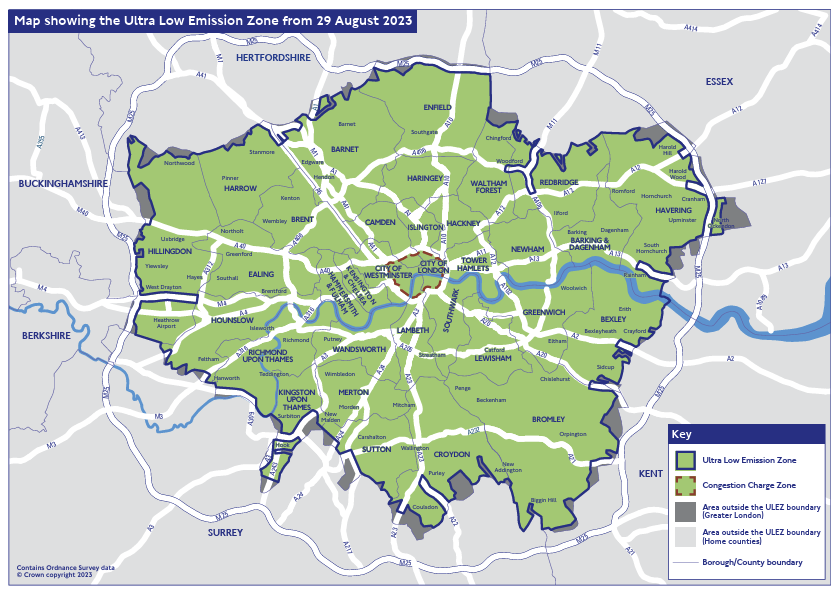
That's been a particular pain point as the zone expanded to include all of Greater London.
Researchers from institutions across the UK measured the lung function and growth of 3,414 school children, aged six to nine years at the start of the study.
Roughly half were from central London; the other half lived about 56 kilometers (35 miles) away in Luton, a busy, industrialized town that didn't introduce a clean air zone.
At annual school visits, the researchers measured the children's lung function by having them forcefully exhale air in one second and measuring the volume of that exhalation – a common approach used by doctors to assess how well a patient's lungs are working and, in the case of children, how well their lungs are growing.
As a town of around 225,000 residents, Luton is not exactly the same kind of environment to grow up in as London.
Still, the idea with this kind of study design is that children from each location have roughly similar lifestyles, with the only major differences being baseline air pollution and the ULEZ intervention.
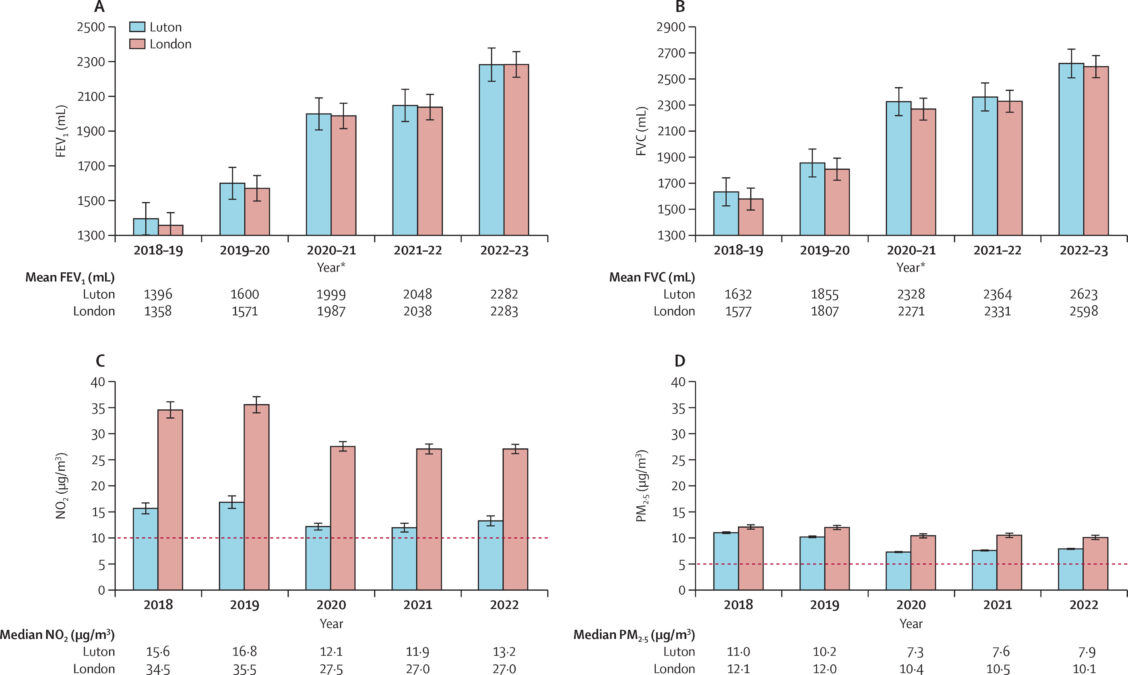
In the first year of data, before the ULEZ was implemented in central London, it was clear that London kids' average lung growth was stunted compared to their Luton peers.
Meanwhile, their average annual exposure to nitrogen dioxide (NO2) was modeled as 18.95 μg/m3 higher than that of kids in Luton.
But in the years following the introduction of the ULEZ, London kids' lungs began to catch up, with that lung function measurement increasing by 10 mL/year faster, on average, than it did in Luton.
Meanwhile, NO2 in central London dropped 3.77 μg/m3 per year in London, while it decreased 1.77 μg/m3 per year in Luton.
The odds of those two things occurring randomly are so low that it's pretty strong evidence the ULEZ was responsible.

Four years after the introduction of the ULEZ, London kids' lung function was on par with the children in Luton.
The researchers also noticed that as air pollution in central London dropped, so too did the proportion of children with clinically impaired lung function: from 14 percent before the ULEZ was introduced to 9 percent five years later.
Parents, children, and teachers said the air in London was cleaner, the traffic less congested, and their asthma less troublesome.
As air quality improved, London kids were also four times more likely to start riding or walking to school than children in Luton.
Related: These Babies Grew Up With Strict Sugar Limits. Decades Later, The Results Are Dramatic.
"We already knew that the ULEZ reduced air pollution but now we know that children's lung health has improved at the same time, which is a really important finding for children and parents living in London," says the study's lead author, respiratory physiologist Helen Wood of Queen Mary University of London.
"However, we must not be complacent: air pollution in both London and Luton – as well as other cities across the UK – remains above WHO guideline levels, so there is still work to be done."
The research was published in The Lancet Public Health.
This article was fact-checked by Clare Watson and edited by Clare Watson. While we pride ourselves on our process, we are only human. If you spot a mistake, please let us know.