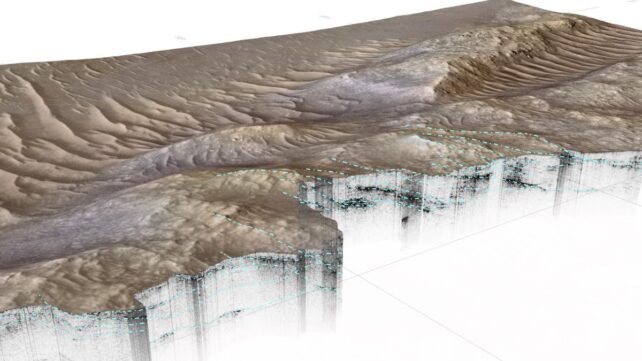
Far away, alone in a crater on a planet inhabited only by robots, NASA's Perseverance rover explores a dry landscape that was once a river system billions of years ago.
According to a new discovery, however, the Jezero Delta on Mars is not the sole remnant of abundant water that once flowed across the surface. Perseverance's RIMFAX instrument has now probed deeper than ever beneath the Jezero crater, revealing a vast delta system fed by flowing water that existed long before the one the rover now explores.
In turn, this indicates that water flowed across the surface of Mars for much longer than the surface alone implies – a finding with important implications for the planet's past habitability.
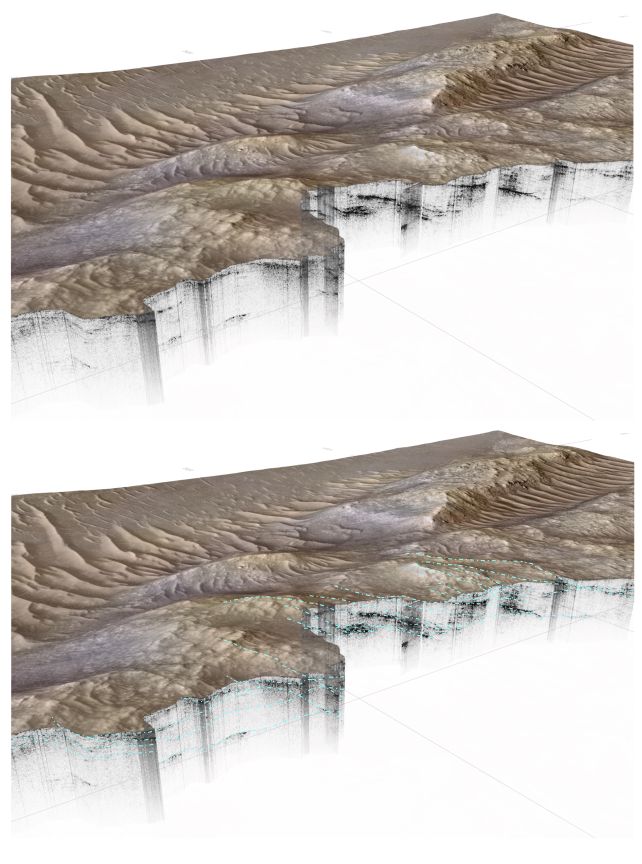
"Overall, RIMFAX elucidates a broader fluvial system than what was observed from orbit, and indicates an extended window of fluvial deposition, aqueous alteration, and habitable conditions than previously envisioned at Jezero crater," geomicrobiologist Emily Cardarelli of the University of California, Los Angeles told ScienceAlert.
"RIMFAX has revealed an earlier subsurface deltaic environment under the present-day delta, thereby extending the period of potential habitability for Jezero back further in time."
After many years of dedicated exploration, it has become clear that Mars wasn't always the arid, rusty dustball of a planet it is today. Multiple lines of evidence show that water once flowed abundantly, from water-carved landscapes to minerals that could only have formed in the presence of liquid water.
This raises other questions. One of the most pressing for habitability is how long liquid water persisted on the surface of Mars. A longer timespan offers a larger window for the emergence of microbes that scientists think are the most likely form of life that could have existed on Mars.

In general, the landscape of Mars has been preserved very well for billions of years, since it's not subject to the same tectonic and weather conditions we have here on Earth. The Jezero Delta that Perseverance is exploring is thought to be around 3.7 billion years old, dating back to the late Noachian to early Hesperian period.
However, that time is when Mars is known to have had surface water – and flowing surface water creates the conditions for stronger erosion and sediment deposition.
The formation and evolution of some of the mineral deposits in the Jezero crater have puzzled scientists, specifically a unit rich in carbonates and olivine known as the Margin. To investigate how the Margin unit formed, researchers used Perseverance's RIMFAX to probe deep under the ground for clues.

Over the course of 78 traverses between September 2023 and February 2024, Perseverance repeatedly took measurements with its ground-penetrating radar, collecting data along a trail some 6.1 kilometers (3.8 miles) long. Those measurements penetrated to depths greater than 35 meters (115 feet).
As the researchers began to piece together the data, a hidden deltaic landscape unfolded from the darkness.
"The moment we saw the Sol 909 radargram, we realized that this unit was more transparent to the radar than other units that we had seen before. As we continued driving on the Margin unit, we saw deeper and deeper into the subsurface down to up to 35 meters," Cardarelli said.
"The Sol 1052 radargram was particularly exciting to see because we began to see complex features at depth that we hadn't seen before!"
The radar data revealed many layers of rock extending deep underground, arranged in sloping patterns that on Earth are typical of sediment settling out of water as it flows into a wide basin.
The researchers also identified lobe and channel structures consistent with formation by flowing water, along with scours, backseats, and buried boulders.
"These are common features for river systems to develop, though the preservation is not always guaranteed because river systems are dynamic," Cardarelli said.
Although the radar only probes tens of meters underground at any one location, combining those measurements across the entire length of Perseverance's traverse allows scientists to reconstruct a much thicker deposit.
Related: Ancient Beaches Found on Mars Reveal The Red Planet Once Had Oceans
This combined measurement suggests that the Margin could be up to 90 meters thick, the result of multiple episodes of deposition, with evidence of some erosion between them. Based on the geological context of Jezero crater, the researchers estimated that the region hosted a functional delta system as early as the Noachian, some 4.2 to 3.7 billion years ago.
"We estimate that the Margin unit has a true thickness or actual vertical extent of at least 85 to 90 meters," Cardarelli said.
"The features we document range in size from submeter to hundreds of meters in length."
Taken together, the evidence suggests that Mars did not host water only during a brief period, but experienced multiple phases of water flowing over and shaping its surface. That extended water history opens the window of opportunity for life to have emerged.
"This work also may have implications for the preservation of potential biosignatures and habitability in the subsurface of Jezero crater," the researchers write.
"Fine-scale internal structures could preserve mineral compositions and geochemical conditions of past water-related events and may have once provided past habitable conditions."
The research has been published in Science Advances.