
Three weeks of exposure to a pesticide left laboratory mice moving slowly and struggling to balance.
Scientists were using the chemical to study some of the movement problems seen in Parkinson's disease. But as they continued watching the animals after exposure ended, those problems began to ease.
Without receiving a treatment to reverse their symptoms, the mice gradually improved. By the end of a year, they performed movement tests as well as controls of the same age.
Neuroscientist Xuelin Lou of the Medical College of Wisconsin told ScienceAlert that the resolution of these Parkinson's-like deficits was "totally unexpected."
In a study published in iScience, Lou and colleagues, cell biologist Prince Joshi and physiologist Fan Fan, investigated what happened long after exposure to the pesticide rotenone ended.
Parkinson's damages cells that produce dopamine, a chemical that helps control movement. Rotenone reproduces some features of the disease in animals by interfering with the tiny energy-producing structures inside cells, called mitochondria.
Exposure to rotenone and certain other pesticides has also been associated with a higher risk of Parkinson's in people. However, these associations alone don't establish causation.
Most experiments using rotenone models focus on the early effects.
The researchers gave young adult male mice daily rotenone injections for 21 days. Control mice received the same injection mixture without the toxin.
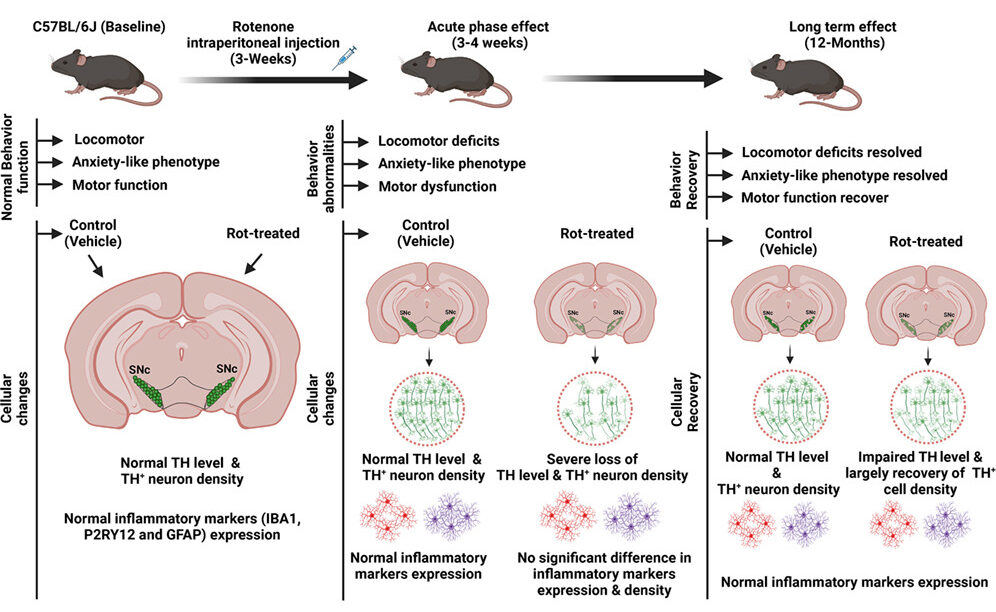
Within four weeks of the experiment's start, exposed mice traveled shorter distances, moved more slowly, and struggled to stay on a rotating rod used to assess balance and coordination. They also spent less time exploring the open, unwalled arms of an elevated maze, a measure of anxiety-like behavior.
The longer follow-up revealed a gradual change.
In the open-field movement test, exposed mice reached control-group levels within about four months. By seven months, their rotating-rod performance was no longer significantly different from that of controls. At 12 months, the groups also performed similarly in anxiety-related tests.
Brain tissue offered a possible clue. The researchers examined a movement-related midbrain region called the substantia nigra pars compacta.
They identified dopamine-producing cells using an enzyme needed to make dopamine, called tyrosine hydroxylase (TH). Early after exposure, the number and density of cells detectable with this marker were about 40 percent lower in exposed mice.
However, a second marker that labels neurons more broadly showed that total neuronal density was preserved.
"Our findings suggest that they just lose their identity," Lou said.
Some surviving cells may have produced too little TH to be identified as dopamine-producing neurons. Their disappearance from the TH-positive count didn't establish that they had died.
At 12 months, TH-positive cell counts and density were comparable between groups, although the enzyme signal remained weaker in exposed mice.
Aging complicated that comparison. Control mice examined at 12 months had about 45 percent lower TH-positive cell density than controls examined early on. In exposed mice, that density changed little between the two measurements. Lou said the reason for this difference wasn't known.
These tissue measurements came from different animals at each time point. Both groups also declined in rotating-rod performance as they aged, so matching older controls did not mean returning to their younger condition.
Lou explained that the recovery likely reflects both better function in the remaining dopamine-producing neurons and their resistance to age-related loss. Separating those contributions is difficult because the methods could not track individual neurons over time.
The recovery mechanism isn't clear. Lou said possibilities worth exploring include surviving neurons growing new branches, adjustments in their connections, and changes linking cellular metabolism to gene activity. The team is now studying what drives this resilience.
Other scientists have tested an experimental drug combination for Parkinson's-like symptoms in mice. Here, the behavioral differences resolved without such an intervention.
Only male mice were studied, with three to eight animals per group in the 12-month analyses, depending on the measurement.
The mouse models lacked several features of human Parkinson's, including significant accumulation of an abnormally modified form of the protein alpha-synuclein. Rotenone can also cause muscle weakness and general illness that influence movement tests.
Lou cautioned that "the findings do not mean that pesticide exposure is harmless or disprove the association between pesticide exposure and Parkinson's disease risk."
"The conclusion from this work should not be directly extrapolated to patients or workers under risk," Lou said.
Establishing the findings' relevance to humans will require evidence from people or studies of human dopamine-producing cells and tissues.
The research has been published in iScience.
This article was fact-checked by Rebecca Dyer and edited by Rebecca Dyer. While we pride ourselves on our process, we are only human. If you spot a mistake, please let us know.