
For many people around the world, putting food on the table isn't an easy thing.
But as populations grow and pressure on the world's resources intensifies, that burden is expected to only grow heavier.
New projections suggest that by 2050, millions of the world's poorest people could be spending around half their income on food alone.
"Anything that's taking up half of your income is potentially destabilizing for your entire life," says energy researcher Jennifer Morris from MIT, "because it leaves so few resources for the other critical needs and basic life necessities."
In a new study published in Earth's Future, Morris and her co-authors modeled almost 4,000 hypothetical scenarios, weighing up numerous factors to envisage what resource security might look like in tomorrow's world.
Resource security is people's access to and control over vital resources like food, energy, and water.
While many of these are the focus of considerable study – for example, food security – the researchers say most analyses look at single resource topics in isolation, rather than jointly assessing them.
Given how inter-related many of these resource issues are, that's a problem.
To plug the gap and provide a more comprehensive analysis, the researchers used a large-scale computer model called the Global Change Analysis Model (GCAM).
"GCAM models how energy, water, land, socioeconomics, and Earth systems co-evolve in response to various sources of future uncertainties," the researchers explain in their paper.
"The model operates across 32 geopolitical regions, and within each region the population is further divided into 10 income subgroups representing different portions of the income distribution."
Ultimately, GCAM produced 3,735 scenarios that the researchers suggest are feasible, and the results show that those income subgroups play a big part in determining people's future resource security.
"For a lot of these outcomes, the lower-income groups see much worse potential insecurity," Morris says.
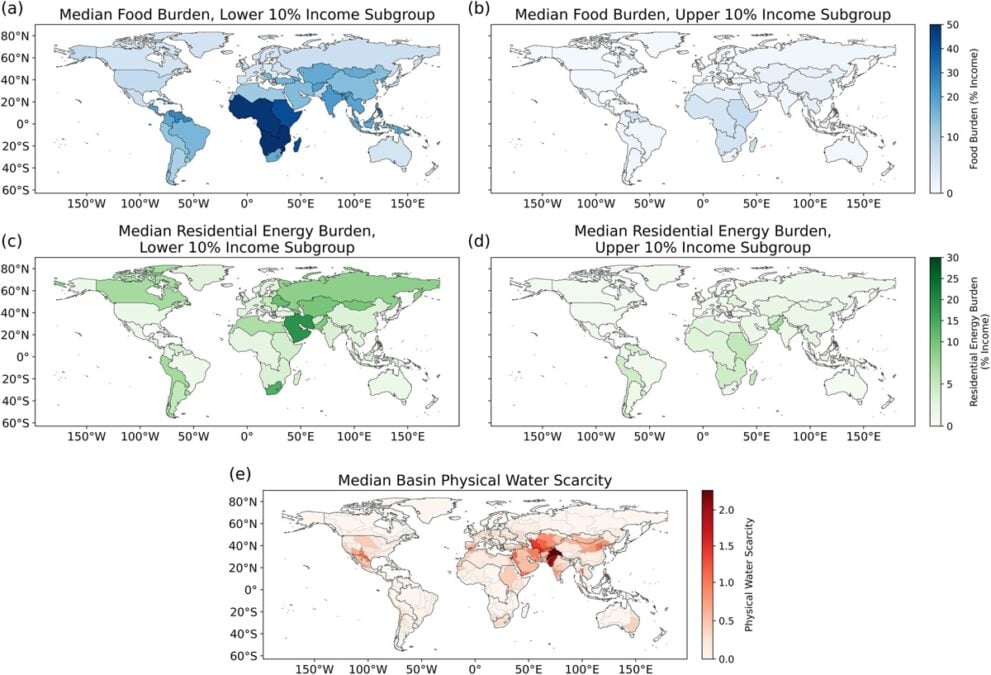
In terms of median results – the midpoint of the results produced across the 3,735 hypothetical scenarios – regions in Africa and India are projected to experience the highest food burden.
Based on the median projections, by 2050, the poorest 10 percent of people in Western, Eastern, and Southern Africa would have to spend close to 50 percent of their income on food (48.4, 42.5, and 49.6 percent respectively).
The researchers say this is attributable to low regional income and high food prices that arise in scenarios where land is set aside for decarbonization measures, such as bio-crops and forestation.
That the costs of fighting climate change are themselves a considerable source of pressure affecting resource security just goes to show how delicate this balancing act is.
"This study shows that there is no single driver of future food, energy, and water insecurity," says first author and environmental engineer Gi Joo Kim from Tulane University in New Orleans.
"Income is important, but regional conditions, land use, energy systems, water availability, and consumer behavior all shape the risks people face."
But while price increases will affect all, they won't affect all equally.

For example, in Southern Africa, where the poorest could have to spend 49.6 percent of their income on food by 2050, the region's richest would only have to spend 5.5 percent.
"For this type of study, where we're focused on human well-being outcomes, the income piece is really important," Morris says.
These kinds of income disparities exist widely across the spectrum of resource security, the researchers found.
"Across all sectors, we demonstrate that the regional average outcomes obscure both extremely high burden outcomes for lower-income subgroups and extremely low burden outcomes for higher-income subgroups," the paper states.
"For instance, the range of food burden for Western Africa's lowest-income population extends from 18.5 percent to 77.5 percent, while the regional average only ranges between 5.4 percent and 24 percent."
Related: Earth's Population Has Surpassed The Planet's Capacity, Study Suggests
The price hikes and pressure points go far beyond food, too.
In the Middle East and South Africa, projections suggest people will have to spend significantly more for energy, due to high demand for residential cooling and heavy reliance on fossil fuels.
Meanwhile, in South Asia, the Middle East, and Northern Africa, rapid growth and extensive groundwater extraction are expected to produce significant water scarcity issues.
The researchers note that their modeling only indicates plausible futures, and doesn't indicate any single scenario that is most probable to eventuate.
Rather, they describe their work as a starting point that could be expanded in subsequent research.
"Our method was designed to identify the conditions that produce different resource security outcomes," Kim says, "rather than to predict one most likely future."
The findings are reported in Earth's Future.
This article was fact-checked by Rachel Garner and edited by Rebecca Dyer. While we pride ourselves on our process, we are only human. If you spot a mistake, please let us know.