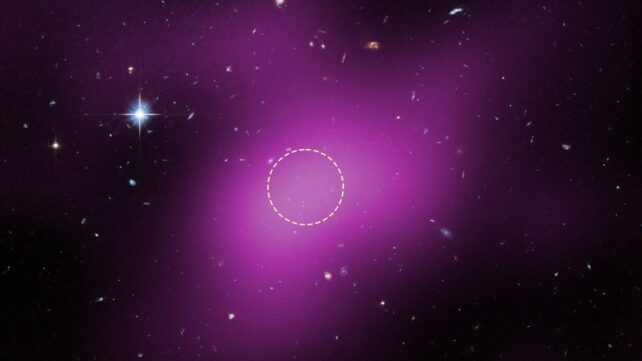
An object spotted in deep space is the strongest candidate yet for a galaxy arrested during early development.
It's been named Cloud-9, and it's a mysterious object about 14.3 million light-years away, near the spiral galaxy M94, which appears to be completely devoid of stars. Instead, it seems to consist mostly of dark matter wrapped in a cloud of hydrogen gas, lingering in space like a specter.
"This cloud is a window into the dark Universe," says astronomer Andrew Fox of the Space Telescope Science Institute.
"We know from theory that most of the mass in the Universe is expected to be dark matter, but it's difficult to detect this dark material because it doesn't emit light. Cloud-9 gives us a rare look at a dark-matter-dominated cloud."
Related: In a World First, Physicists Narrow Down The Possible Mass of Dark Matter
Although galaxies come in all shapes and sizes, there's a basic set of ingredients that astronomers expect them to have: stars, gas, and a surrounding halo of dark matter that supplies most of their gravity.
While we don't know for sure how galaxies form, that dark matter halo is thought to be crucial. Think of it like an invisible blob of gravity that keeps things together; we don't yet know what this mass is made of, so we call it dark matter – but without it, the Universe would probably be a scattered mess.
According to galaxy formation models, dark matter structures form early, creating a gravitational pocket that accumulates normal matter, such as neutral hydrogen gas (H I), which can gradually become dense enough to form stars.
Cloud-9 was first spotted in a radio survey of the sky searching for neutral hydrogen using the Five-hundred-meter Aperture Spherical Telescope (FAST) in China, not far from the galaxy M94, the Cat's Eye Galaxy.
The neutrality of the hydrogen is important; it strongly suggests the gas is relatively cool, compact, and gravitationally bound. It also hasn't been ionized by the pervasive ultraviolet radiation that fills the Universe, much of it produced by stars and galaxies.
This detection, as the astronomers noted in their 2023 paper, could be what is known as a Reionization-Limited H I Cloud, or RELHIC – a glob of gravitationally bound neutral hydrogen and dark matter that has not reached the star formation threshold.
These objects have long been predicted by simulations of the early Universe, but have proven extremely difficult to identify. Most are expected to lose their gas over time, or to be mistaken for debris or foreground clouds, leaving astronomers with few clear examples to study.
However, the FAST observations were not detailed enough to confirm it. For example, a similar cloud named FAST J0139+4328 contains evidence of a small smattering of stars and a strong signal of rotation, which suggests that it is not quite as primordial as a RELHIC.
Led by astronomer Gagandeep Anand of the Space Telescope Science Institute, a team of researchers followed up the discovery with radio observations from the NSF's Green Bank Telescope and the Very Large Array to learn more about the neutral hydrogen.
These studies revealed that Cloud-9 consists of a dense, spherical accumulation of neutral hydrogen about 4,900 light-years across. That gas has a mass of about a million Suns and is not rotating. The amount of dark matter required to keep it contained and balanced would be about 5 billion solar masses, the researchers determined.
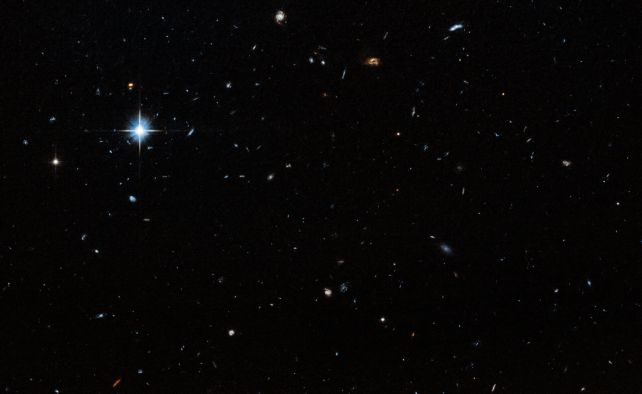
They also used the Hubble Space Telescope to take deep optical observations. If there were more than a few thousand solar masses' worth of stars lurking within the cloud, Hubble would have found them. It detected nothing.

Based on the depth of the observations, the team was able to rule out even a tiny dwarf galaxy similar to Leo T, one of the faintest known gas-rich galaxies in the local Universe. If Cloud-9 has any stars at all, there can only be a few thousand Suns' worth of them.
"This is a tale of a failed galaxy," says astronomer Alejandro Benitez-Llambay of the Milano-Bicocca University in Italy. "In science, we usually learn more from the failures than from the successes. In this case, seeing no stars is what proves the theory right. It tells us that we have found in the local Universe a primordial building block of a galaxy that hasn't formed."
Other RELHIC candidates exist; an object called J0613+52 may be one, although its distance is difficult to gauge. What makes Cloud-9 special is that it ticks all the boxes. It has no stars, it is not spinning, and, thanks to its association with M94, we know how far away it is.
This makes it the most confident detection of a RELHIC yet. It may become a full galaxy in the future – but for now, it's a rare relic of galaxy formation that gives us crucial information about how the Universe formed.
The object, the researchers conclude, is likely "among the rare RELHICs that inhabit the boundary between failed and successful galaxy formation. Regardless of its ultimate nature, Cloud-9 is unlike any dark, gas-rich source detected to date."
The findings have been published in The Astrophysical Journal Letters.