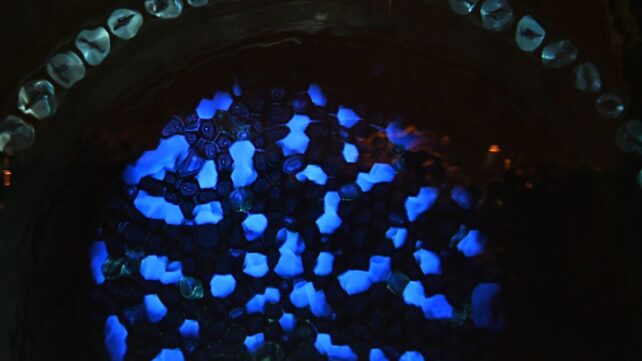
A 'boom' of light that appears when a particle exceeds the speed of light set by a medium could, in other contexts, signal a kind of quantum instability that could trigger what's known as vacuum decay.
If ever spotted in the emptiness of space, according to theoretical physicist Eugeny Babichev of the University of Paris-Saclay, the eerie blue glow of Cherenkov radiation could be interpreted as a manifestation of negative-energy ghost perturbations.
Why does it matter? Because our current theory of gravity is incomplete, and such a signal would offer rare insight into how spacetime behaves in regimes where existing theories break down, and potentially narrow the search for better models.
Related: Ghostly Glow of a Nuclear Power Station Was Detected in Pure Water 150 Miles Away
"Here we show that one can consider two seemingly very different physical effects, Cherenkov radiation and ghost instability, from the same perspective," Babichev writes in his paper.
"That is, we will demonstrate that one can interpret Cherenkov radiation as instability with creation of ghost carrying negative energy."
A "ghost" in physics can describe any non-physical factor added to a particle theory to make it mathematically consistent. But it can also refer to a physical negative-energy disturbance, distinct from mathematical gauge ghosts, that signals an instability.
This is where our water analogy is helpful. Think of the surface of the water as a baseline, the lowest-energy state the water can occupy. Making ripples costs energy, such as the injection of a pebble; usually, nature won't create ripples without the addition of energy to feed them.
Under certain conditions, however, theory predicts the appearance of a disturbance that carries negative energy – a ghost. This looks a lot like ripples spontaneously appearing, without the supply of a pebble to inject the energy required to create them.
It's not the creation of energy from nothing. Instead, the system can lower its total energy by producing paired disturbances – one positive and one negative – making the original state unstable.
Here on Earth, Cherenkov radiation is a visible-light signature of an instability; it occurs when a perturbation in a medium travels faster through that medium than the 'ripples' it creates – the light version of a sonic boom. The ripples build up until they erupt in a boom. It's usually seen in nuclear reactors, where charged particles travel through water faster than light can.
However, according to known physics, nothing can move faster than light in a vacuum, so Cherenkov booms should not appear there.
In his paper, Babichev explains that a ghost instability in empty space could behave very similarly to a superluminal charged particle and produce a Cherenkov boom in the same way. "As we have shown, the kinematics of the two processes – Cherenkov radiation and the ghost instability of a certain type – are indeed fully equivalent," he says.
That would be a game-changer for our understanding of the physical Universe. Detecting Cherenkov radiation in nothingness would mean that, at least sometimes, the cosmic vacuum can behave like a medium with structure, limits, and stored energy, helping inform or rule out some of the proposed modifications to our theories of gravity.
In turn, this would mean our definition of the vacuum is incorrect or incomplete, not the lowest-energy state of the Universe we assume it to be, forcing us to rethink our understanding of some pretty fundamental physics.
This would not be entirely unexpected; the tension between general relativity and quantum mechanics has been signposting a gap in our understanding of the physical Universe for decades.

This discussion is currently firmly ensconced in the realm of the theoretical; the paper offers no practical means of even seeking such a detection. But a solid theory is a good first step; and exploring the possibilities presented by this idea is a way to figure out how to look for it.
"It would be interesting to study a scenario, when such an unstable configuration in modified gravity is quasi-stable, that is the time of instability being much longer than relevant physical processes. For example, one can think of a black hole with the presence of a ghost, but with instability rate smaller than the frequency of quasinormal modes," Babichev writes.
"Another direction for future study would be to examine analytically and numerically how such type of ghost instability is developed for particular solutions in various gravity theories."
The paper has been published in Physical Review D.