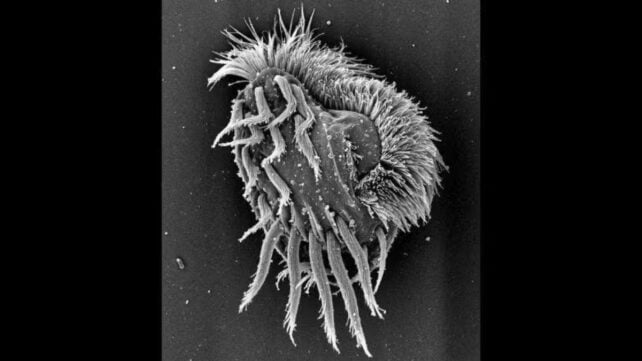
A newly discovered microbe has a strange Dr. Jekyll and Mr. Hyde duality.
Euplotes gigatrox is a tiny ciliate that's normally content to swim around serenely in seawater, swallowing bacteria.
But given enough time, a colony of clones will eventually be rocked by a rogue cell that grows into a "supergiant" and goes on a cannibalistic rampage.
"This is a single cell doing something we usually associate with the development of animals," says Ben Larson, a biologist at Rensselaer Polytechnic Institute in the US.
"It expands our picture of what single-celled organisms are capable of, and gives us a new system for asking questions about how cells control their form and function."
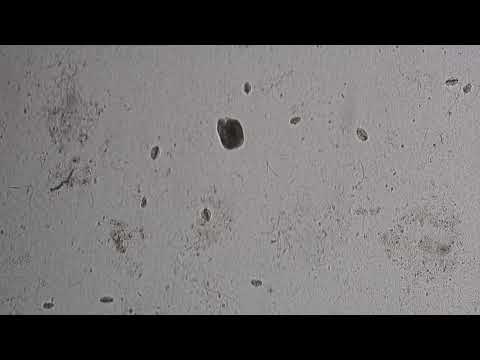
The researchers discovered E. gigatrox in samples of seawater collected from a filtration system on the Caribbean island of Curaçao.
The organisms were cultured in artificial seawater, and supplemented with plenty of nutrients and bacteria to eat.
For a few months, things seemed normal.
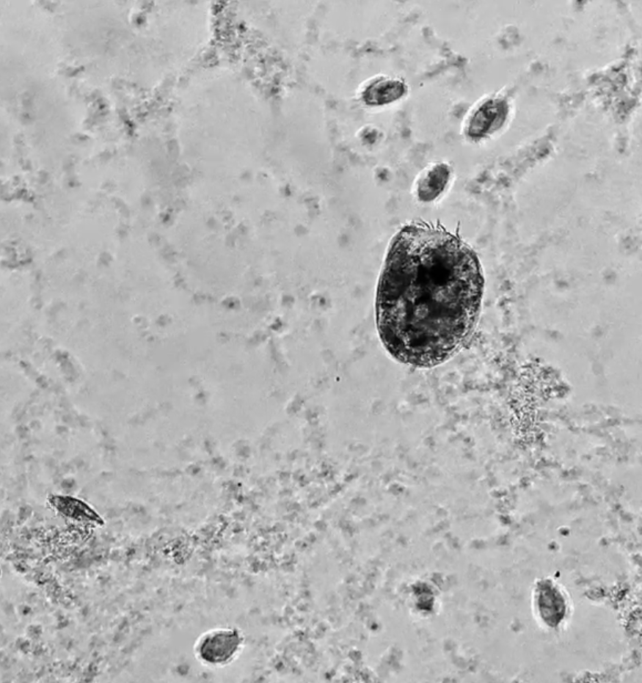
But eventually, the researchers noticed some cells had spontaneously grown to massive sizes.
Where a normal cell was around 54 micrometers long on average, the supergiants grew to around 140 micrometers.
And unfortunately for the regular cells, these changes weren't just cosmetic.
The supergiants used their extra bulk to hunt down the common clones, eating one cell each every 10 minutes or so.
"In cannibalistic feeding, predator cells 'run over' normal morphs until they are lodged in the oral cavity, where they are engulfed," the researchers write.
"This contrasts sharply with filter feeding in normal morphs and other Euplotes species, where a current is generated by the membranelles to pull bacteria and small protists in."
Thankfully, there is a way for regular cells to avoid being eaten by a supergiant: Just keep swimming. In their normal state, E. gigatrox can 'walk' along surfaces or swim in fluids with an elegant helix-shaped movement.
Supergiants, however, are too bulky to swim, and can only hunt along surfaces in circular patterns. When the researchers shook them loose, they could only tumble awkwardly through fluids until they reached a surface again.
"Supergiant formation represents a tradeoff," says Larson.
"These cells become better hunters but worse swimmers, shifting their trophic niche from feeding on bacteria to exploiting a completely different type of prey."

This larger state wasn't a permanent change, however.
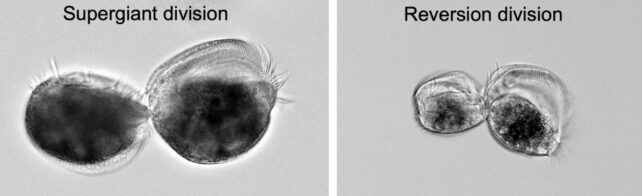
The team observed that all supergiants reverted back to normal size within 24 hours. There seemed to be a latency period afterward, where they couldn't become supergiant again for a while.
When the researchers separated populations into normal cells and those that had recently reverted from supergiants, new supergiants formed earlier and more frequently from the normal populations than from former supergiants.
To find out what was going on in the cells during the transformation, the researchers investigated gene expression in normal cells, supergiants, and recently reverted cells. They found two particular sets of gene expression that seemed to play a key role.
"One set is switched on during the differentiation to supergiant, and partially lingers in the reverted stage, while a second set is upregulated in reverted cells only, and it likely accounts for the latency period," the researchers write.
As for what triggers some cells to enter a supergiant phase, the researchers found a few clues. They consistently appeared only after a population had finished a period of exponential growth and leveled off into a more stable phase.
Intriguingly, they won't appear if there's a bounty of bacteria to eat.
It's only when other food sources become scarce that a small subset of cells seems to enter their Mr. Hyde phase and turn to devouring their fellow cells.
On closer inspection, even more diversity appeared in the cultures, including "winged" morphs, which Larson and team note "might serve a defensive purpose".
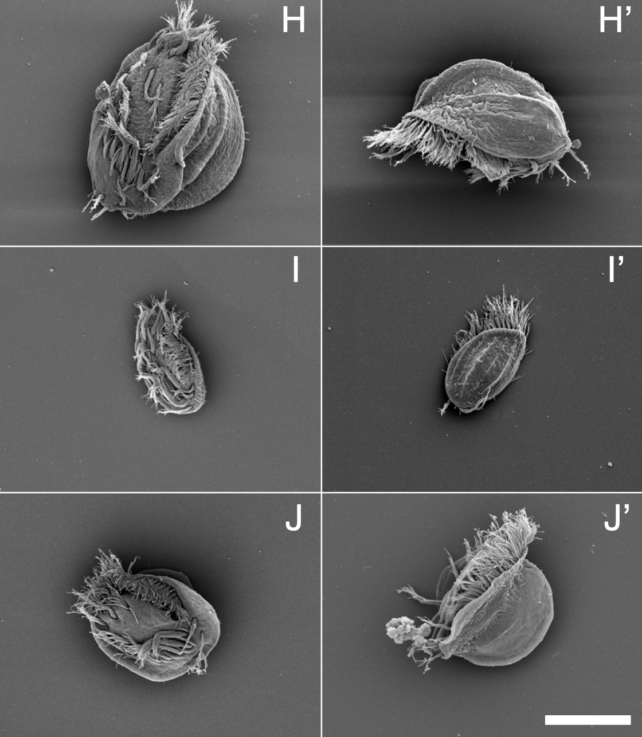
In all of their experiments, the researchers report that supergiants never accounted for more than 5 percent of a total population.
This, they say, suggests "that the formation of supergiants could serve as a bet-hedging strategy for a subset of cells in a recently growing population as it reaches carrying capacity."
Related: Newly Discovered Organism Could Represent a Whole New Branch in The Tree of Life
This work is yet another reminder of the kinds of tiny horror stories that are constantly playing out all around us.
The research was published in the journal Proceedings of the National Academy of Sciences.