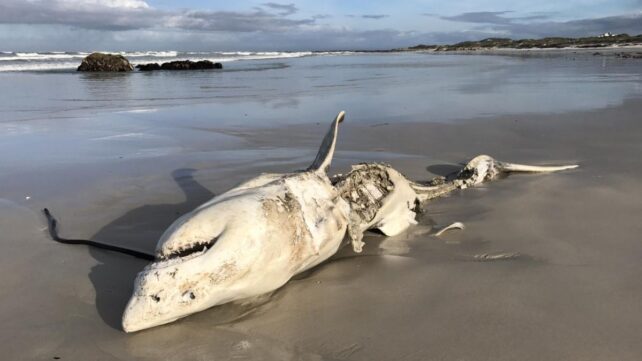
Off the coast of South Africa, near the fishing town of Gansbaai, two orcas have made a name for themselves worldwide.
Their names are Port and Starboard, and on multiple occasions, they've been observed hunting and killing one of the most fearsome predators in the ocean: the great white shark, Carcharodon carcharias.
So efficient are the hunting skills of these two killer whales (Orcinus orca) that some scientists have attributed the sharks' dwindling numbers in a once-heavily populated habitat to them.
There's just one problem, a new paper lays out. The orcas aren't the real culprit. Rather, an even more efficient predator could be driving sharks from their home: us.
In recent years, it has begun to emerge that killer whales are highly skilled hunters of sharks, including large species such as whale sharks and great whites.
Orcas use echolocation to essentially ultrasound a shark's body, targeting the liver – rich in lipids that sustain sharks on long migrations – and extracting it with near-surgical precision.
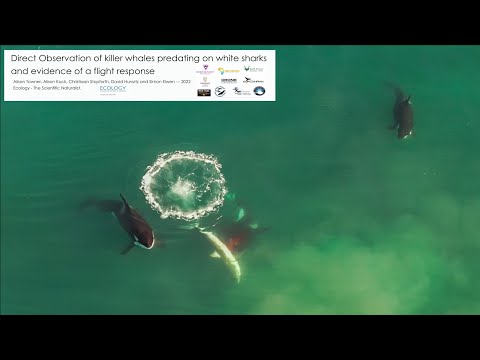
Between 2017 and 2025 – a span of about eight years – there were 11 documented occurrences of orca predation on white sharks, mostly wash-up carcasses, thought to be the work of Port and Starboard. In 2017, researchers watched as the pair killed and eviscerated 17 smaller sevengill sharks in a single day, but that was a rarity.
It's impossible to tell how many sharks Port and Starboard kill each year on average, since we can't be sure humans always record the hunts.
However, according to a paper led by marine biologist Enrico Gennari of the Oceans Research Institute in South Africa, humans likely have the killer whales beat hand over fist.
He and his colleagues drew on multiple lines of evidence to estimate the anthropogenic white shark death toll among the South African population, and the numbers are far higher than known orca kills.
Humans, they find, are removing an estimated 44 white sharks per year from coastal South Africa through the KwaZulu-Natal shark control program and as bycatch of longline shark fisheries.
Historically, this line of enquiry has been complicated. In 1991, South Africa became the first nation to enact legislation protecting the great white shark. Subsequently, it needed to monitor shark populations and take measures to protect them.
However, exactly what those white shark populations are doing has been the subject of debate. A 2023 study suggested the sharks have not declined, but instead shifted their range eastward, with the same group of researchers clarifying in 2024 that the lack of population growth since the 1991 protections was nevertheless cause for concern.
The narrative of a stable population may limit the urgency with which governments consider further conservation efforts, researchers warned.
Gennari and his colleagues argue in their opinion piece that the broader evidence is more concerning. The white shark population is not stable, they say, but declining. And this has graver implications for the species globally.
"If the worrying declines observed in what were once considered the largest aggregation sites of white sharks in the world, in just less than a 15 yr period, were representative of the entire population of white sharks in southern Africa, as we believe they are," the researchers write, "the situation would be extremely alarming, and the possible extinction risk could happen much earlier than modelled."

The most recent count of white shark numbers used data up to 2011 and estimated that the population swam at around 908 individuals. Subsequent analyses incorporating genetic data published in 2016 suggested there are only 333 mature individuals in a single interbreeding population along the South African coast.
No census has been taken since then – and sightings of the animals have fallen dramatically in some places.
In False Bay, near Cape Town, white sharks could be seen at a rate of about 1.64 per hour between 2000 and 2015. Between 2016 and 2020, that rate dropped to 0.3 sharks per hour. By 2018, the number was effectively zero in boat-based surveys.
Gennari and colleagues are likewise concerned that the white shark population is in decline. They estimate that the 44 white sharks killed each year, through the demersal shark longline (DSL) fishery regulated by the South African government and the KZNSB shark control program, amount to around 5 to 10 percent of the estimated population yearly.
That's unsustainable on its own, and it's not even accounting for other sources of human-caused mortality not included in the estimate.
Related: There's One Predator in The Ocean Instilling Terror in Great White Sharks
We can't control what Port and Starboard do, obviously – but that, the researchers say, makes it even more important to impose limits on human activity that endangers this population of sharks.
"Predation by orcas is a natural phenomenon that, no matter the level, does not fall under management control of the government of South Africa, similarly to other sources of mortality occurring in international waters," the researchers write.
"However, the ongoing mortality of white sharks from the DSL and KZNSB, which do fall under government regulation, [is] alone at levels sufficient to prevent white shark recovery, and likely to drive its decline."
"While South Africa was the first nation to protect white sharks," the team concludes, "we fear that it may soon also hold the title as the first nation to lose this species."
The report was published in Endangered Species Research.