When someone is affected by a stroke, the standard treatment to restore blood flow to the brain can both save their life and cause additional damage – damage which a new, injectable nanomaterial promises to protect against.
The regenerative material, called IKVAV-PA for short, was developed by researchers at Northwestern University in the US. It's previously been shown to repair tissue in a mouse model of spinal cord injuries, and here it was tested on a mouse model of acute ischemic stroke, the most common type.
At the core of the treatment are supramolecular therapeutic peptides (STPs), nicknamed 'dancing molecules' because of how dynamically their biological parts can move. This makes them more adaptable and versatile when interacting with target cells.
Related: Huge Study Links 99% of Heart Attacks And Strokes With 4 Risk Factors
Another key innovation here was the use of systemic delivery: injecting the molecules into the bloodstream. It's fast and simple to administer, and far less invasive than delivering them directly to the brain.
"This systemic delivery mechanism and the ability to cross the blood-brain barrier is a significant advance that could also be useful in treating traumatic brain injuries and neurodegenerative diseases such as amyotrophic lateral sclerosis," says materials scientist Samuel Stupp.
In the tests on mice, the first success was getting the drug into the brain through the bloodstream. What's more, side effects and broader disruption appeared to be minimal, suggesting the therapy had indeed hit the target of the stroke site.
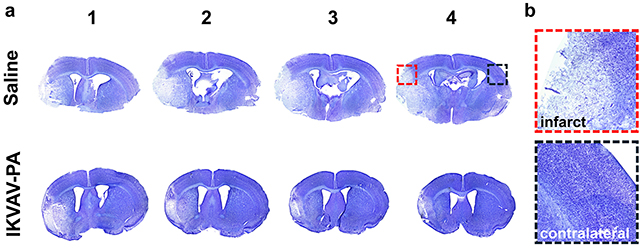
Compared to untreated mice, those given the injected biomaterial after the restoration of blood flow to the brain showed less damage to brain tissue, fewer signs of inflammation, and fewer signs of harmful immune responses.
The main job of IKVAV-PA is to encourage nerve cells to repair themselves after injury, whilst also keeping inflammation to a minimum. That inflammation is a real risk as the body continues to react to the initial blood flow blockage.
"You get an accumulation of harmful molecules once the blockage occurs and then suddenly you remove the clot and all those 'bad actors' get released into the bloodstream, where they cause additional damage," says Stupp.
"But the dancing molecules carry with them some anti-inflammatory activity to counteract these effects and at the same time help repair neural networks."
Treating patients post-stroke is an incredibly delicate balancing act. After clots block blood flow to the brain to cause the stroke, restoring that flow is crucial, but collateral damage and even long-term disability can follow.

With further development, we could be looking at a secondary treatment that can be applied alongside the restoration of blood flow (known as reperfusion). Of course, this also needs to be tested in humans, and over a much longer time period to assess its long-term safety and viability.
Tens of millions of people are affected by strokes each year, and while the survival rate is relatively high, we're still looking at several million deaths each year and many more lives affected by disability. IKVAV-PA could help make a difference to those figures.
"It has not only a significant personal and emotional burden on patients, but also a financial burden on families and communities," says neuroscientist Ayush Batra.
"Reducing this level of disability with a therapy that could potentially help in restoring function and minimizing injury would really have a powerful long-term impact."
The research has been published in Neurotherapeutics.