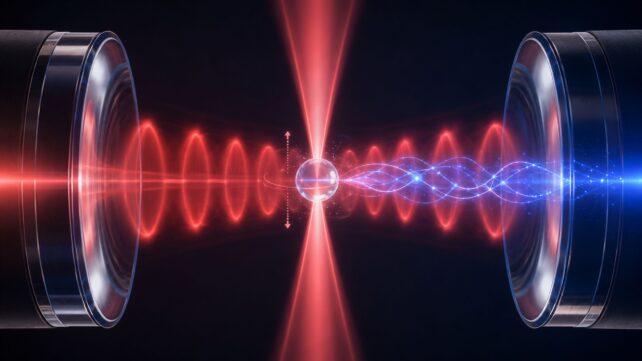
A new window into the quantum realm has just been opened by a single microscopic grain of glass levitating in a beam of light.
In what may be the world's tiniest disco, physicists intertwined the grain's properties with those of light so tightly that one could not be described without including the other.
This is quantum entanglement – and this experiment marks the first demonstration of persistent entanglement between the motion of a levitated object and light that travels away from it, all without cryogenically cooling the apparatus.
It's a milestone that the researchers say could open new avenues for quantum communication and tests of quantum physics.
"I have always been fascinated by the possibility of observing quantum effects in macroscopic systems, something that occurs notably in quantum optomechanics experiments," physicist Francesco Marin of the University of Florence in Italy told ScienceAlert.
He and his colleagues had already shown that they could use light to cool the motion of a levitating glass nanosphere, bringing it into the strange domain where quantum effects start to become important.
"My next goal was to push the interaction between the light and the nanosphere's motion to the point of generating entanglement – arguably the most defining and counter-intuitive phenomenon in quantum mechanics," Marin said.

Entanglement is one of the strangest consequences of quantum mechanics – where the properties of two objects become so deeply correlated that they can no longer be fully described independently.
Physicists have demonstrated it countless times with the tiny particles that inhabit the quantum realm – photons and atoms, for example.
Even on this scale, the delicate correlations of quantum entanglement are easily disrupted by interactions with the surrounding environment. And the larger and more complex an object becomes, the harder it is to keep its quantum behavior intact.
Marin and his team wanted to see if entanglement could be coaxed out of a tiny bead of glass. To our eyes, this speck would be utterly undetectable – it measured just 100 nanometers across, about the size of a virus.
Compared to the quantum realm, however, this nanoparticle would be a colossus, containing tens of millions of atoms.
The quantum behavior the researchers were interested in wouldn't involve any one of those atoms, but in the center-of-mass motion of the entire sphere.
And, to maintain the isolation that would enable quantum behavior, the sphere wasn't attached to anything.
It was levitated in a tightly focused laser beam called an optical tweezer, which uses the force exerted by light – radiation pressure – to keep the nanoparticle aloft and confined between two opposing mirrors that form an optical cavity, while still allowing it to oscillate around its equilibrium position.
This was done inside a near-vacuum chamber, insulating the sphere's motion from environmental disturbances that would otherwise erase fragile quantum behavior. Box one, ticked.
But creating entanglement would prove to be rather more complicated.
To encourage the nanosphere into the quantum regime, the researchers needed light that would cool and stabilize its motion. Yet the light needed to generate entanglement did the opposite: it heated the sphere's motion and eventually destabilized it.
The researchers needed to separate the job of cooling the sphere from the job of entangling it with light.
"The solution was to decouple the two phenomena by using two distinct lasers – one red-detuned and the other blue-detuned relative to different optical cavity resonances – and combining them to form a single two-color tweezer," Marin explained.
The two separate lasers divvied up the tasks. The red-detuned light cooled and stabilized the sphere's tiny oscillations, bringing its motion close to its quantum ground state. The blue-detuned light could then take a crack at the main event: entangling that motion with light.
More specifically, the entanglement linked the sphere's position and momentum as it oscillated within the trap with properties of the light, called quadratures, that are analogous to its amplitude and phase.
"Entanglement means that the quantum fluctuations of these two systems cannot any more be described independently," Marin said.
"There is no longer a complete quantum description of 'the sphere' and 'the light' separately. A measurement of the light quadratures somehow modifies the state of the nanosphere. The appropriate description is a joint state of the mechanical motion and the electromagnetic field."
Importantly, none of this required cooling the entire apparatus to cryogenic temperatures, as many quantum optomechanics experiments do.
It was only the sphere's motion that the lasers cooled, while levitation and the near-vacuum environment shielded that cooled motion from outside influences.
"So the surrounding laboratory is at room temperature, but the particular mechanical degree of freedom we study is prepared at a much lower effective temperature," Marin explained.
"The combination of levitation, high vacuum, and optical cooling allows the quantum correlations to develop before environmental heating destroys them."
But creating entanglement is only half the battle. The other half is proving that the correlations really are quantum in nature, rather than something forged by classical physics.
And this is where the experiment demonstrates its cleverness – because that evidence was written in the light traveling away from the sphere.
As the sphere wiggled inside the optical cavity, information about its motion became encoded in the light.
By measuring the light emerging from the cavity, the researchers could therefore reconstruct the correlations between the sphere's position and momentum and the light's quadratures.
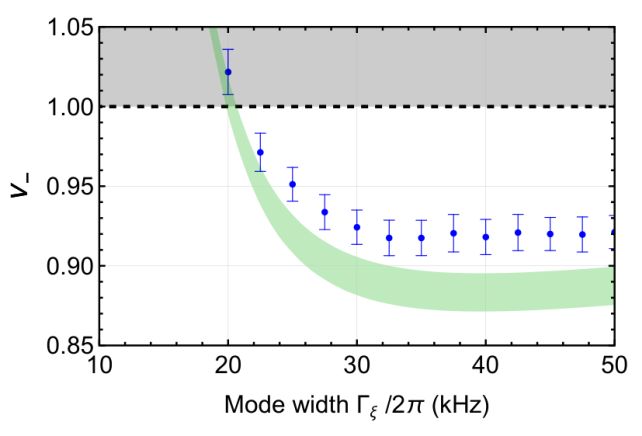
Quantum mechanics provides a threshold for distinguishing entangled systems from separable ones. When the team reconstructed the full pattern of correlations, their measurements crossed that threshold – and remained on the entangled side even when the researchers accounted for experimental uncertainties and varied the assumptions used in their analysis.
"This is what gives us confidence that the correlations we observe are genuinely quantum and correspond to entanglement between the nanosphere motion and the light," Marin said.
It wasn't a result that announced itself with a sudden flash on a screen, though. The experiment had to run for hours as the chamber reached sufficiently low pressure, with three laser systems remaining stable throughout.
Even after data collection began, the evidence mounted slowly.
"Once the analysis method is optimized, we process increasingly larger datasets, and gradually, the presence of entanglement emerges with statistical significance," Marin said.
"That is a moment of relief… we realize we've made it."
What makes the result particularly useful, however, is what happened to the entangled light next: it left.
Unlike the glass bead itself, the quantum correlations weren't confined to light trapped between the mirrors of the optical cavity. They persisted in the light traveling away from the nanosphere – turning it into something that could, at least in principle, carry those correlations elsewhere.
"A field that exists only inside a cavity is difficult to use as a quantum resource elsewhere. Once the light leaves the cavity, however, it becomes a traveling quantum system. It can in principle be transmitted through an optical network, measured at another location, or made to interact with another quantum device," Marin explained.
"The propagating field is essentially the channel that could connect the mechanical system to the outside world."
There is much to be done before that is achievable, though.
The researchers need to strengthen the entanglement and learn to control it dynamically, rather than simply observing the stationary state – steps that could eventually allow quantum information to be written to, stored in, and retrieved from the mechanical oscillator.
But the fundamental interface from which to build is now in place, and ready to go to work.
"The next challenge is to turn that interface from something we observe into something we can actively use," Marin said, "and eventually to connect several such interfaces – several nanospheres in different optical tweezers – into a larger quantum system."
The research has been published in Science.
This article was fact-checked by Rebecca Dyer and edited by Rebecca Dyer. While we pride ourselves on our process, we are only human. If you spot a mistake, please let us know.