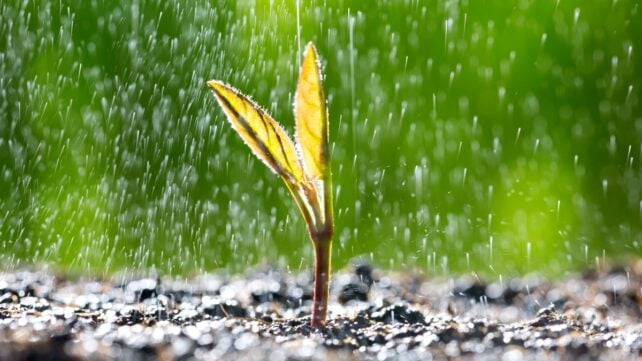
Plant seeds can sense the vibrations generated by falling raindrops and respond by waking from their state of dormancy to welcome the water, new research shows.
While the soothing pitter-patter of rainfall induces humans to snuggle up and settle down, it appears to do the opposite for rice seeds, causing them to germinate in 'anticipation' of the coming deluge.
The finding, discovered by MIT mechanical engineers Nicholas Makris and Cadine Navarro, offers the first direct evidence that seeds and seedlings can sense and respond to sounds in nature.
"What this study is saying is that seeds can sense sound in ways that can help them survive," explains Makris.
"The energy of the rain sound is enough to accelerate a seed's growth."
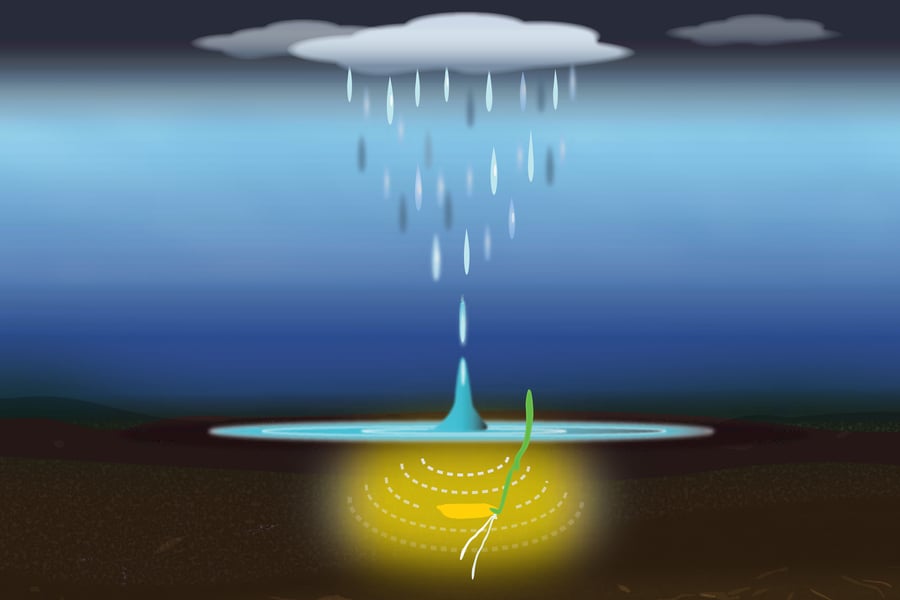
Plants don't have the same aural equipment we do to actually hear sounds, of course. But the study suggests that seeds respond to the same vibrations that can produce a sound experience in our human ears.
Across a series of experiments, the researchers submerged nearly 8,000 rice seeds in shallow tubs of water, at a depth of around 3 centimeters (1 inch), and exposed some of them to falling water drops over periods of six days.
They varied the height and size of each falling drop to simulate rainstorms of differing intensities, while also altering the positions of the seeds to determine how depth and distance influence germination.
A hydrophone recorded the acoustic vibrations produced by the drops, confirming that the experiment mimicked the vibrations produced by actual raindrops falling in nature – such as the driving downpours that can sometimes pelt Massachusetts' puddles, ponds, and wetlands.
For those suddenly craving the soothing sounds of a storm, the researchers uploaded the otherworldly percussion of a Massachusetts shower serenading a puddle, providing a rare human glimpse of a submerged seed's experience.
"It gives new meaning to the fourth Japanese microseason, entitled 'Falling rain awakens the soil,'" Makris says.
In their study, the researchers observed that seeds exposed to the falling drops germinated up to around 37 percent faster, compared with seeds that did not receive the simulated rainstorm treatment but were housed in otherwise identical conditions.
This adaptation appears to be facilitated by statoliths – gravity-sensing organelles that settle toward the bottom of certain plant cells, providing a sense of gravitational direction (gravitropism) to guide the downward growth of roots and the upward growth of shoots.
The sound waves produced by falling raindrops can impart enough force through water and possibly soil to jostle these statoliths and trigger seed growth.

Indeed, the highest increases in germination rates were observed in the seeds that experienced the highest levels of statolith displacement, due to proximity to the falling drops.
This suggests that seeds planted closer to the surface are likelier to respond, because they're at an optimal depth for absorbing moisture and growing.
Acoustic vibrations are most pronounced in submerged conditions. Since water is denser than air, pressure waves are magnified and travel more easily, making rain much louder underwater.
For perspective, the sounds of rain produced in a shallow puddle are in the range of hundreds of Pascals, while a typical human conversation at a distance of 1 meter (3.3 feet) may be in the range of 0.005 to 0.05 Pascals.
"So if you're a seed that's within a few centimeters of a raindrop's impact, the kind of sound pressures that you would experience in water or in the ground are equivalent to what you'd be subject to within a few meters of a jet engine in the air," says Makris.
Related: Plants Really Do 'Scream'. We Just Never Heard Them Until Now.
The researchers believe that other types of plant seeds react to environmental sounds in similar ways, and ultimately chose rice because it shares similarities in gravitropism with many other plants.
Rice, an essential staple food for billions of people, also grows in underwater environments, making it perfectly suited for this experimental setup.
This research was published in Scientific Reports.