The fungal compound verticillin A, discovered more than 50 years ago, has long been regarded for its potential cancer-fighting capabilities. Scientists have now managed to artificially synthesize the compound for the first time, meaning they can study it in more detail and potentially develop new cancer treatments.
Being able to produce verticillin A on demand in the lab is a major step forward. In nature, it's found only in small amounts in a microscopic fungus and is very difficult to extract.
Before now, the complex chemical structure and inherent instability of verticillin A made it tricky to synthesize, but researchers from MIT and Harvard Medical School have overcome both problems.
Related: Blocking One Protein Slows Cancer Growth in Mice, Scientists Discover
The key was finding a way to rework the approach MIT chemist Mohammad Movassaghi had used before to synthesize similar compounds, which differed from verticillin A by just a few atoms.
"We have a much better appreciation for how those subtle structural changes can significantly increase the synthetic challenge," says Movassaghi.
"Now we have the technology where we can not only access them for the first time, more than 50 years after they were isolated, but also we can make many designed variants, which can enable further detailed studies."
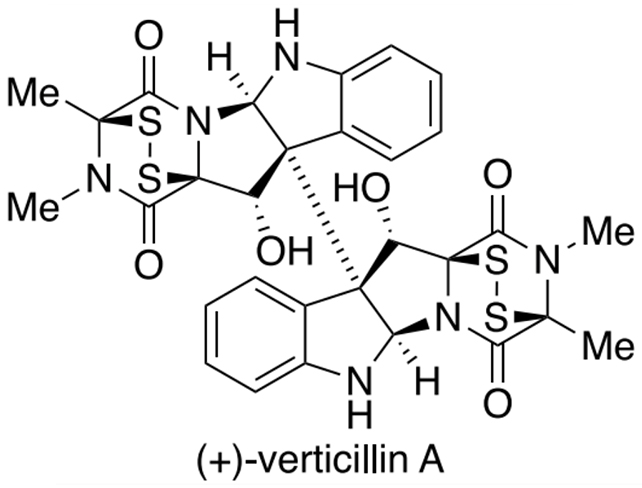
Verticillin A molecules are basically two identical halves fused together, creating what's known as a dimer molecule. Sounds simple to make, but verticillin A's 3D structure must be precisely arranged for the compound to form.

To build verticillin A, the researchers used a few tricks, switching up the order in which they added molecules and protecting fragile bonds from being broken during synthesis.
Their 16-step process, which 'unmasked' some of verticillin A's functional groups after its two halves had been brought together, gave the researchers the precise 3D structure they needed.
"What we learned was the timing of the events is absolutely critical," says Movassaghi.
"We had to significantly change the order of the bond-forming events."
The researchers tested their new synthetic compound and several variations of it on lab-grown cells of diffuse midline glioma (DMG), an aggressive brain cancer affecting children.
Molecules related to verticillin A had previously shown promise in killing DMG cells, and this was again observed in the new tests on lab-grown cancer cells.
A closer analysis also revealed that the new synthetic compound was hitting its intended protein targets inside the cells.
Related: Multiple Sclerosis May Have Two Distinct Subtypes, Scientists Discover
Now that verticillin A has been synthesized for the first time, the work to understand how it interacts with cancer and how it could be adapted into treatments can be taken to a whole new level.
"Natural compounds have been valuable resources for drug discovery, and we will fully evaluate the therapeutic potential of these molecules by integrating our expertise in chemistry, chemical biology, cancer biology, and patient care," says chemical biologist Jun Qi, from Harvard Medical School.
The research has been published in the Journal of the American Chemical Society.