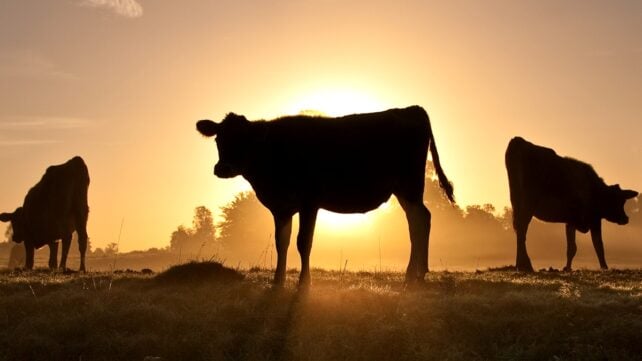
Almost half of all habitable land on Earth is used for agriculture, and most of that is dominated by livestock farming, which not only monopolizes land, but has numerous negative impacts on the environment.
Yet despite the size and environmental burden of animal farms, animal agriculture, including dairy production, only provides about 17 percent of global calories consumed and just one-third of the protein we eat.
Given the disparity, there's huge interest in finding more efficient farming solutions for the foods we need, all aside from the looming sustainability concerns associated with animal farming.
In a recent study published in Frontiers in Sustainable Food Systems, scientists in the UK quantified a dramatic alternative to conventional milk production, with the ultimate potential to free up huge amounts of land currently used for dairy cattle.
If the UK were to replace traditional dairy milk with milk produced by a technique called precision fermentation, the land footprint would be up to 96 percent lower than that of cow's milk, researchers estimate.
"By avoiding raising animals and growing their feed, the land-sparing potential of precision fermentation [milk products] could be substantial," environmental scientist Jade A. Warren from Imperial College London and colleagues write in their paper.

Precision fermentation uses genetically engineered microbes such as yeast or fungi to produce ingredients, including the dairy proteins found in cow's milk.
Aspects of the process have been used since the 1980s, but recent advances in technology are leading to new kinds of food production possibilities, including viable alternatives to cow's milk.
In those formulations, milk proteins are added to a mix of plant-based fats and sugars – so there's no lactose or cholesterol – plus many of the vitamins and minerals you would usually find in cow's milk.
Due to its potential, precision fermentation has been studied from an environmental perspective, but mostly in terms of its carbon footprint.
In their own study, Warren and colleagues focused on the benefits that precision fermentation could offer to land usage in the UK, calculating the amount of land needed to produce 1 metric ton of precision fermentation milk.

They then compared this to the amount of land used for dairy cow grazing – and the cropland used to grow their feed – to produce the same amount of milk.
The results were striking.
Replacing just 20 percent of the UK's annual milk production with precision fermentation milk would free up an estimated average of 859 kilohectares (8,590 square kilometers, or about 3,320 square miles) of land currently used for dairy milk production.
Moving to a 50/50 split would more than double the amount of land freed up. And completely replacing dairy milk production with precision fermentation would give the UK back an estimated 4,294 kilohectares of land – an area the size of mainland Denmark.
"This land could be used for various purposes, including rewilding, providing settlement or producing food for the growing UK population," the researchers write, also noting the land releases could more than satisfy national targets to reduce and repurpose agricultural land use in accordance with net zero goals by 2050.
Related: The Best Way to Restore Forests May Not Actually Involve Planting Trees
The researchers also say the move to precision fermentation could help fill in a gap in the UK's net zero goals, which call for agricultural land to be freed up to restore forests and peatlands by 2050, but don't explicitly explain how that can be achieved without producing less food.
"Given the political sensitivity around dietary change," the researchers write, "precision fermentation, which can be used to produce identical proteins with potentially much lower land demands than their animal-derived counterparts, could help policymakers navigate this challenge and overcome inertia around reducing animal agriculture."
While this study focused on the UK, the researchers say their findings could have global implications, helping countries all around the world to free up land used in animal agriculture and repurpose it towards greener ends.
In a world where milk consumption is rising, something has to give.
The findings are reported in Frontiers in Sustainable Food Systems.
This article was fact-checked by Rachel Garner and edited by Clare Watson. While we pride ourselves on our process, we are only human. If you spot a mistake, please let us know.