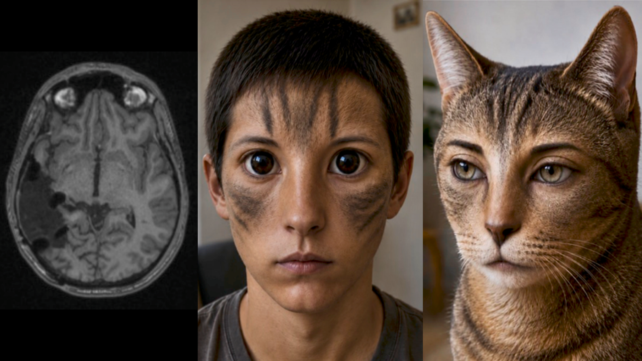
Just when you think you've heard it all when it comes to curious medical tales, along comes the case of a 28-year-old man from the northeastern US who sees his pet cat Luna in the faces of the people he meets during the day.
Sometimes it happens the other way around: If the first face he sees in the morning is a person, then features from that human face get transposed onto Luna, as well as other people he encounters.
These rather unsettling experiences have been going on for two years, after the man (known only as Karl) had an operation to remove a tangle of blood vessels that may have caused a brain bleed (a condition known as arteriovenous malformation).
The case has been reported on in the journal Cortex, by researchers from Dartmouth College and Brigham and Women's Hospital in the US.
"These episodes often persist for several hours and occasionally last all day," write the researchers in their published paper.
"Aside from their unusual combinations of features, the resulting faces appear entirely coherent. The transferred features are seamlessly integrated into the viewed face rather than appearing superimposed, and they change naturally as viewpoint or distance shifts."
It's not a condition completely unknown to science, and it's called palinopsia, which means that something seen – so the face of a cat or a person, for example – then reappears or persists later on.
This particular case is known as prosopometamorphopsia, where face distortions are involved.
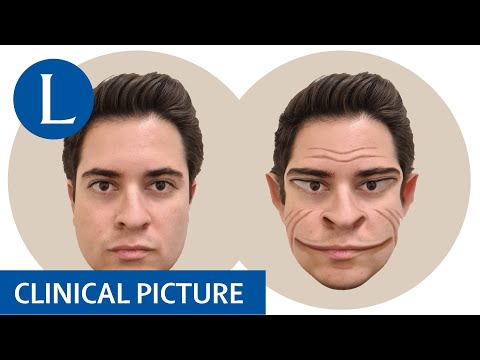
And face processing happens to rely heavily on the brain's right temporal lobe – part of which had to be removed during Karl's operation.
"This case of Karl seeing his cat's features in human faces and vice versa demonstrates that individual features can be pulled from memory and influence our ongoing perception," says psychologist and brain scientist Brad Duchaine, from Dartmouth College.
Duchaine and Karl worked together to produce an AI-generated image that represented the prosopometamorphopsia, and according to the researchers, the latest AI tools promise to be a major step forward in understanding these conditions.
Images can be produced in seconds from just a few words or sentences, and then refined until they match what's showing up in someone's mind's eye.
"AI provides researchers like us with the ability to generate more accurate visualizations of what people are experiencing when they're having distorted visual perceptions," says Duchaine.
"If you know what the person is experiencing, you can much better research what they're dealing with and try to figure out ways to control it. And now the patient can also take part in that process of creating those visualizations."
There's an even stranger twist to the story too: This has happened before.
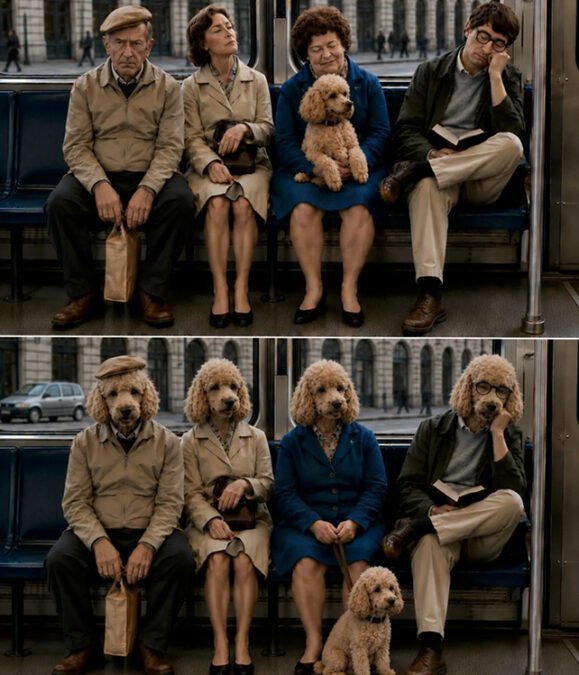
In a 1986 case also reported in Cortex, a 58-year-old woman who was sitting on a bus looked at a fellow passenger's poodle. When she looked back at the other passengers, they all seemed to have the dog's face.
Again, there was an issue with damage to the brain, this time caused by a stroke, which had also left the woman with problems recognizing people she knew, and even her own apartment.
The work to understand exactly what's going on continues.
Both the poodle and cat cases suggest that our brains process faces differently to other visual inputs, because the canine and feline characteristics only showed up there – not on trees or furniture.
It's more evidence that our brains are not simply looking at what our eyes see – they're combining other information at the same time. Digging deeper will require more case studies, and quite possibly more AI.
"Because progress in understanding many disorders of visual perception depends on accurately characterizing what patients see, we expect photorealistic visualizations to become an increasingly valuable tool for documenting such experiences," write the researchers.
The research has been published in Cortex.
This article was fact-checked by Rebecca Dyer and edited by Rebecca Dyer. While we pride ourselves on our process, we are only human. If you spot a mistake, please let us know.