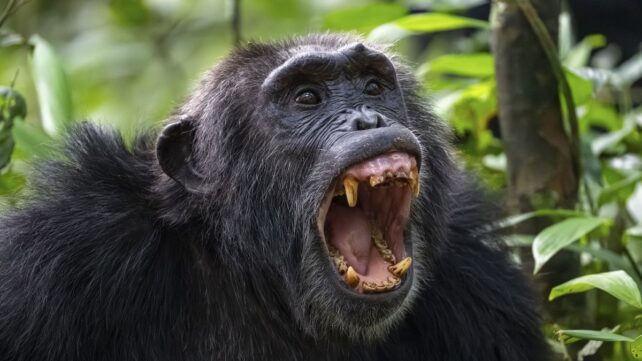
Deep in the rainforests of Uganda, scientists have watched the largest known group of wild chimpanzees (Pan troglodytes) turn on each other, as if engaging in a 'civil war'.
The lethal conflict is the first clear example of a ferocious fission in a wild chimpanzee community – which fractured into two warring groups.
Over many years, scientists watched as wild primates that once lived, ate, groomed, and patrolled together gradually turned on each other, ultimately becoming lethal rivals.
As one of humanity's closest living relatives, these chimps and their social interactions may help us better understand the evolutionary roots of 'war' and 'peace' in our own societies.
"It is tempting to attribute polarization and war that occur in humans today to ethnic, religious, or political divisions," explain the study authors, led by evolutionary anthropologist Aaron Sandel at the University of Texas at Austin.
But these primates don't have the same reasons for in-fighting. Instead, it seems that shifting social relationships can also drive a wedge between primates of the same culture.
"This study encourages a reevaluation of current models of human
collective violence," Sandel and colleagues conclude in their paper.
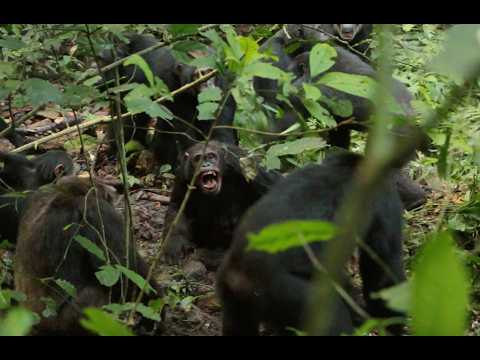
Their evidence, extracted from over 30 years of observations, contributes to a decades-long debate. In the 1970s, the late primatologist Jane Goodall noticed a community of chimps in Tanzania splinter into two rival factions, leading to a four-year-long lethal battle.
The reports became famous worldwide as a shocking example of non-human 'warfare', but the details were limited, and some critics have since argued that the battles only occurred because of food sources supplied during Goodall's research.
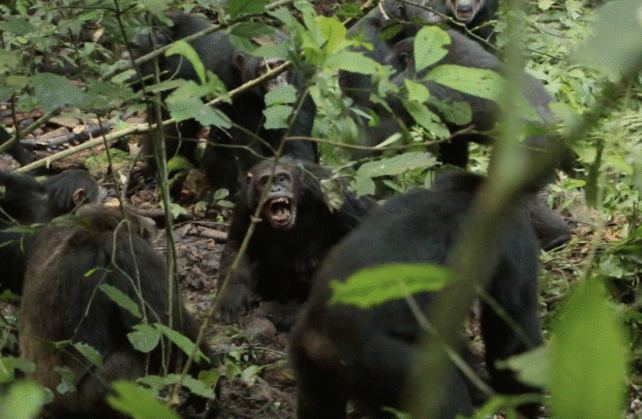
Chimpanzees can be gruesome killers, and in the wild, they are known to attack other neighboring groups, possibly to defend and expand their territory or to raid resources. But whether chimps of the same cultural group engage in civil 'warfare' has been less clear.
The genes of chimps, for instance, suggest that permanent fissions within groups are exceedingly infrequent – with an event occurring every 500 years or so.
This recent example in Uganda may be one such rarity. Back in 1995, Ngogo chimps in western Uganda's Kibale National Park were part of a single, large group.
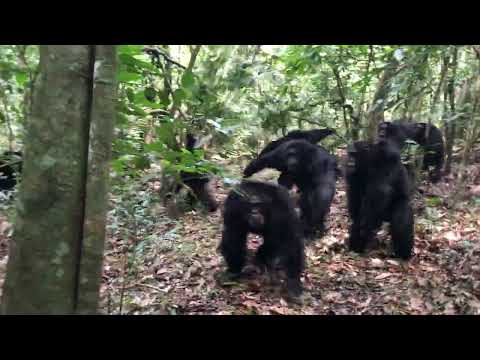
Then, in 2015, just after a new alpha male had been crowned, primatologists noticed an inexplicable shift.
Two clusters of chimps began to take shape within the same community, and mating occurred only between males and females of the same cluster or clique.
"Our first behavioral observations suggestive of a split occurred on 24 June 2015, when members of the Western and Central clusters approached each other near the center of their territory," the research team explains.
"Rather than reuniting in typical fission-fusion fashion, the Western chimpanzees ran away, and the Central chimpanzees chased them. A 6-week period of avoidance followed. Such a prolonged period of avoidance had not been observed before."
What was once the center of the Ngogo chimp community became a border, patrolled by males from both sides. Then, in 2017, social tension came to a head.
The Western group was much smaller than the Central group, but it initiated all the attacks. That year, Western chimps battled and severely injured the alpha male of the larger Central cluster.
By 2018, the rupture between these two cliques had become permanent in social, spatial, and reproductive terms. The females and offspring would no longer even feed at the same fig tree.
A few years later, in 2021, the aggression turned to infants. Researchers directly observed Western chimps stealing and killing 14 infants from the Central cluster.
Between 2018 and 2024, Western chimps would attack and kill an average of one adult male and two infants a year.
Such killing rates far exceed those that have been estimated for intergroup aggression among chimpanzees, the authors say, and there may have been more.
Over the years, more than a dozen Ngogo Central chimps died due to unknown causes. Often, these apparently healthy primates would just disappear, and their bodies were never recovered by researchers. It is very possible they, too, were killed by the Western 'rebellion'.

"With nearly 200 individuals, including more than 30 adult males, the Ngogo chimpanzee group exceeded the size of other chimpanzee groups, potentially straining the capacity for relationship maintenance," the research team hypothesizes.
"Although an alpha male change alone does not explain why the Ngogo group split, it may have amplified tensions between the two clusters."
James Brooks, from the German Primate Center, who was not involved in the research, says it is too early to draw any firm conclusions about why this chimp group ruptured, or what that means for other groups and species, including ourselves.
"Nevertheless," he writes in an accompanying perspective, the study provides "crucial information for… modeling the socioecological processes that underlie these events."
Related: Chimps Reveal Why Teenagers Are Notorious For Risky Behaviors
Humans may share 98.8 percent of our DNA with chimpanzees, but our genes are not our destiny. Our relationships with others can drive deadly divisions, but they can also foster cooperation and compassion.
"Relational dynamics may play a larger causal role in human conflict than often assumed," suggest Sandel and colleagues.
"In some cases, it may be in the small, daily acts of reconciliation and reunion between individuals that we find opportunities for peace."
The study was published in Science.