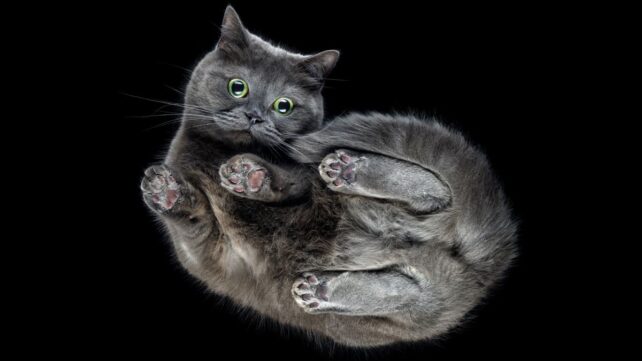
For more than a century, scientists have been trying to figure out how a falling cat lands on its feet with such astonishing regularity.
A famous scientific exploration of the subject was published in 1894. It's now 2026, and a newly published paper shows that research is far from finished exploring the details.
According to a team led by veterinary physiologist Yasuo Higurashi of Yamaguchi University in Japan, cats' extraordinary ability to stick the landing is at least partially due to differences in flexibility along their spines.
They measured each section's torque, rotation angle, stiffness, and neutral zone – the range of motion where minimal force is required for movement.
The front half – the thoracic spine – has a wider range of motion, and twists far more readily than the stiffer lumbar spine in the back half.
The researchers find that "trunk rotation during air-righting in cats occurs sequentially, with the anterior trunk rotating first, followed by the posterior trunk, and that their flexible thoracic spine and rigid lumbar spine in axial torsion are suited for this behavior."
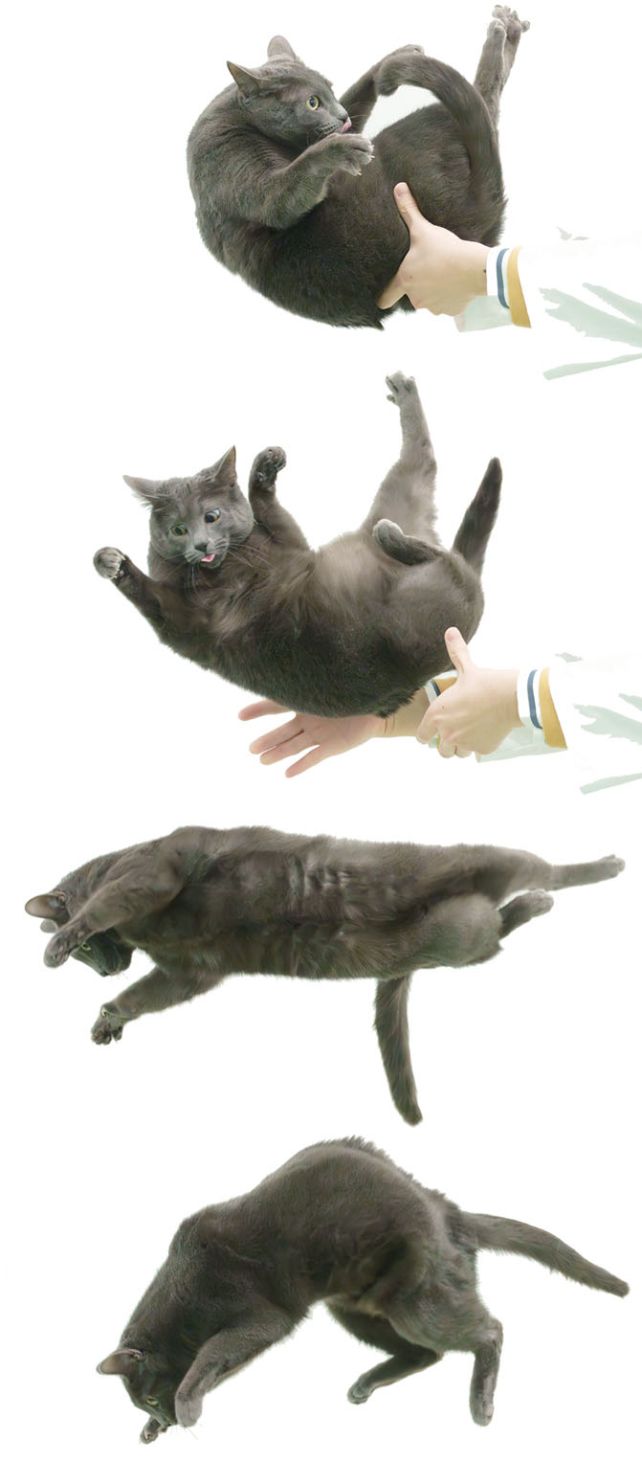
The puzzle presented by falling cats came to widespread attention when French physiologist Étienne-Jules Marey used early high-speed photography to capture a cat twisting midair. His images appeared in Nature in 1894, showing a cat starting its fall without rotation, yet somehow reorienting before landing – apparently contradicting the law of conservation of angular momentum.
This phenomenon quickly became known as the "falling cat problem" in physics. It wasn't until 1969 that researchers demonstrated mathematically that a cat can reorient itself in midair by twisting different parts of its body relative to each other, allowing it to rotate even while conserving angular momentum.
However, many studies have focused on the physics. The anatomical trickery that allows cats to achieve this rotation has been explored very little by comparison.
Just a heads up before you read on: The study included tests on the spines of donated cat cadavers.
Higurashi and his colleagues investigated the puzzle at its source: cats' spines. They carefully harvested the spinal columns from five donated cat cadavers, including the ribs and sacrum, while leaving the ligaments and intervertebral discs intact.
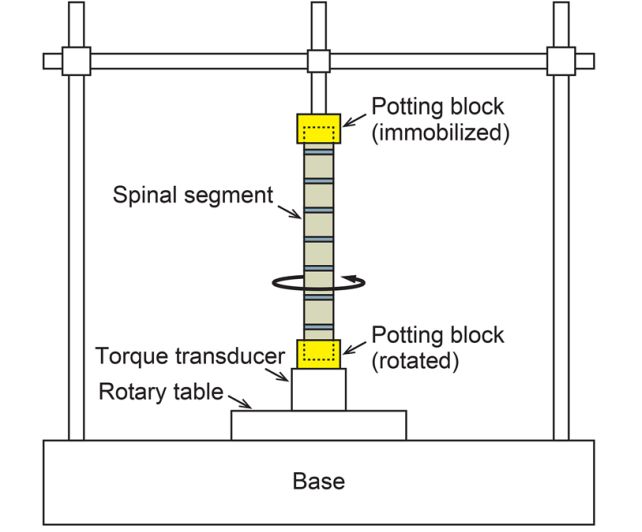
Each spine was divided into two regions: the thoracic vertebrae and the lumbar vertebrae. Then, each of the 10 spinal sections was placed in a torsion rig to literally test how far it could be twisted.
The difference between the thoracic sections and the lumbar sections was stark. The range of motion for the thoracic spines was about three times that of the lumbar spines, and thoracic stiffness was about a third lower than that of the lumbar spines.
The thoracic spines also had a neutral zone of about 47 degrees. Lumbar spines had no neutral zones at all.
Although the sample size was small, the difference was apparent in all five spines, suggesting that thoracic flexibility and lumbar stiffness are likely to be features of cat spines in general.
Next, the researchers wanted to know if these properties could be detected in a cat's twisting fall. They studied two live cats, dropping each cat eight times from a height of about 1 meter (3.3 feet) onto a soft cushion, using a high-speed camera to film the process.

The results showed that the cats weren't twisting in a single smooth motion; rather, the front half rotated first, then the back half followed. The time difference between the two halves was around 94 milliseconds for one cat and 72 milliseconds for the other.
The researchers propose that falling cats right themselves sequentially, rather than as a single discrete unit. The front of the body goes first because the spine is more flexible, and the front half of a cat's body has about half the mass of its posterior. Then, the stiffer, heavier rear end (AKA floofy butt) follows.
Related: Scientists Developed a Questionnaire to Find Out if Your Cat Is a Psychopath
This variable flexibility may also be useful for such movements as galloping and high-speed turning, during which the ability to angle sections of the spine independently may aid agility.
The researchers caution that they had to cut through the cats' rib cages, which could affect the mechanical properties of the thoracic spine. However, they also note that their findings are consistent with a 1998 study conducted on living, anesthetized cats, which showed similar flexibility in the thoracic spine.
"Further studies on the material properties of the spine may help clarify how differences in trunk flexibility affect locomotor performance in mammals," they conclude.
The research has been published in The Anatomical Record.