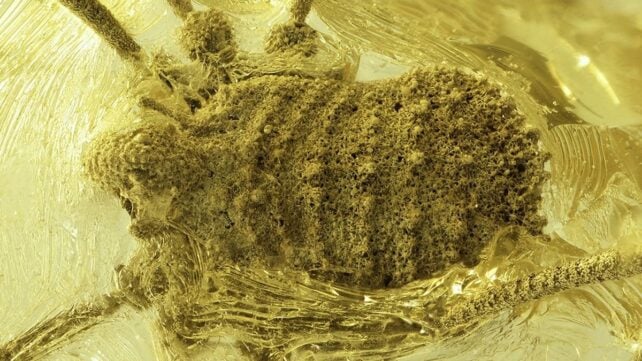
Harvestmen are some of the weirdest-looking arachnids to roam this Earth, and they've been doing so for millions of years.
A particularly wacky new species has now been found in two separate 35-million-year-old amber specimens from Ukraine and the Baltic region.
The new species, Balticolasma wunderlichi, belongs to a subfamily of harvestmen known as Ortholasmatinae.
Harvestmen from this group are extinct in modern Europe, but the amber fossils reveal that these arachnids were rather widespread during the late Eocene, when northern Europe was warm, temperate, and possibly even humid.
These are also the first fossil representatives of Ortholasmatinae ever reported.
"The discovery of an ortholasmatine harvestman in European amber deposits surprised us," says lead author and paleontologist Christian Bartel of the Bavarian State Collections of Natural History (SNSB).
"Relatives of these animals are currently found only in East Asia as well as in North and Central America. Evidently, 35 million years ago, during the Eocene epoch, these harvestmen were much more widely distributed across the Northern Hemisphere than they are today."
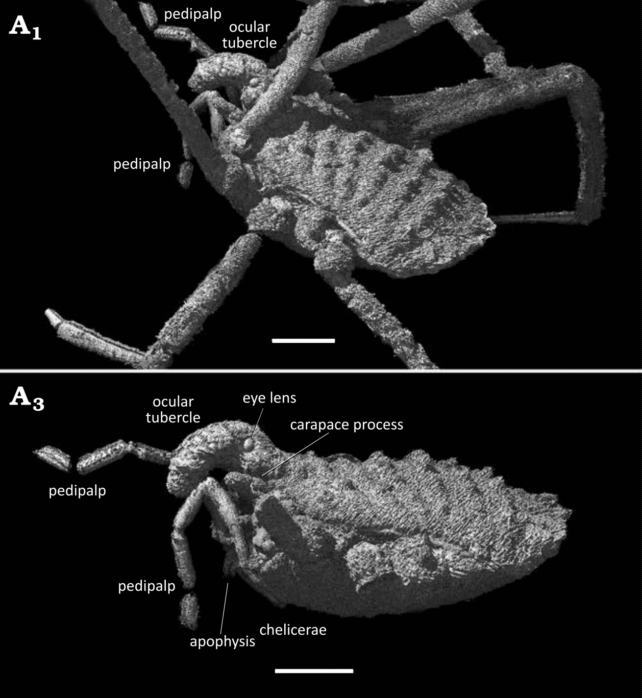
Bartel and team imaged the specimens in unprecedented detail with a combination of light microscopy and computed tomography to capture the arachnid's three-dimensional features digitally. This allowed them to peer through the fossilized tree resin to examine the creatures trapped within.
These scans revealed the ornate ridges across the arachnid's back;
lattice-like patterns on its head; its prominent (and rather adorable) eye mound; the complexity of its mouthparts; its eight gangly legs, with the second pair noticeably longer than the rest.
The scans also revealed some of the more pertinent taxonomic details, like the structure of each sex's genitals (an essential feature in arachnid identification).

The Baltic amber specimen is male, while the Rovno amber specimen is female, found in northwest Ukraine.
It's difficult to imagine now, but during the Eocene, the land between the Baltic and the Black Seas (modern Ukraine, Estonia, Latvia, Lithuania, and Belarus) was a much warmer, possibly even subtropical place.
The two kinds of amber – Rovno and Baltic – are distinct, as are the insect species often found trapped within, though there is sometimes overlap, which appears to be the case here.
This new addition brings the number of harvestman species found in both regions to six. It also brings the number found in Baltic amber to 19, and those from Rovno amber to seven.
"Baltic amber is known for its enormous diversity of fossils and repeatedly reveals species that no longer occur in Europe today," says co-author Jason Dunlop, a paleontologist at the Natural History Museum Berlin in Germany.
"The fact that the new harvestman species was also found in Ukraine shows how similar the faunas of both regions were at that time."
As the first fossils of Ortholasmatinae ever found, the pair will help researchers map out the harvestman tree of life more accurately in future studies.
Related: Incredible 112-Million-Year-Old Amber Reveals an Entire Ancient Ecosystem
Given that living members of this group exist only in East Asia and North America, this discovery fills a continent-sized gap in the arachnid's global distribution, though many questions remain.
"Additional fossil finds from other sources would be necessary to fully reconstruct the history of Ortholasmatinae," the team notes.
The research was published in Acta Palaeontologica Polonica.